Of all the plumbing issues Marietta and East Cobb homeowners face, sewer line problems tend to generate the most uncertainty. Part of this is because sewer lines are buried and invisible — by the time symptoms appear at the surface, something has usually been developing underground for months. Part of it is that “sewer line repair” covers a wide range of conditions and repair methods, from a trenchless patch that resolves in hours to a full line replacement that requires excavation. The appropriate response depends entirely on what the camera shows, which is why diagnosis always comes before any scope or cost discussion.
Cobb County’s housing stock creates specific sewer line conditions worth understanding. The combination of aging cast iron drain lines in pre-1990 construction, East Cobb’s mature tree canopy driving root intrusion, and the soil movement from Georgia’s clay that stresses pipe joints over decades produces a consistent set of sewer repair patterns throughout the area. Knowing what to watch for and what the repair process involves helps homeowners make better decisions when the time comes.
What Causes Sewer Line Problems in Marietta and East Cobb
Cast Iron Line Deterioration in Pre-1990 Homes
Cast iron sewer lines are the most common source of significant sewer line repair needs throughout Marietta and East Cobb. Homes built before 1990 — which includes the majority of Indian Hills, the Powers Ferry corridor, the Whitlock and Fair Oaks areas, and much of Smyrna’s established residential stock — were frequently constructed with cast iron drain lines. Cast iron is a durable material but it is not permanent. Over 35 to 55 years, the interior surface oxidizes and develops pitting and scale that progressively narrows the pipe, creates rough surfaces that accumulate debris, and eventually produces cracks, perforations, or structural collapse in sections that have corroded the most.
The combination of internal corrosion and root intrusion in cast iron lines is the most aggressive sewer condition we encounter on camera inspections in Marietta. Cast iron’s roughened interior surface is more hospitable to root growth than smooth PVC, and roots that have been growing inside a cast iron line for years can become significantly embedded. A camera inspection determines whether the line is a candidate for cleaning and lining, or whether the deterioration is extensive enough to require section replacement.
Root Intrusion Throughout the Area
East Cobb’s defining character — the wooded, tree-lined streets of Indian Hills, Windrush, Blakeford, the Sandy Plains corridor, and the communities along Johnson Ferry and Lower Roswell roads — is also one of its most consistent sewer service contributors. Trees planted when these neighborhoods were developed in the 1970s and 1980s have had 40 to 50 years to extend root systems toward buried sewer lines. This is not a problem unique to cast iron — roots enter PVC lines at joints and fittings just as readily when moisture draws them there.
What makes East Cobb’s root intrusion pattern distinctive is the scale of it. Large hardwoods — oaks, poplars, maples — on properties with large lots have root systems that extend well beyond the tree canopy. Sewer lines buried 4 to 6 feet beneath these properties have been in the path of those root systems for decades. Camera inspection in these neighborhoods regularly reveals root intrusion at multiple joints rather than a single entry point, particularly in older properties on larger wooded lots.
Newer Homes and PVC Lines
A significant portion of East Cobb’s residential stock was built from the late 1980s through the 2000s with PVC sewer lines. These homes have a different service profile than the older cast iron stock but are not without sewer concerns. Root intrusion is active in PVC systems wherever mature trees are present. Homes from the late 1980s and 1990s are now 25 to 35 years old, and the trees planted at construction are mature enough to be producing meaningful root pressure toward buried lines. Joint offsets from soil movement are also a consistent finding in PVC lines of this age, particularly in yards where soil conditions have been disrupted by landscaping or irrigation system installation.
Bellied Pipe and Joint Offsets
A belly in a sewer line is a section where the pipe has sagged, creating a low point where water and waste pool rather than flow freely through the line. Bellied sections accumulate debris, cause recurring slow drains and backups, and do not respond to clearing because the underlying cause is the pipe position rather than a blockage. Georgia’s clay soil — which expands when wet and contracts when dry through seasonal cycles — creates ground movement beneath foundations and buried lines that can cause both bellies and joint offsets over time. Camera inspection identifies bellied sections and offsets clearly and helps determine whether the affected area requires repair.
How We Diagnose Sewer Line Problems
Camera Inspection Is the Starting Point
Every sewer repair engagement begins with camera inspection. A flexible camera cable transmits live video of the pipe interior — showing root intrusion at specific joints, cast iron corrosion and scale buildup, offset sections, belly locations, cracks, or partial collapse. The camera footage is the foundation for every repair recommendation we make. Without it, scope and cost are guesses. With it, we can tell you exactly where the problem is, what is causing it, and what repair options are appropriate before any work begins.
For Marietta and East Cobb homeowners who have not had a camera inspection on their older home, we recommend scheduling one proactively — particularly for properties with significant tree cover over the sewer line route or homes built before 1990 with original cast iron lines that have never been assessed. Identifying a developing problem before it produces a backup is always less expensive than responding to one.
Sewer Line Repair Options
Trenchless Pipe Patch Repair (CIPP)
For sewer line damage contained to a specific section — root intrusion at a joint, a crack in an otherwise sound line, or a localized area of deterioration — cured-in-place pipe patch repair is often the most practical solution. A flexible epoxy-saturated liner is inserted into the existing pipe, positioned over the damaged section, inflated, and cured in place. The result is a smooth, structurally sound repair bonded to the interior of the host pipe without any excavation.
Trenchless patch repair is equally applicable to cast iron and PVC lines. For cast iron sections with contained damage in an otherwise serviceable line, a CIPP patch extends the useful life of the line significantly and eliminates the entry point for future root growth at the repaired joint. We confirm every trenchless repair with post-liner camera inspection before closing the job.
Open Cut Excavation and Section Replacement
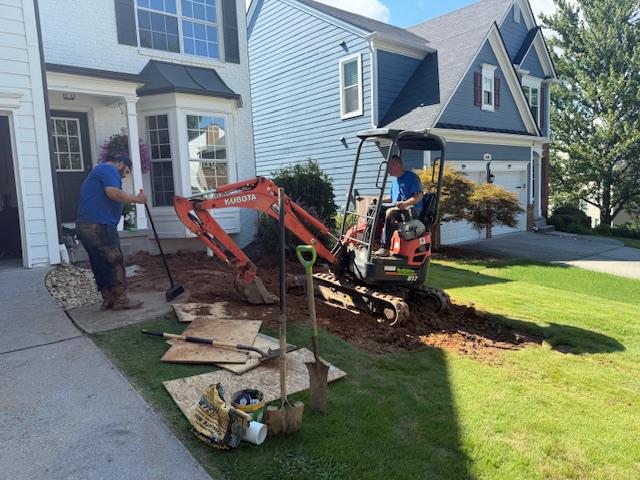
When trenchless patch repair is not feasible — due to the extent of damage, structural collapse, or pipe condition that cannot support a liner — traditional open cut excavation and section replacement is the appropriate solution. We excavate to the damaged section, remove and replace the affected pipe with new material properly bedded and supported, and restore the surface. For most residential sewer repairs in Marietta and East Cobb, open cut work is targeted to the specific damaged section rather than the full line route, keeping the yard disruption as limited as possible.
Flat-rate pricing for all sewer repair work is provided after camera inspection confirms the scope — before any excavation begins. We explain the options and the reasoning clearly so homeowners understand what is being done and why. Every repair carries a full warranty.
Warning Signs Your Marietta Sewer Line Needs Attention
- Multiple drains slow throughout the house at the same time
- Recurring backups that return quickly after clearing
- Sewage odors from floor drains, basement drains, or outdoor clean-out access points
- Gurgling from toilets or floor drains when other fixtures are in use
- Wet or soft patches in the yard along the sewer line route
- A home built before 1990 with cast iron drain lines and no sewer inspection history
- Multiple drain cleaning calls in the same year without lasting improvement
Benjamin Franklin Plumbing® of Marietta serves homeowners throughout Marietta, East Cobb, Sandy Springs, Smyrna, and Vinings. Available 24/7 — call (770) 999-9871 or book online. Licensed, background-checked, and drug-tested technicians.

 Your Privacy Choices