A slow drain is easy to put off. It’s inconvenient but not urgent — at least not yet. The problem is that drain issues in Marietta and East Cobb homes rarely resolve on their own. The underlying cause progresses whether it’s being addressed or not, and what starts as a minor annoyance has a predictable path: slow, to intermittently backing up, to fully blocked, to — in some cases — a structural failure inside the line that requires repair rather than just cleaning.
Cobb County’s housing stock presents specific drain cleaning conditions that are worth understanding. The combination of older cast iron drain lines in pre-1990 construction, the documented root intrusion patterns driven by East Cobb’s mature tree canopy, and the CCMWA water chemistry that affects not just supply pipes but also the scale accumulation inside drain lines creates a consistent set of drain service patterns throughout this area. Knowing what to watch for and when to call helps homeowners get ahead of the problem rather than behind it.
What Causes Drain Problems in Marietta and East Cobb Homes
Cast Iron Drain Lines in Pre-1990 Construction
Marietta and East Cobb have a significant share of the Atlanta metro’s older housing stock. Homes built before 1990 throughout the area — including the established neighborhoods of Indian Hills, the Powers Ferry corridor, Fair Oaks, Whitlock, and Smyrna’s older districts — were frequently constructed with cast iron drain lines. Cast iron is a durable material, but it is not permanent. Over 30 to 50 years, the interior surface oxidizes and roughens, developing scale and corrosion that progressively narrows the effective pipe diameter. Debris, grease, and organic matter adhere to roughened cast iron more readily than to smooth pipe walls, accelerating the accumulation process.
A cast iron drain line in a 1970s or 1980s Marietta home that has never been professionally serviced is almost certainly operating at a fraction of its original capacity. The drain slows gradually enough that homeowners adjust to the new normal without recognizing how far the condition has declined. By the time the line produces recurring backups, the interior buildup may be extensive enough that mechanical clearing alone is insufficient — hydrojetting, which scours the pipe walls rather than just clearing a channel, is the more appropriate service.
Root Intrusion Across All Pipe Materials
East Cobb’s heavily wooded residential character — the mature oaks, pines, and hardwoods that line the streets of Indian Hills, Windrush, Blakeford, and the communities along Sandy Plains and Johnson Ferry roads — is one of the area’s defining features and one of its most consistent plumbing service contributors. Trees planted when these homes were built in the 1970s and 1980s have had 40 to 50 years to extend root systems toward buried drain lines. Root intrusion is not limited to older clay or cast iron pipes — it occurs in PVC lines as well, wherever roots can find a joint, fitting, or imperfection to enter through.
Once inside, roots grow with the water flow. What begins as a small intrusion through a single joint becomes an expanding root mass that constricts the line progressively until blockages are frequent. In Marietta’s older cast iron systems, root intrusion combined with decades of internal corrosion is one of the most aggressive combinations we encounter on sewer camera inspections.
Newer Homes and PVC Lines
Marietta and East Cobb also have a substantial share of newer residential construction — homes built from the 1990s through the 2010s with PVC sewer lines. These homes have a different drain service profile than the older cast iron stock, but they are not problem-free. Root intrusion is active in newer PVC systems wherever mature trees are present on or near the property. Grease and organic buildup accumulate in PVC lines the same way they do in any drain system. And homes from the 1990s are now 25 to 35 years old — entering the age range where the first significant drain service events typically occur.
Grease and Organic Buildup in Kitchen Lines
Kitchen drain lines in all homes accumulate grease, food particles, and soap buildup regardless of construction era or pipe material. Grease cools and solidifies on pipe walls as it travels through the line, building up layer by layer until the drain slows and eventually backs up. Hot water and dish soap — the standard home remedy — soften grease temporarily but do not remove accumulated deposits. For kitchen drain lines that have been slow for months or years, professional hydrojetting is the most effective clearing method and produces results that last significantly longer than mechanical clearing or chemical treatments.
When to Call a Professional
The signals that a drain issue requires professional service rather than a DIY approach are clear:
- Multiple drains slow at the same time — indicates a main line issue, not individual fixture clogs
- A drain that backs up repeatedly after clearing — the underlying cause is not being resolved
- Sewage odors from floor drains or outdoor clean-out access points
- Gurgling from toilets or floor drains when sinks or showers run — classic main line partial blockage
- Any backup involving sewage coming up through a floor drain or toilet — requires immediate service
Chemical drain cleaners are appropriate for occasional minor fixture drain clogs. They are not appropriate for main line issues, cast iron scale buildup, root intrusion, or recurring blockages. Repeated chemical treatment on a root-intruded or structurally degraded line dissolves organic matter temporarily while leaving the root mass and joint damage unaddressed — providing relief for weeks before the same symptoms return.
How We Approach Drain Cleaning in Marietta
Assessment Before Equipment
For any issue beyond a simple fixture clog, we start with an assessment. The pattern of symptoms — which drains are affected, how long the problem has been developing, whether clearing has been attempted and how long the relief lasted — gives us a working diagnosis before any equipment touches the drain. A kitchen sink that backs up is a different problem than a floor drain that backs up, even though both present as drain issues.
Mechanical Clearing
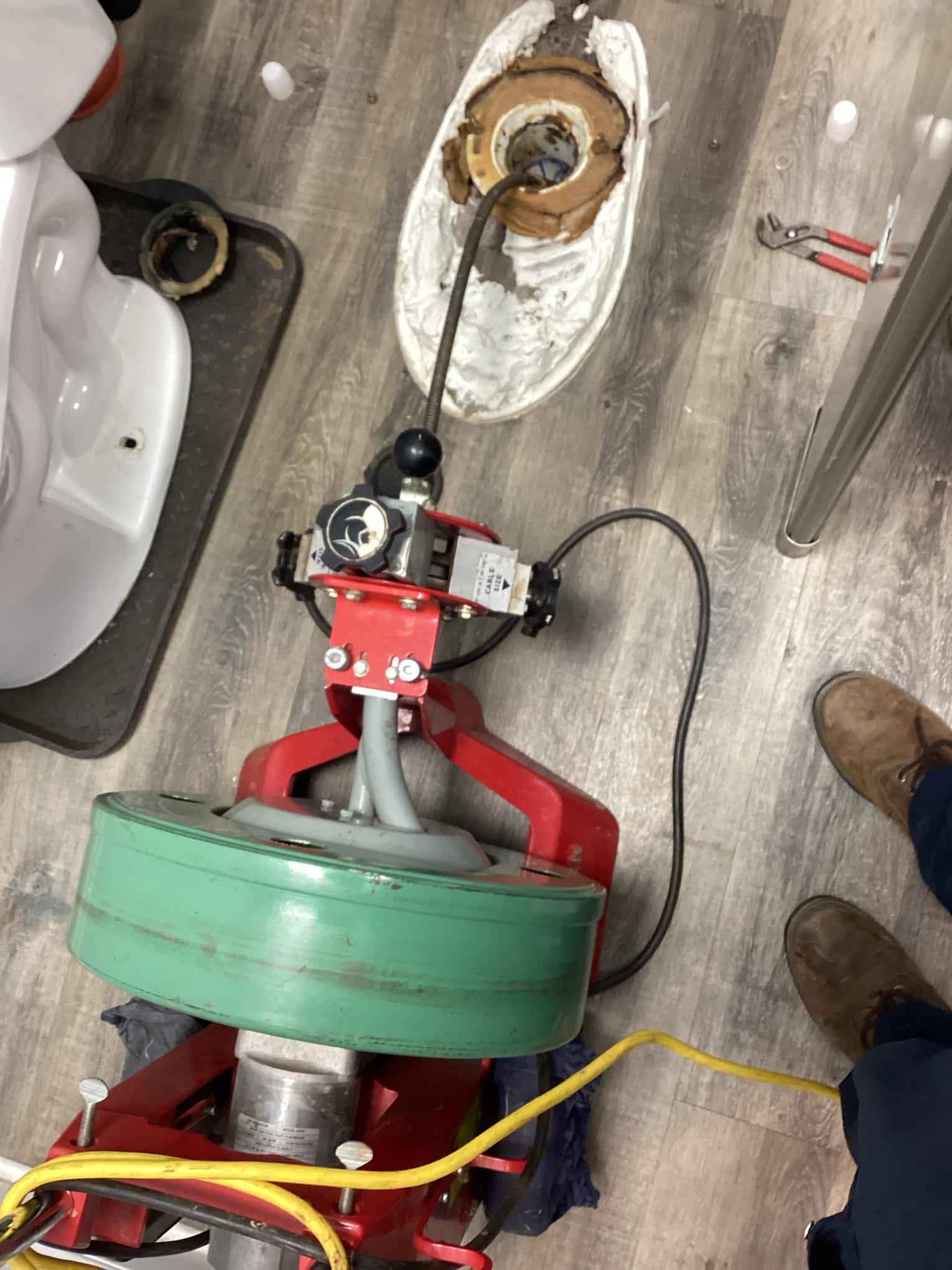
For blockages in the main line or at fixture drains, mechanical clearing with a drain cable is typically the first service step. The rotating cable cuts through blockages and clears the line. We confirm the clearing by running water through the system and checking flow rate before the job is considered complete. For straightforward blockages, mechanical clearing fully resolves the issue.
Hydrojetting for Cast Iron and Recurring Issues
For cast iron lines with scale buildup, recurring blockages that mechanical clearing doesn’t fully resolve, or any line where we want to restore as much of the original pipe capacity as possible, hydrojetting is the appropriate service. High-pressure water scours the interior pipe walls — removing grease, scale, and debris rather than just clearing a channel through the blockage. For Marietta’s older cast iron sewer systems, hydrojetting makes a meaningful and lasting difference in drain performance. We combine hydrojetting with camera inspection when the cause of a recurring issue is unclear.
Sewer Camera Inspection
Camera inspection is how we take the guesswork out of drain problems. A camera mounted on a flexible cable transmits live video of the pipe interior — showing root intrusion at specific joints, cast iron corrosion and scale buildup, offset or cracked sections, or collapsed pipe. This is the information that drives repair decisions rather than assumptions. For Marietta homeowners who have been dealing with recurring drain issues for years without a clear resolution, camera inspection frequently identifies a specific structural problem that has been driving the pattern.
Repair When Camera Inspection Identifies Structural Damage
When camera inspection finds structural damage — significant root intrusion, offset joints, cracked pipe, or internal collapse — repair is the appropriate next step rather than continued clearing. For sections with contained damage in an otherwise sound line, trenchless pipe patch repair installs a cured-in-place liner inside the existing pipe, restoring full function without excavation in most cases. For more extensive damage, we excavate and replace the affected section with flat-rate pricing agreed before any digging begins. Every repair is backed by a full warranty.
Benjamin Franklin Plumbing® of Marietta serves homeowners throughout Marietta, East Cobb, Sandy Springs, Smyrna, and Vinings. Available 24/7 — call (770) 999-9871 or book online. Licensed, background-checked, and drug-tested technicians.

 Your Privacy Choices