Trusted Plumbers for Sandy Springs & North Fulton County
Sandy Springs is one of metro Atlanta's most established and prosperous communities — incorporated as a city in 2005, it is now home to over 110,000 residents. Residentially, Sandy Springs offers a range of neighborhoods from classic mid-century ranch homes in Riverside and Mount Vernon to newer townhome communities near City Springs and Roswell Road, and established swim-tennis subdivisions throughout the city.
That range of housing types and ages creates a broad range of plumbing demands. Benjamin Franklin Plumbing® of Marietta serves Sandy Springs from our Cobb County base, bringing licensed, on-time, flat-rate service to both the established neighborhoods along the Chattahoochee River corridor and the newer developments near Glenridge Connector and Hammond Drive.
Plumbing Challenges Specific to Sandy Springs, GA
Slab Leaks in Mid-Century & 1970s–1980s Homes
Sandy Springs has a significant share of mid-century and 1970s to 1980s homes — particularly in the Riverside, Mount Vernon Woods, and Northside Woods neighborhoods — where concrete slab foundations contain copper supply lines that are now 40 to 50 years old. The interaction between aging copper, Georgia clay soil movement, and the chemistry of the municipal water supply makes pinhole and slab leaks a documented concern throughout this area. A slab leak typically announces itself through a slowly rising water bill, warm spots on the floor, the sound of running water with everything off, or hairline cracks appearing at wall bases. We use thermal imaging cameras and acoustic detection to locate slab leaks precisely before any concrete work begins.
Aging Pipe Systems in Established Neighborhoods
Sandy Springs' older neighborhoods have housing stock that in many cases predates the widespread use of polybutylene — but comes with its own aging pipe concerns. Galvanized steel supply lines from the 1960s and early 1970s are now 50 to 60 years old and exhibit the classic failure modes: rust-colored hot water, steadily declining water pressure, and eventual leaks at corroded joints. Homes from the late 1970s and 1980s may have polybutylene. Either way, a pipe assessment for a Sandy Springs home in this age range is a worthwhile investment before a failure causes water damage behind walls or to finished flooring.
Water Heaters in Sandy Springs' Established Neighborhoods
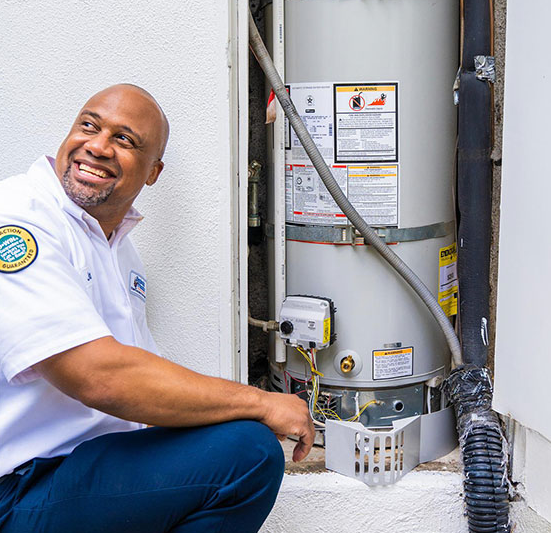
Sandy Springs' mid-century and 1970s–1980s homes — particularly in Riverside, Mount Vernon Woods, and the Northside Drive corridor — have a significant volume of water heaters that are at or past their expected service life. Hard water mineral buildup in Fulton County's water supply reduces efficiency and shortens heater lifespan over time. If your Sandy Springs home has a water heater that is 10 years or older and making noise, producing discolored water, or struggling to maintain temperature, replacement is likely the most cost-effective path. We install both traditional tank and tankless water heaters and can typically complete same-day replacement when the existing unit has failed.
Drain Cleaning in Mid-Century & Established Sandy Springs Homes
Sandy Springs' older homes often have cast iron or clay drain lines that have been in service for 40 to 60 years — well past the age where annual professional cleaning becomes important. Grease buildup in kitchen lines, root intrusion in aging sewer pipes, and mineral deposits that narrow drain diameter over time are all common in this housing stock. Slow drains that have been getting progressively worse over months, or recurring backups that come and go, typically indicate a problem in the main sewer line rather than an individual fixture. We provide drain cleaning, hydro jetting, and sewer camera inspection — giving you a clear picture of what is happening underground before recommending any repair work.
Water Service Line Stress from Clay Soil
Like all communities in the metro Atlanta area, Sandy Springs sits on Georgia's expansive red clay soil. The seasonal cycle of soil expansion in wet weather and contraction in dry periods places ongoing stress on underground water service lines — particularly in older properties where original galvanized or polybutylene service lines are still in place. A soft wet area in the yard between the street and the house, combined with reduced water pressure or a rising water bill, are the hallmark signs. We use directional boring for service line replacements to protect established landscaping, particularly important in Sandy Springs' mature residential neighborhoods along the Chattahoochee corridor.
Our Plumbing Services in Sandy Springs, GA
We serve Sandy Springs homeowners and businesses with a comprehensive range of plumbing services, including:
- Slab Leak Detection & Repair — thermal imaging, acoustic detection
- Pipe Repiping — galvanized and polybutylene replacement, PEX installation
- Water Heater Repair, Service & Replacement — tank and tankless
- Drain Cleaning & Hydro Jetting — kitchen, bathroom, and main sewer line
- Sewer Line Services — camera inspection, repair, and trenchless replacement
- Water Service Line Replacement — directional boring to protect landscaping
- Leak Detection — slab, hidden wall, underground supply line
- Emergency Plumbing — available 24/7 for urgent plumbing situations
- Faucet, Toilet & Fixture Repair and Installation
- Gas Line Services — inspection and repair
- Water Treatment & Filtration — whole-home softeners, reverse osmosis
- Pressure-Reducing Valve (PRV) Installation & Service
Sandy Springs Neighborhoods We Serve
We serve homeowners and businesses throughout Sandy Springs, including Riverside, Mount Vernon, Glenridge, Northside Woods, neighborhoods along Roswell Road and Hammond Drive, communities near Perimeter Center, City Springs area, and properties along the Chattahoochee River corridor in zip codes 30328, 30338, and 30350.
Why Sandy Springs Homeowners Choose Benjamin Franklin Plumbing®
Our Marietta base puts us minutes from Sandy Springs via I-285. Every technician is licensed, insured, background-checked, and drug-tested. We provide flat-rate pricing before work begins, fully stocked trucks, and a 100% satisfaction guarantee. We are backed by Forbes' top-ranked plumbing company recognition for 2024 and a 4.9-star Google rating from Cobb County homeowners.
Call us 24/7 at (770) 999-9871 or book online. Serving Sandy Springs, GA and North Fulton County.




 Your Privacy Choices
© 2026 Benjamin Franklin Franchising SPE LLC. All Rights Reserved.
Your Privacy Choices
© 2026 Benjamin Franklin Franchising SPE LLC. All Rights Reserved.