
Most homeowners in Marietta, East Cobb, Sandy Springs, and Smyrna know their water tastes fine and passes every safety test. What fewer homeowners know is the specific profile of Cobb County’s water — where it comes from, how it’s treated, and how it interacts with the plumbing in older homes. Understanding your water is one of the most useful things you can do to protect your home’s plumbing and appliances over the long term.
Where Cobb County’s Water Comes From
The Cobb County-Marietta Water Authority (CCMWA) is a surface water utility that draws from two sources: Lake Allatoona and the Chattahoochee River. The water is treated through a conventional process — oxidation, coagulation, flocculation, sedimentation, and filtration — and disinfected using sodium hypochlorite, which provides a free chlorine residual throughout the distribution system. Lime is added to raise the pH for corrosion control. The result is a relatively low-mineral water that is well buffered and held in a pH range designed to keep lead and copper in solution at very low levels. Cobb County water is soft, typically measuring only about 1 to 2 grains per gallon of hardness, so the aggressive scale buildup associated with genuinely hard-water regions isn’t the primary concern here.
PFAS in Cobb County’s Water Supply
Cobb County’s 2024 water quality testing detected several PFAS compounds — per- and polyfluoroalkyl substances, sometimes called “forever chemicals.” The specific compounds detected included PFOA (3.1 ppt), PFOS (2.7 ppt), PFBS (3.9 ppt), PFBA (4.4 ppt), PFPeA (4.4 ppt), and PFHxA (4.9 ppt). All were detected below EPA Maximum Contaminant Levels, meaning the water is in full compliance with federal standards.
PFAS are present at trace levels in many municipal water systems nationally due to their widespread use and environmental persistence. For homeowners who want to minimize PFAS exposure at the tap, a reverse osmosis system is the most effective residential treatment option — RO membranes remove PFAS compounds to levels below detection in most cases.
Copper Pinhole Leaks: A Documented Regional Pattern
Pinhole leaks in aging copper supply lines are a well-known issue across East Cobb and Marietta — common enough that the CCMWA took the unusual step of commissioning formal engineering studies to investigate the cause. The authority worked with HDR Engineering and later partnered with researchers at Virginia Tech, who performed a forensic analysis of copper pipe samples pulled from local homes in 2018. The fact that the water authority itself studied the problem tells you something useful: pinhole leaks here are a genuine regional pattern, not an anomaly specific to any one house.
What the research points to is a combination of factors rather than a single cause. The leaks are a form of localized pitting corrosion — small pits that develop on the interior wall of the pipe and eventually penetrate it — and the studies found contributing factors that include the age of the area’s 1970s and 1980s copper plumbing reaching the end of its practical service life, the localized nature of the pitting itself, and in-home conditions such as low-use fixtures where water sits stagnant in the lines. There is no single simple cause that explains every case.
The practical takeaway for homeowners is what matters most: once one pinhole leak appears in an older copper system, it is often the first visible sign of broader pipe-wall deterioration. A second leak in a different location is a strong signal to have the whole system professionally evaluated rather than continue repairing one spot at a time.
How Cobb County Water Affects Your Plumbing and Appliances
Water Heaters and Tankless Systems
While Cobb County’s water is not hard, sediment accumulation in water heater tanks still occurs over time and warrants annual maintenance flushing. For tankless water heater owners, annual descaling of the heat exchanger is manufacturer-specified required maintenance — Navien and most other manufacturers require annual service to keep the warranty valid and the unit running efficiently.
Fixtures, Aerators, and Taste
Some Cobb County homeowners notice a chlorine taste or smell in their water, particularly during certain seasons when free chlorine levels run higher in the distribution system. Aerators can also clog over time from particulates. A whole-home carbon filter addresses the taste-and-odor concern effectively, removing chlorine and improving water at every tap without changing the water’s soft, low-mineral character.
Water Treatment Options for Cobb County Homes
Whole-Home Carbon Filtration
Carbon filtration is the most directly relevant treatment option for most Cobb County homeowners. A whole-home carbon filter removes free chlorine, chlorination byproducts, and organic compounds at the point of entry, so every tap in the house runs cleaner-tasting, better-smelling water — without changing the water’s soft, low-mineral character. For thorough chlorine removal we typically use catalytic carbon, a high-grade media that’s especially reactive at breaking down chlorine and the compounds that cause that faint “pool water” taste and odor.
Beyond taste, there are two practical reasons to take chlorine out of your water. First, comfort and health: chlorine strips the natural oils from skin and hair, which is why some people notice dryness or irritation — filtered water is gentler for bathing, especially for kids and anyone with sensitive skin. Second, plumbing longevity: chlorine is an oxidizer, and over time it dries out and hardens the rubber seals, gaskets, and toilet flappers throughout your fixtures and appliances, leaving them brittle and prone to cracking and small leaks. Removing it at the point of entry helps those components last longer.
Point-of-Use Reverse Osmosis
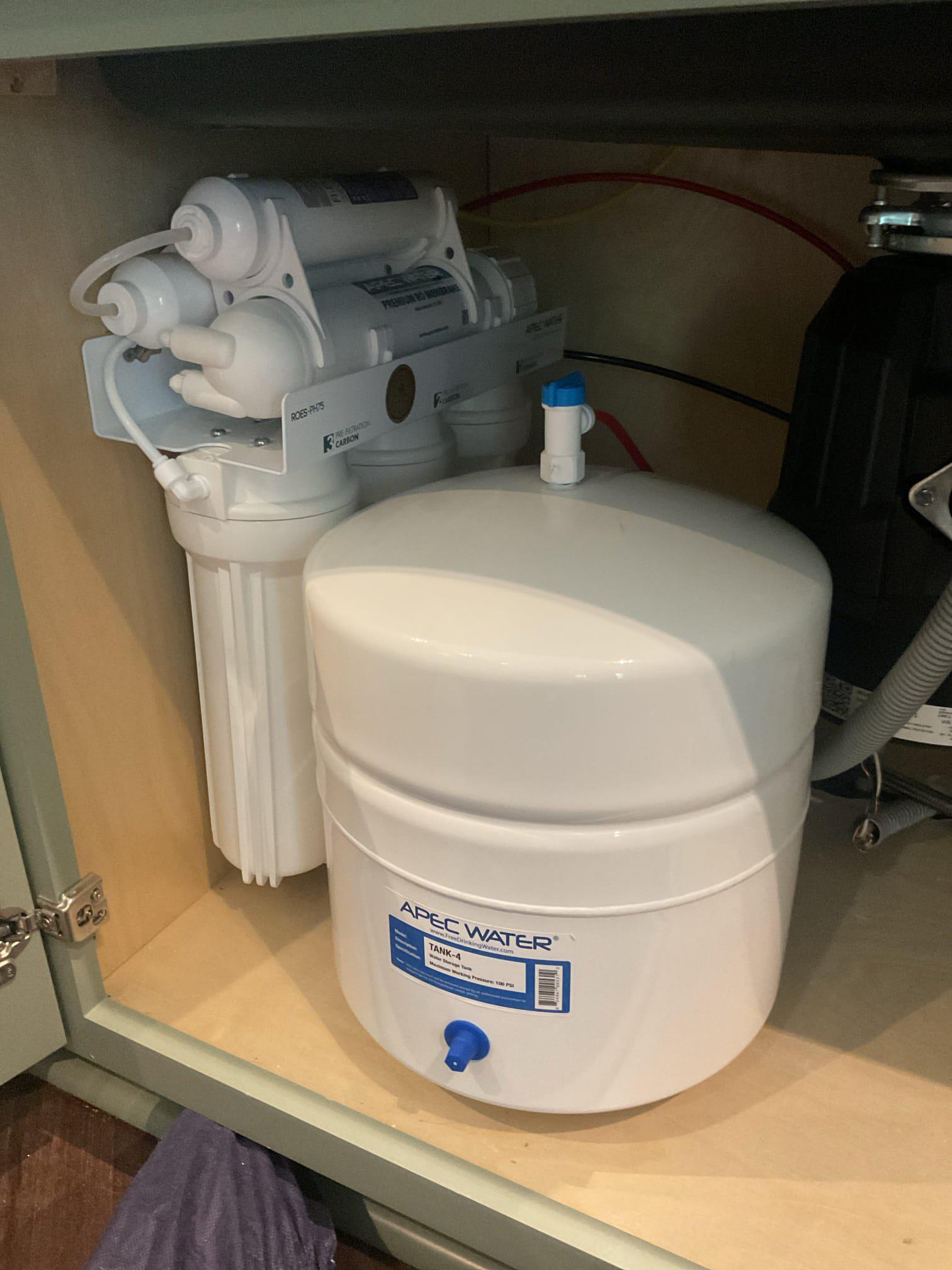
For drinking and cooking water quality, an RO system under the kitchen sink provides the highest level of residential filtration available. RO removes chlorine, disinfection byproducts, PFAS compounds, heavy metals, and most other regulated and unregulated contaminants. Given the PFAS detection levels reported in Cobb County’s 2024 water quality data, an RO system is a well-justified investment for homeowners concerned about long-term PFAS exposure from drinking water specifically.
A Note on Water Softeners
Because Cobb County water is already soft, a whole-home softener isn’t the default recommendation here the way it is in hard-water regions — but it’s still something we install for homeowners who want it, and there are good reasons to. Some people simply prefer the feel of softened water for bathing and cleaning, notice less soap scum and spotting, and like how it treats their skin and laundry. And while Cobb County’s water is low in minerals to begin with, reducing what hardness is there can only help your plumbing and appliances over the long run — every bit less mineral content means a little less wear on water heaters, fixtures, and supply lines over their service life. So if soft water is the experience you want, it’s a worthwhile upgrade rather than a necessary fix.
The point is simply that it’s a choice, not a requirement. We assess your actual water and your home’s specific concerns before recommending any system — so you can decide whether a softener is right for you, rather than having equipment installed to solve a problem your water doesn’t have. As a Brita PRO authorized dealer, we install and service whole-home softeners, carbon filtration, and RO systems matched to what your home actually needs and what you want from your water.
The Bottom Line for Marietta Homeowners
Cobb County’s water is soft, well-treated, and fully compliant with federal safety standards. The two things worth a homeowner’s attention are the trace PFAS levels — best addressed with point-of-use RO if you’re concerned — and the documented regional pattern of pinhole leaks in older copper plumbing, which is really a function of aging pipe more than anything in the water itself. If your home was built before 2000 and still has original copper, a plumbing assessment is the most useful step you can take. Call us 24/7 at (770) 999-9871 or book online.

 Your Privacy Choices