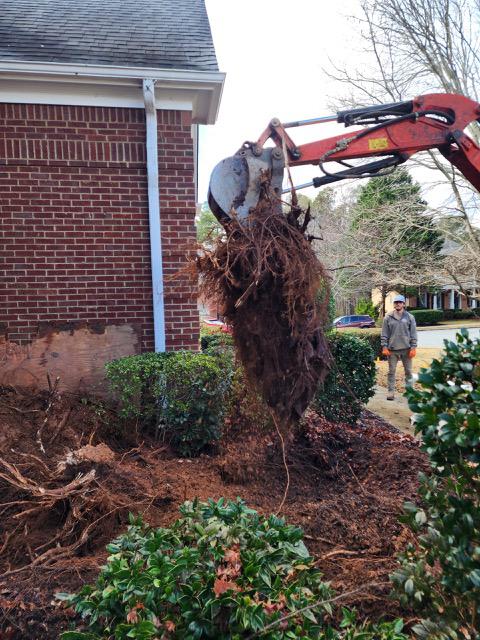
When a drain in your Marietta or East Cobb home backs up again and again — no matter how many times it gets cleared — the cause usually isn’t inside the house. It’s underground, where tree roots have grown into your sewer line. It’s one of the most common plumbing problems in established Cobb County neighborhoods, and one of the most frequently mishandled. Homeowners pay to snake the drain, it works for a while, and then it backs up again, because the actual cause was never addressed. Here’s what’s really happening below the surface, how to spot it, and how it gets solved for good.
Why Sewer Lines Attract Tree Roots
To a tree, a sewer line is a reliable source of water and nutrients running through the soil. Roots naturally grow toward that moisture, and when they reach a sewer line, they take advantage of any weak point to get inside — a loose joint, a small crack, a separated connection. Once a fine root enters, it flourishes on what flows through the pipe and grows into a dense mass that catches debris, narrows the channel, and eventually blocks the line.
Cobb County’s established neighborhoods are especially susceptible, for two reasons working together. The mature tree canopy is one: Marietta, East Cobb, Smyrna, and the areas along the Chattahoochee are full of wooded neighborhoods where hardwoods planted decades ago have had ample time to send roots toward buried lines. The other is the soil — Georgia’s red clay expands when wet and contracts when dry through seasonal cycles, and that ground movement stresses buried pipes year after year, opening the joint separations and cracks that give roots a way in. In older Cobb homes, this combines with aging cast iron and clay sewer lines that are more vulnerable to intrusion to begin with.
The Warning Signs of Root Intrusion
- Recurring backups after clearing. The most reliable sign. A drain that clogs again weeks or months after being snaked means the roots were only cut back, not removed.
- Several drains acting up at once. When the trouble is in the main sewer line rather than a single fixture, multiple drains slow or back up together — usually the lowest ones first.
- Gurgling from toilets or drains. Air trapped by a partial blockage escapes as a gurgle when you flush or run water, a hallmark of a main-line obstruction.
- Intermittent sewage odors. Waste trapped by a blockage can produce sewage smells around drains or out in the yard.
- A greener strip in the lawn. Where a cracked line leaks, the surrounding grass gets extra water and nutrients, sometimes visible as a lusher line tracing the pipe’s route.
Why Snaking Doesn’t Fix It
A drain snake cuts through the root mass and gets the water flowing again, so it feels like the problem is solved. But it’s the equivalent of cutting a weed off at the surface instead of pulling the root — the roots are still in the pipe, and they grow back. Within weeks or months, the backup returns, and the cycle repeats. This is exactly why so many Cobb County homeowners find themselves calling for the same drain clearing several times a year. Truly resolving root intrusion means removing the roots far more thoroughly than a snake can and, where needed, sealing the pipe damage that’s letting them in.
How We Diagnose and Solve It Permanently
Sewer Camera Inspection
Every root problem starts with a camera inspection. We run a high-resolution camera through the line to see precisely where the roots are, how far the intrusion extends, and the condition of the pipe itself — which matters especially in older Cobb homes, where the sewer line may be aging cast iron or clay with its own deterioration. This tells us whether we’re dealing with minor root incursion or a structurally failing line, and you see the footage yourself, so the recommended repair is something you can see the reason for.
Hydrojetting
For clearing roots, hydrojetting outperforms a mechanical snake by a wide margin. It uses high-pressure water — typically 3,000 to 4,000 PSI — to scour the pipe interior completely, cutting through the root mass and flushing out the debris and scale that a snake leaves behind. Rather than punching a hole through the blockage, it cleans the pipe wall to wall, which substantially delays regrowth. In older cast iron lines, hydrojetting also clears the accumulated scale that gives roots and debris something to catch on.
Sealing or Replacing the Entry Point
Removing the roots is only lasting if the damage that admitted them is addressed. For a contained crack or joint separation, trenchless pipe patch repair — a cured-in-place liner set inside the existing pipe — seals the entry point without digging up the yard. For more extensive deterioration, common in older Cobb County lines, targeted section replacement is the durable fix. The camera inspection determines which is appropriate, and we lay out the options with flat-rate pricing before any work begins.
What a Cobb County Homeowner Should Do
If you’ve cleared the same drain more than once, it’s time to stop treating the symptom and find the cause. A sewer camera inspection gives you a definitive answer about what’s in your line and its condition — and points to a real fix instead of another temporary clearing. We serve Marietta, East Cobb, Smyrna, Vinings, Sandy Springs, and Cumberland, and we’re available 24/7. Call (770) 999-9871 or book online.

 Your Privacy Choices