
It’s the first question almost every homeowner asks when they call about a water heater: “What’s it going to cost?” It’s a completely fair question, and the answer you’ll get from nearly every reputable plumber in North Fulton is some version of “we need to see it first.” That can feel like a runaround. It isn’t — and understanding why will help you get a better price and steer clear of the companies worth avoiding.
The Unit Is Only Part of the Cost
When people picture what a water heater replacement costs, they’re usually thinking about the price of the appliance. But the appliance is one line on the invoice. The rest comes from what your specific installation requires — and that varies between homes far more than most homeowners expect.
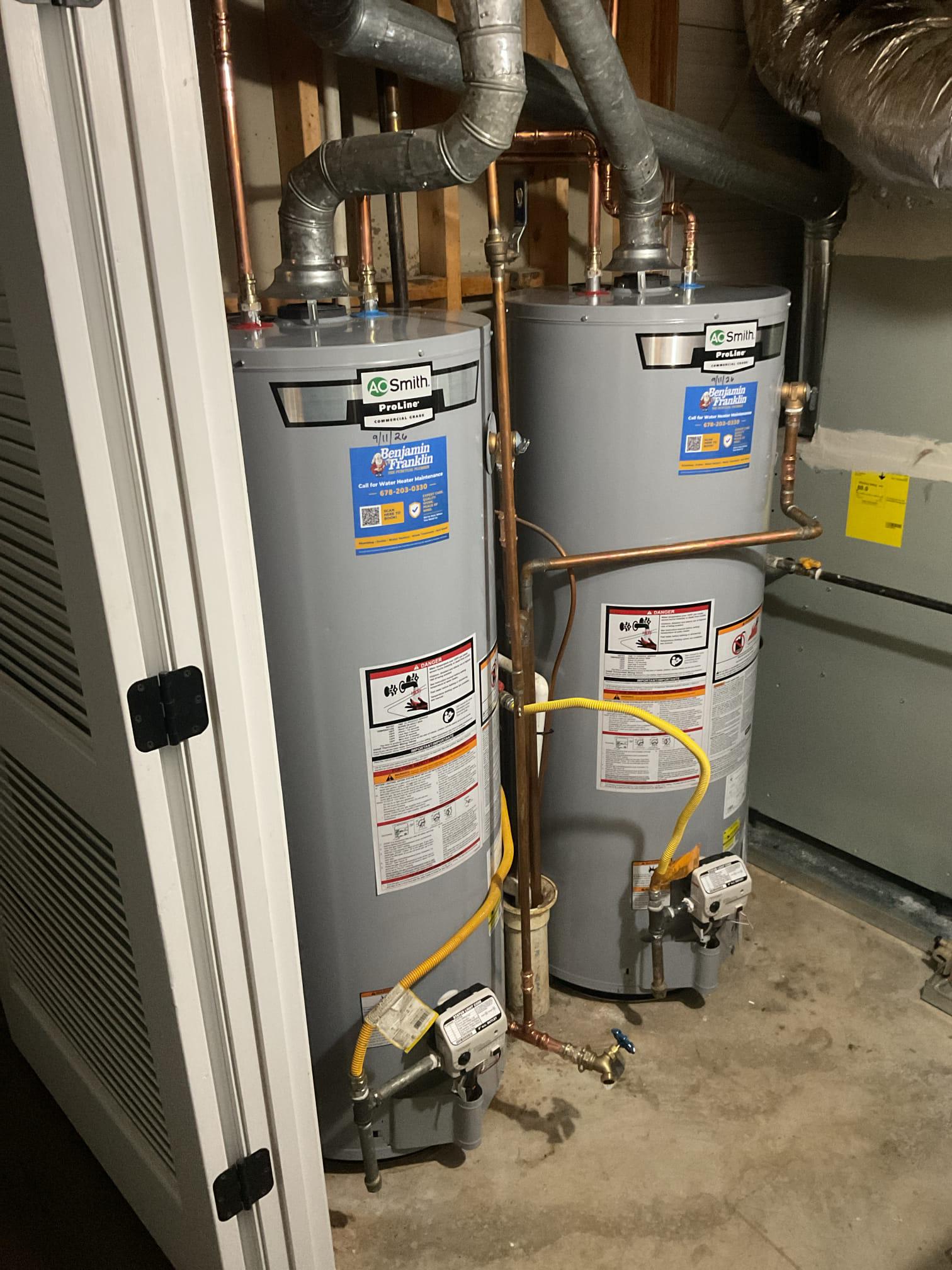
Two houses on the same street, built the same year, can land at meaningfully different prices. One has a water heater in an open garage with current venting, a working shutoff, and an expansion tank already in place. The other has the same unit wedged into a tight closet with venting that no longer meets code, no expansion tank, and a corroded valve that won’t hold. Same appliance, very different job.
What Actually Drives the Price
- The unit itself. Tank size, gas versus electric, efficiency rating, and whether you’re replacing like-for-like or converting to tankless.
- Code-required upgrades. Replacements are permitted work, and current code frequently requires components the original installation didn’t have. More on this below — it’s the part homeowners are most often surprised by.
- Gas line sizing. A tankless unit demands a higher gas flow rate than a tank, so a conversion often requires upsizing the gas supply.
- Accessibility. A unit in an open garage is straightforward. One in a cramped attic, tight closet, or crawlspace takes considerably more labor.
- The condition of everything it connects to. Shutoff valves, supply connections, and fittings that are corroded or past service life need replacing at the same time. Skipping that is how you end up with a new water heater and an old leak.
What “Code Upgrades” Actually Means
This deserves its own explanation, because it’s where a lot of the price difference between quotes comes from — and where a cheap quote often turns expensive later.
A water heater installation has to meet current code, not the code that existed when the original unit went in. Depending on what’s already there, bringing an installation up to standard commonly includes:
- A thermal expansion tank, properly supported. Required on closed plumbing systems to absorb pressure as water heats. It also has to be correctly secured and braced — not simply hung off the water piping, which is one of the most common installation shortcuts we find on older jobs.
- A new ball valve on the cold water supply. So there’s a reliable shutoff that actually closes when you need it.
- A new flexible gas connector (gas whip) where applicable. Old connectors degrade and shouldn’t be reused on a new installation.
- A drain pan with proper routing. Where the unit sits somewhere a leak could cause damage — an attic, a finished space, or above living area.
- Updated venting and correct T&P discharge piping. Both are safety items, and both are frequently out of compliance on older installations.
Our installations include these upgrades as part of the job, quoted in the flat-rate price up front. They are not add-ons we discover halfway through. If another quote comes in noticeably lower, it’s worth asking specifically which of these items are included — because the work still has to be done to pass inspection.
Why Hiring a Licensed and Insured Company Protects You
This one gets treated as a formality, and it shouldn’t be. Plumbing work means water lines, gas lines, and heavy equipment moving through finished parts of your home. Most jobs go exactly as planned. Occasionally something gets damaged, or someone gets hurt. The question worth asking before that happens is simple: if it does, who pays for it?
When you hire a licensed and insured company, that risk sits with the company and its insurance carrier rather than with you. General liability coverage handles accidental property damage — a cracked tile, a damaged wall, water where it shouldn’t be. Workers’ compensation covers an injured worker’s medical costs. Without both of those in place, a homeowner can end up financially responsible for an injury that happened on their property or for damage they had nothing to do with. Homeowners insurance doesn’t reliably fill that gap.
The same logic applies to permits. Permitted work gets inspected, which means an independent set of eyes confirms the installation is safe and correct — and it keeps you clear of problems with your insurer or at resale, when unpermitted work on a gas appliance tends to surface. We are fully licensed and insured, and we pull permits on work that requires them.
Why an Over-the-Phone Number Can Cost You More
If a company gives you a firm price without seeing the installation, ask which of two things is happening. Either it’s a starting price that will climb once the technician arrives, or it excludes items that will appear later as add-ons — the permit, the expansion tank, the venting update, hauling away the old unit. Either way, the number you were told isn’t the number you’ll pay.
The alternative is better: someone assesses the actual installation, then gives you a firm flat-rate price in writing before any work begins. You know the full cost, you can compare it honestly against another quote, and it doesn’t change once work starts.
The Questions That Actually Separate Companies
Since you can’t compare prices over the phone, compare on what you can ask about. These five questions tell you a great deal in about ninety seconds:
- Is this flat-rate or an estimate that can change? Flat-rate means the agreed number is the final number.
- What’s included? Permit, code-required upgrades, removal and disposal of the old unit, and all new connections should be in the price — not added later.
- What exactly is the warranty? Not “do you offer one” — ask how many years, and whether it covers parts, labor, or both. This question separates companies faster than any other.
- Is the company licensed and insured? Including liability and workers’ compensation coverage, so you’re not exposed if something goes wrong.
- Is there a charge just to come out? A simple question that should get a simple answer.
Where We Stand on Each of Those
Our pricing is flat-rate, quoted in writing before any work begins, and it includes the permit, the code-required upgrades described above, removal of the old unit, and new connections. We are a licensed and insured company, and our technicians are experienced, background-checked, drug-tested, and trained on the equipment they install. We don’t charge a dispatch fee.
On the warranty — the question we’d most encourage you to ask every company you call — our terms are specific rather than vague: six years parts and labor on new tank water heaters, and a ten-year labor warranty on Navien tankless installations, where we are a Navien NSS certified installer. Every job is backed by a 100% satisfaction guarantee, and if we’re ever late for a scheduled appointment, we pay you $5 for every minute, up to $300.
If Your Water Heater Is Over Ten Years Old
The best time to get an estimate is before you need one. A water heater past ten years is in its failure window, and an assessment now means you can plan the replacement on your schedule, find out which code upgrades your installation will need, weigh whether a tankless conversion makes sense, and avoid a rushed decision on a cold morning with no hot water.
Call us 24/7 at (678) 833-2754 or book online. Serving Alpharetta, Milton, Roswell, Johns Creek, and Cumming.

 Your Privacy Choices