Sewer line problems are among the most anxiety-inducing plumbing issues a homeowner can face — and often among the most misunderstood. The phrase “sewer line repair” covers a wide range of conditions, from a minor root intrusion that a trenchless patch resolves in a few hours to a collapsed section that requires excavation and full replacement. The appropriate repair depends entirely on what is actually inside the line, which is why sewer camera inspection is always the first step rather than an assumption about scope.
For Alpharetta and North Fulton homeowners, understanding the specific sewer conditions common to this area — the types of pipe material in use, the root intrusion patterns driven by the local tree canopy, and what repair options are available for each situation — helps make an informed decision when a sewer issue arises.
What Causes Sewer Line Problems in Alpharetta Homes
Root Intrusion in PVC Sewer Systems
Root intrusion is the most consistent sewer line finding throughout Alpharetta and North Fulton. Most homes built in the area from the 1980s onward have PVC sewer lines, and PVC is not immune to root intrusion. Tree and shrub roots follow moisture toward any pipe and enter through joints, fitting connections, or any small imperfection in the line — regardless of pipe material. Once inside, roots grow with the water flow and expand progressively until they constrict the line, cause blockages, and eventually compromise the structural integrity of the joint itself.
The established tree canopy throughout Alpharetta’s neighborhoods is a significant contributor to this pattern. The communities along Windward Parkway, Haynes Bridge Road, and the Johns Creek and Roswell corridors have mature hardwoods and ornamental trees that were planted when the neighborhoods were developed in the 1980s and 1990s. Those trees have now had 30 to 40 years to extend root systems toward the sewer lines buried beneath the same lots. Root intrusion is not a sign of poor installation or poor maintenance — it is the natural result of time and biology.
Offset Joints and Settlement
PVC sewer lines are joined in sections, and over time Georgia’s clay soil movement — expanding when wet, contracting when dry through seasonal cycles — can cause those joints to shift. An offset joint is one where two sections of pipe have moved out of alignment at the connection point, creating a partial obstruction, a debris catch point, and in some cases a gap that allows soil infiltration. Minor offsets are a common finding on sewer camera inspections in North Fulton homes that have experienced soil settlement or significant root pressure near the line.
Older Lines: Cast Iron and Clay
In the established neighborhoods along the Haynes Bridge and Jones Bridge corridors — homes built in the late 1970s and early 1980s — cast iron drain lines are present in some properties. Cast iron corrodes internally over decades, developing scale and pitting that narrows the pipe, creates debris catch points, and eventually produces cracks or perforations. Clay pipe, used in even earlier construction, is brittle and susceptible to cracking from soil movement and root intrusion. Sewer camera inspection is the only reliable way to assess the condition of older pipe materials and determine whether cleaning, repair, or full replacement is the appropriate response.
Bellied Pipe
A belly in a sewer line is a section where the pipe has sagged — typically due to inadequate bedding material at installation or soil settlement beneath the line — creating a low point where water and waste pool rather than flow freely. Bellied sections do not drain efficiently, accumulate debris, and are a frequent cause of recurring slow drains and backups that clearing doesn’t resolve. A camera inspection identifies a belly clearly and helps determine whether the sagged section requires repair or can be managed with more frequent maintenance.
How We Diagnose Sewer Line Problems
Sewer Camera Inspection First
Every sewer line repair engagement we undertake begins with camera inspection. A flexible camera cable transmits live video of the pipe interior, showing exactly what is present at every point in the line — root masses at specific joints, corrosion condition, joint offsets, cracks, belly sections, or debris accumulation. This is the information that determines what repair is actually needed. Without it, any scope estimate is a guess. With it, we can tell you precisely where the problem is, what caused it, and what the repair involves before any work begins.
Camera inspection also benefits homeowners who are not currently experiencing an active backup. A pre-purchase sewer inspection on an older Alpharetta home is a worthwhile investment — it reveals conditions that a standard home inspection cannot assess and that can be expensive to address after closing. We also recommend periodic camera inspections for properties with significant tree cover over the sewer line route, where root intrusion is an ongoing risk.
Sewer Line Repair Options
Trenchless Pipe Patch Repair (CIPP)
For sewer line damage that is contained to a specific section — a joint with significant root intrusion, a crack in an otherwise sound line, or a localized area of deterioration — trenchless cured-in-place pipe patch repair is often the most practical solution. A flexible liner saturated with epoxy resin is inserted into the existing pipe and positioned over the damaged section. The liner is then inflated and cured in place, bonding to the interior of the host pipe and creating a smooth, structurally sound repair without excavation.
The advantages of trenchless repair are meaningful for North Fulton homeowners: no digging up the yard, no disruption to driveways or landscaping, and a repair that is typically completed in a single day. The cured liner creates a seamless interior that is resistant to future root intrusion at the repaired joint. We confirm the repair with a post-liner camera inspection before the job is closed.
Open Cut Excavation and Section Replacement
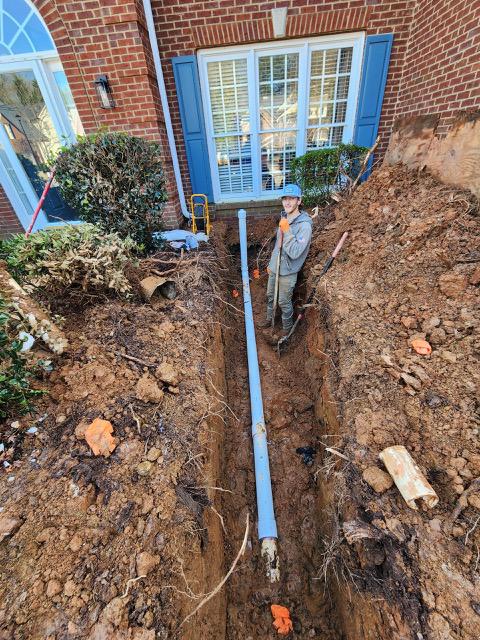
When trenchless patch repair is not feasible — due to the extent of damage, the condition of the surrounding pipe, or structural collapse — traditional open cut excavation and section replacement is the appropriate solution. We excavate to the damaged section, remove and replace the affected pipe, properly bed the new line, and restore the surface. For most residential sewer repairs in Alpharetta, open cut work is targeted to the specific damaged section rather than the full line route, minimizing the disruption to the yard.
In limited cases where a new line route is more practical than following the original — for example, where access to the existing route is significantly obstructed — directional boring to install the new section underground is an option we can evaluate. For standard residential sewer repairs, however, targeted excavation to the affected section is the typical approach.
Flat-rate pricing for all sewer repair work is provided after camera inspection confirms the scope — before any excavation begins. We explain the options and the reasoning clearly so homeowners understand what is being done and why. Every repair carries a full warranty.
Warning Signs That Your Alpharetta Sewer Line Needs Attention
- Recurring slow drains or backups throughout the house that don’t resolve with clearing
- Sewage odors inside the home or from outdoor clean-out access points
- Gurgling sounds from toilets or floor drains when sinks or showers are in use
- Wet or unusually green patches in the yard along the sewer line route
- Multiple drain clearing calls in the same year without lasting results
- A home built in the late 1970s or early 1980s with no recorded sewer inspection history
Benjamin Franklin Plumbing® of Alpharetta serves homeowners throughout Alpharetta, Cumming, Roswell, Milton, and Johns Creek. Available 24/7 — call (678) 833-2754 or book online. Licensed, background-checked, and drug-tested technicians.

 Your Privacy Choices