A slow drain is easy to ignore. It’s inconvenient but manageable — water drains, just slowly. The problem is that slow drains in Alpharetta and North Fulton homes rarely resolve on their own, and the underlying cause almost always progresses if it isn’t addressed. What starts as a minor nuisance has a predictable path: from slow, to intermittently backing up, to fully blocked, to — in some cases — structural damage inside the line that requires repair rather than just cleaning.
Understanding what causes drain problems in North Fulton homes, when professional drain cleaning is the right call, and what the process actually involves helps homeowners make better decisions before a manageable problem becomes an expensive one.
What Causes Drain Problems in Alpharetta Homes
Root Intrusion in PVC Sewer Lines
The most consistent finding in Alpharetta drain service calls is tree root intrusion — and this surprises many homeowners who assume that newer PVC sewer lines are immune to root problems. They are not. Roots follow moisture toward any pipe regardless of material, entering through joints, small gaps at fittings, or any imperfection in the line. Once inside, they grow with the water flow, progressively constricting the pipe interior until blockages become frequent and eventually the structural integrity of the joint is compromised.
Most of Alpharetta’s residential development occurred from the mid-1980s through the early 2000s, and the PVC sewer lines installed during that period are now 25 to 40 years old. The trees and landscaping planted when these homes were built have had the same 25 to 40 years to extend root systems toward those buried lines. Root intrusion is not a problem unique to old homes with clay or cast iron pipes — it is a present and active issue in Alpharetta’s mainstream PVC sewer systems.
Cast Iron Lines in Older Alpharetta Homes
In the established neighborhoods along the Haynes Bridge, Jones Bridge, and Webb Bridge corridors — homes built in the late 1970s and early 1980s — cast iron drain lines are still common. Cast iron has a long service life, but it is not permanent. Over decades, the interior surface corrodes, roughens, and develops scale buildup that progressively narrows the pipe diameter. Grease and debris adhere more easily to roughened cast iron than to smooth PVC, accelerating the accumulation. By the time a cast iron line in a 40-year-old home is producing recurring backups, the interior condition is often significantly degraded.
Grease and Organic Buildup
Kitchen drain lines in homes of all ages accumulate grease, food debris, and soap buildup over time regardless of how carefully homeowners manage what goes down the drain. Grease cools and solidifies on the pipe walls as it travels through the line, building up layer by layer until the effective pipe diameter is significantly reduced. This process is slow enough that most homeowners don’t notice it until the drain is backing up regularly. Hot water and dish soap — the standard home remedy — soften grease temporarily but do not remove the accumulated layers.
Bathroom Drain Buildup
Bathroom sink, shower, and tub drains accumulate hair, soap scum, and toothpaste residue at the drain opening and in the P-trap. These blockages are typically shallower and more accessible than main line issues, and they’re the appropriate candidates for DIY clearing — a drain snake or a hair removal tool from the hardware store will usually resolve a bathroom drain that is slow but not completely blocked. When the same bathroom drain keeps backing up within weeks of clearing, or when multiple drains throughout the house slow at the same time, the issue is in the main line rather than individual fixture drains.
When to Call a Professional
The clearest signals that a drain issue requires professional service rather than a DIY attempt are:
- Multiple slow drains throughout the house at the same time — this indicates a main line issue rather than individual fixture blockages
- A drain that backs up regularly despite repeated clearing — the underlying cause is not being addressed
- Sewage odors from drains or clean-out access points — indicates a blockage or venting issue in the main line
- Gurgling sounds from toilets or floor drains when sinks or showers are used — a classic main line partial blockage symptom
- Any backup that involves sewage coming up through a floor drain or toilet — this is a main line blockage and requires immediate attention
Store-bought chemical drain cleaners are appropriate for occasional, minor blockages in individual fixture drains. They are not appropriate for recurring issues, main line problems, root intrusion, or cast iron scale buildup. Chemical treatments applied to a root-intruded or structurally compromised line can temporarily dissolve organic matter around the roots while leaving the root mass intact and the joint damage unaddressed.
How We Approach Drain Cleaning
Assessment First
For any drain issue beyond a simple fixture drain clog, we start with an assessment rather than immediately running equipment. The type and location of the blockage determines the right approach. A toilet that backs up is a different problem than a floor drain that backs up — even though both are “drains.” We ask about the pattern of symptoms, how long the problem has been developing, and what has already been tried. This gives us a working diagnosis before any equipment goes near the drain.
Mechanical Clearing
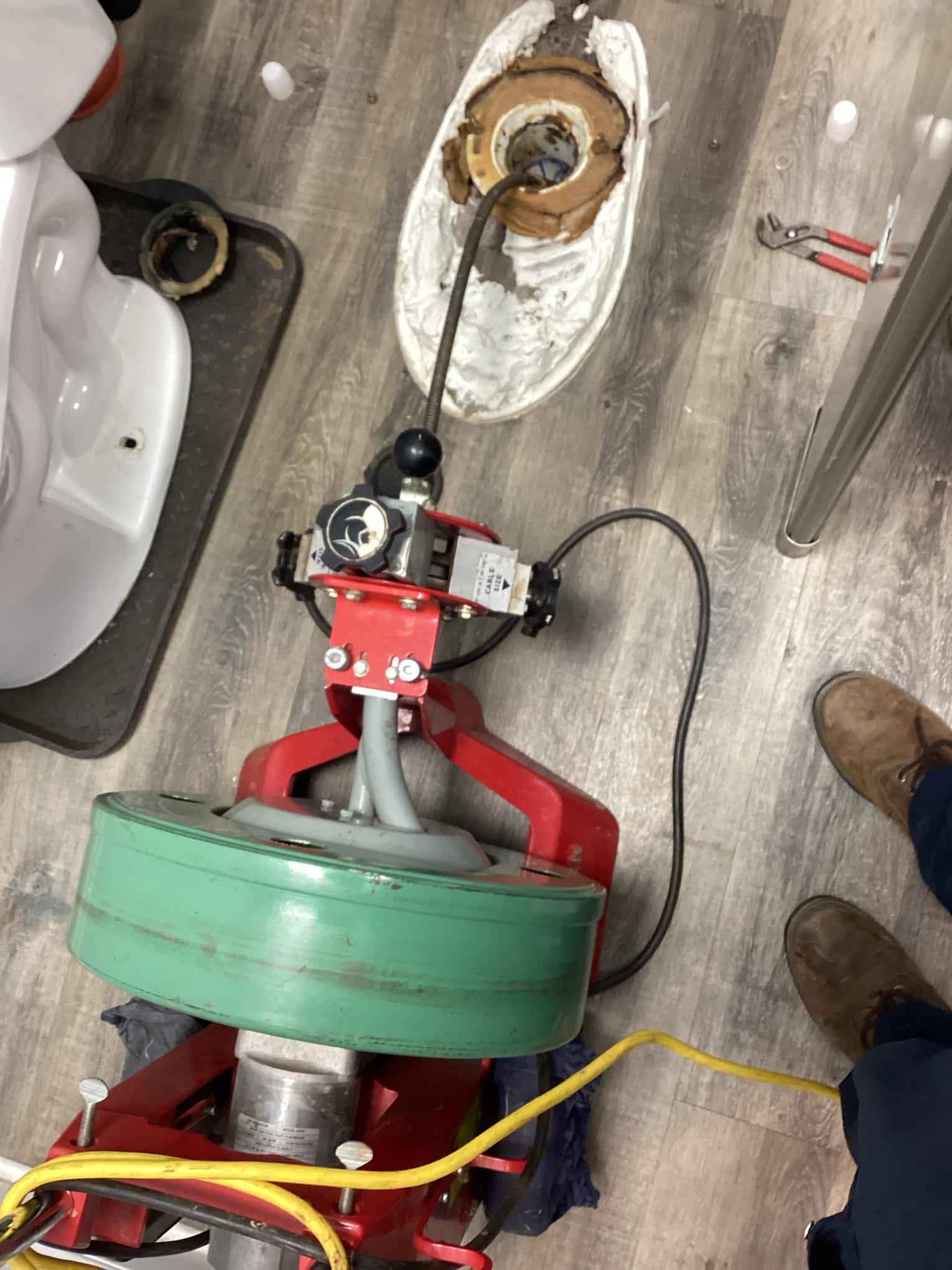
For blockages in the main line or individual fixture drains, mechanical clearing with a drain cable is typically the first service step. A rotating cable cuts through and removes blockages — grease accumulation, hair and debris, and in some cases lighter root masses — and clears the line. We confirm clearing by running water through the system and checking flow rate before considering the job complete.
Hydrojetting for Stubborn or Recurring Blockages
For lines with significant grease buildup, cast iron scale, or recurring blockages that mechanical clearing doesn’t fully resolve, hydrojetting is the more thorough solution. Hydrojetting uses high-pressure water to scour the interior walls of the drain line — removing accumulated grease, scale, and debris rather than just clearing a path through the blockage. The result is a pipe interior that is substantially cleaner than what mechanical clearing alone achieves. For cast iron lines in older Alpharetta homes, hydrojetting makes a meaningful difference in how long the line performs before the next service call.
Sewer Camera Inspection
When a drain issue keeps recurring, doesn’t fully clear with mechanical methods, or when we want to confirm the condition of the line after clearing, we use sewer camera inspection. A camera mounted on a flexible cable transmits live video of the pipe interior, showing exactly what is present — root intrusion at specific joints, cast iron corrosion, offset or cracked sections, or accumulated buildup. This information drives repair decisions based on what is actually in the line rather than assumptions. For homeowners who have been dealing with recurring drain issues for years, a camera inspection frequently reveals the specific structural problem that has been causing the pattern.
Repair When Needed
When camera inspection identifies structural damage — significant root intrusion, offset joints, cracked sections, or pipe collapse — repair is the appropriate next step. For contained damage in an otherwise sound line, trenchless pipe patch repair inserts a cured-in-place liner inside the existing pipe, restoring full function without excavation in most cases. For more extensive damage or sections that require full replacement, we excavate and replace the affected section with flat-rate pricing agreed before any digging begins.
Benjamin Franklin Plumbing® of Alpharetta serves homeowners throughout Alpharetta, Cumming, Roswell, Milton, and Johns Creek. Available 24/7 — call (678) 833-2754 or book online. Licensed, background-checked, and drug-tested technicians.

 Your Privacy Choices