
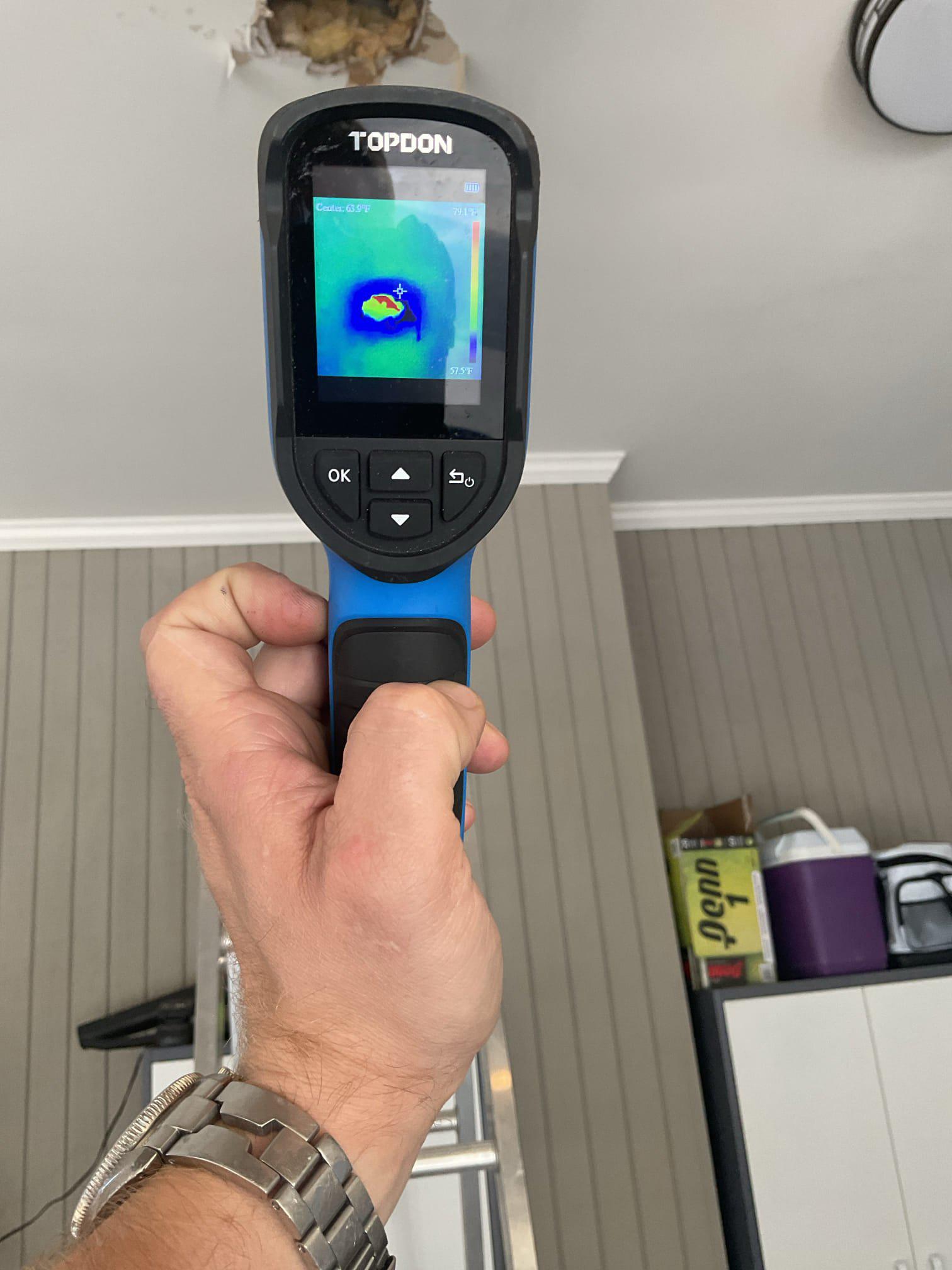
The most expensive leaks are the ones you can’t see. A dripping faucet announces itself. A supply line leaking beneath your foundation, inside a wall, or underground between the street and your house can run for weeks or months — quietly raising your water bill, saturating the soil under your slab, and causing damage that costs far more to repair than the leak itself. Professional leak detection is how you find those leaks before they become that expensive, and it is one of the most requested services we provide throughout Alpharetta and North Fulton County.
What Professional Leak Detection Actually Is
Leak detection is the diagnostic process of locating a hidden leak precisely — before any wall, floor, or concrete is opened. That distinction matters enormously. Without proper detection, finding a slab leak means opening concrete in the general area and hoping you guessed right. With it, we identify the exact point of failure first, which means the access area is as small as possible, the repair is targeted, and the restoration work afterward is minimal.
We use two primary technologies, usually together. Thermal imaging cameras read surface temperature differences — a hot water line leaking beneath a slab creates a warm signature on the floor above it that’s invisible to the eye but obvious on thermal. Acoustic detection equipment amplifies the sound of water escaping a pressurized line, letting us trace and pinpoint a leak through concrete, drywall, or soil. Combined with pressure testing to confirm which line is compromised, these tools let us find a leak accurately rather than approximately.
Signs You May Have a Hidden Leak in Your Alpharetta Home
- A water bill that has climbed with no change in usage. This is the single most common first indicator. A hidden leak runs continuously, and even a small, steady flow adds up to a noticeable bill increase over a month.
- Warm or hot spots on tiled or hardwood floors. A classic slab leak sign — a hot water supply line leaking beneath the concrete transfers heat to the floor surface above it.
- The sound of running water when every fixture is off. If you can hear water moving with everything shut down, water is escaping somewhere in the system.
- Low water pressure throughout the house. When pressure drops at every fixture rather than one, the restriction or loss is upstream — often in the main supply or service line.
- A musty smell, or stains on walls, ceilings, or baseboards. Persistent moisture from a concealed leak produces odor and discoloration before visible water ever appears.
- Wet, soggy, or unusually green patches in the yard. A leaking underground water service line often shows as a wet strip or a strip of grass that’s greener than everything around it.
- Foundation cracks or uneven flooring. A late-stage sign. Water escaping under a slab erodes the soil supporting it, which can lead to movement in the foundation itself.
The Most Common Hidden Leaks in Alpharetta Homes
Slab Leaks
Slab-on-grade construction is standard across Alpharetta, Milton, Johns Creek, and much of North Fulton’s 1980s and 1990s housing. Supply lines run beneath or through the concrete foundation, and when one fails, the water escapes into the soil under the slab rather than into the living space — which is exactly why these leaks go undetected so long. Slab leaks are the single most common hidden-leak call we receive in this area.
Pinhole Leaks in Aging Copper
Homes across North Fulton built in the 1980s and 1990s are on copper supply lines that are now 30 to 45 years old. As copper reaches this age, localized pitting corrosion develops on the interior wall of the pipe until a small hole forms. These leaks can appear inside walls, in ceilings between floors, or beneath the slab. The pattern worth knowing: multiple pinhole leaks in different locations over a short period usually means the system is deteriorating system-wide rather than failing at one weak point.
Water Service Line Leaks
The service line running underground from the street meter to your home is the homeowner’s responsibility, and on the larger lots common throughout Milton, Cumming, and Johns Creek, that line can run a long way. A leak here shows up as low pressure, a rising bill, or wet ground in the yard — and locating it precisely determines whether a targeted repair or a full replacement makes sense.
Why Early Detection Saves Real Money
The cost difference between catching a leak early and catching it late is not incremental — it’s categorical. A slab leak found at the warm-floor or elevated-bill stage is a plumbing repair. The same leak found six months later can involve flooring replacement, drywall and baseboard repair, mold remediation, and in the worst cases foundation stabilization. The plumbing portion of that bill barely changes; everything around it multiplies. That’s the entire argument for calling at the first sign rather than waiting for visible damage.
What to Expect From a Leak Detection Visit
We start by listening. The pattern of symptoms — which fixtures are affected, how long it’s been developing, what your water bill has done — gives us a working diagnosis before any equipment comes out. From there we isolate and pressure test to confirm which line is losing water, then use thermal imaging and acoustic equipment to pinpoint the leak location. You get a clear explanation of what we found, where it is, what caused it, and what the repair involves — with flat-rate pricing quoted before any work begins. Every repair is backed by our warranty and our 100% satisfaction guarantee.
If you’re seeing any of the warning signs above, don’t wait for the damage to become visible. We’re available 24/7 — call (678) 833-2754 or book online. Serving Alpharetta, Milton, Roswell, Johns Creek, and Cumming.

 Your Privacy Choices