
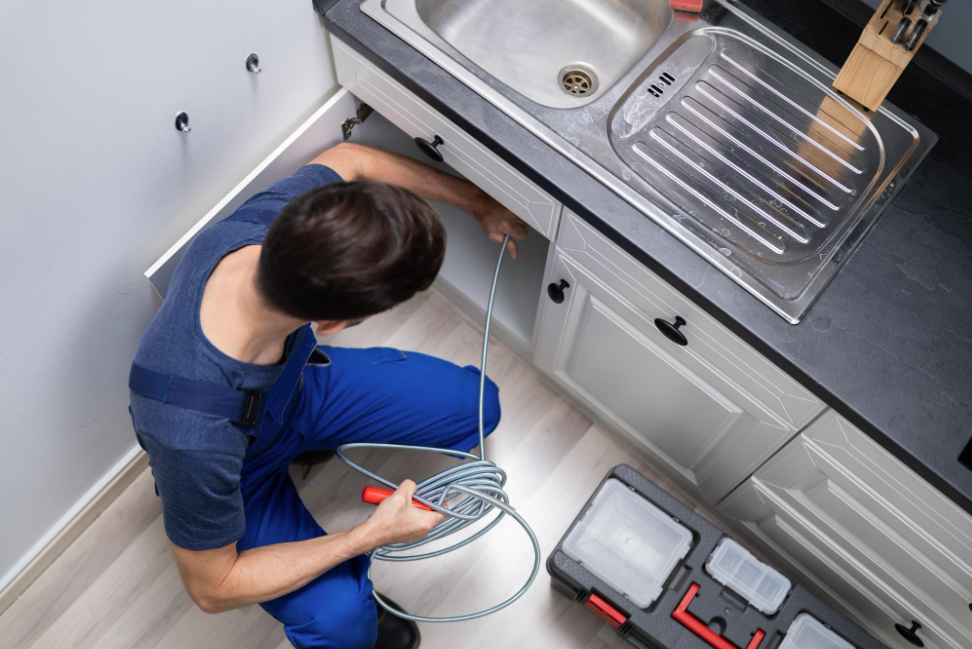
A slow drain in a Kansas City, MO home rarely stays slow for long. What starts as water lingering a few extra seconds in the kitchen sink or bathtub usually turns into a full stop within days or weeks, and by then the fix is often bigger than it needed to be. Kansas City's older housing stock, mature tree canopy, and clay-heavy soil all play a role in why drain cleaning is one of the most requested plumbing services in the metro.
Most homeowners try a plunger first, and sometimes that is enough. But when a clog keeps coming back, or when more than one fixture is draining slowly at the same time, the problem usually sits deeper in the line than a plunger can reach. That is where professional drain cleaning earns its keep, using tools built to clear a pipe completely rather than just punch a temporary hole through the blockage.
This guide walks through what actually causes drains to clog in Kansas City homes, the difference between a DIY fix and a professional one, and the warning signs that mean it is time to stop guessing and call a plumber.
Benjamin Franklin Plumbing of Kansas City has been clearing drains and sewer lines across the metro since 1955, and the patterns repeat often enough that most clogs fall into a handful of predictable categories.
Based out of Lee's Summit, MO, the team runs drain cleaning calls throughout Kansas City, Overland Park, Leawood, Prairie Village, Blue Springs, Gladstone, Greenwood, Independence, and Olathe, and a call to (816) 239-2685 reaches a real person, not an automated queue.
In this article, you will learn about:
- What causes clogged drains in Kansas City homes
- DIY drain clearing versus professional drain cleaning
- Warning signs a drain problem is more serious than it looks
- What to expect from a professional drain cleaning service
Keep reading to find out which signs mean your drain needs more than a plunger, and how a professional cleaning actually works.
What causes clogged drains in Kansas City homes
Kansas City sits on a mix of older neighborhoods and newer developments, and both end up dealing with clogs for different reasons.
In established areas like Prairie Village, homes built decades ago often still run on their original clay or cast iron piping, which behaves very differently than the PVC used in newer construction. The same holds in Leawood, where mid-century blocks still carry their original lines.
Newer pockets of Overland Park lean more toward daily-habit clogs than structural pipe issues, and the same is true across much of Blue Springs. Gladstone follows a similar pattern. Independence sits somewhere in between depending on when a given block was built. Olathe tends to follow that same middle ground.
Understanding which category a clog falls into changes how it should be treated. A grease clog responds to different tools than a root intrusion, and treating one like the other wastes time and sometimes money.
Grease, soap, and everyday buildup
Kitchen sinks take the brunt of daily wear. Cooking grease looks liquid going down the drain, but it cools and hardens against the inside of the pipe within minutes, catching food particles, coffee grounds, and soap scum as it goes. Layer after layer, this buildup narrows the pipe's interior until water barely gets through.
The scale of the grease problem is bigger than any one kitchen. Federal wastewater guidance counts fats, oils, and grease among the top materials that create blockages in sanitary sewer systems nationwide, right alongside root intrusion and items marked "flushable" that are not. Bathroom drains face a similar problem, just with different material.
Bar soap residue combines with hair and mineral deposits from tap water to form a paste-like buildup along pipe walls, and it accumulates slowly enough that most homeowners do not notice until the drain is already struggling.
A few habits make a measurable difference over time:
- Wipe greasy pans with a paper towel before washing, rather than letting grease rinse straight into the drain
- Use a mesh drain cover in the shower and bathroom sink to catch hair before it enters the pipe
- Run hot water for 30 seconds after washing dishes to help move soap and grease further down the line
- Avoid pouring coffee grounds, egg shells, or fibrous food scraps down the kitchen sink
None of these habits eliminate clogs entirely, but they slow the buildup enough to stretch the time between cleanings. Combined with occasional professional maintenance, this is usually enough to keep drains flowing in a typical Kansas City household.
Tree roots and aging sewer lines
Kansas City's tree canopy is part of what makes neighborhoods like Brookside and Waldo pleasant to live in, but mature trees send roots searching for moisture, and an underground sewer line carrying wastewater is exactly what they find. Roots exploit any hairline crack or loose joint in a pipe, and once inside, they grow thick enough to catch debris and eventually block the line entirely.
This problem shows up more in homes built before the 1970s, where clay pipe and cast iron were the standard materials. Clay is brittle and prone to cracking as ground conditions shift with the seasons, and once a crack forms, it becomes an open invitation for roots. The sewer network these pipes tie into is not a minor asset either.
EPA figures put the value of the nation's sanitary sewer infrastructure at more than $1 trillion, which is part of why individual homeowners maintaining their own lateral lines matters more than it might seem.
Homeowners in older Kansas City neighborhoods should treat periodic camera inspection as a way to spot trouble before it becomes an emergency, rather than a reactive step taken only after a backup.
The warning signs of root intrusion often look identical to an ordinary clog at first, and they tend to show up in a predictable order:
- Slower drainage in more than one fixture, usually starting with the lowest drain in the house
- Gurgling sounds from a toilet when a nearby sink or tub is running
- A sewer smell in the yard, especially near where the lateral runs toward the street
- Standing water or a backup that returns within days of being cleared
Any one of these on its own is worth watching. Two or more together are worth a call before the line backs up completely.
Foreign objects and flushed items
Toilets get treated like trash cans more often than most homeowners realize. Wipes labeled "flushable," feminine hygiene products, dental floss, and cotton swabs do not break down the way toilet paper does, and they catch on pipe joints or existing buildup instead of moving through the system. Federal sewer guidance lists these products by name as one of the recurring, preventable causes utilities deal with nationwide.
Kids' toys, jewelry, and small bathroom items are less common but far from rare, especially in households with young children. Unlike organic buildup, a foreign object usually causes a sudden, complete blockage rather than a gradual slowdown, which is often the clearest sign that something other than routine buildup is at fault. That pattern plays out in sewer lines across the metro every year, regardless of how new or old the home is.
DIY drain clearing versus professional drain cleaning
Not every clog needs a professional visit. A single slow drain that responds to a plunger or a store-bought auger is often a simple, localized blockage that a homeowner can clear safely. Understanding where the line sits between a reasonable DIY attempt and a job that needs a professional saves both money and pipe damage.
The biggest mistake homeowners make is reaching for chemical drain cleaner before trying anything mechanical. These products can dissolve a mild clog, but the harsh reality of chemical drain cleaners is that they also generate heat that can soften or warp older plastic pipes, and they do nothing for a clog caused by roots or a foreign object lodged deep in the line.
What homeowners can reasonably try first
A plunger remains the most effective first move for a single clogged fixture. A flange plunger works better for toilets, while a standard cup plunger handles sinks and tubs more effectively, since the seal shape matters for building the pressure needed to dislodge a blockage. Toilets carry more of this responsibility than most fixtures, since they account for nearly 30 percent of a typical home's indoor water use and move the bulk of household waste through the line in the process.
If plunging does not clear the drain, a hand-crank drain auger, sometimes called a plumber's snake, reaches further into the pipe and can hook or break up a clog mechanically without introducing any chemicals. These are available at most hardware stores and work well for clogs within a few feet of the drain opening.
- Start with a plunger on the affected fixture, using firm, steady pressure rather than fast pumping
- If the clog does not clear, feed a hand auger into the drain slowly, turning the handle as resistance is felt
- Run hot water through the drain afterward to flush any loosened debris
- If the same drain clogs again within a few weeks, treat that as a signal the underlying cause was not resolved
These steps handle the majority of single-fixture clogs, and the same habits that stop a drain from clogging also help with reducing water waste at home more broadly. What they do not handle well is anything involving the main sewer line, multiple fixtures backing up at once, or a clog that keeps returning despite repeated clearing.
When the job calls for professional equipment
Professional drain cleaning uses equipment that reaches much further and cuts through blockages a hand tool cannot touch. A motorized drain snake can travel dozens of feet into a line, and hydro jetting uses high-pressure water to scour the full interior diameter of a pipe clean, rather than just punching a channel through the middle of a clog.
Camera inspection is the other major difference. Instead of guessing at what caused a repeat clog, a plumber threads a small camera through the line to see exactly where the blockage sits and what is causing it, whether that is a root mass, a collapsed section of pipe, or built-up scale. This turns a repeat problem into a one-time, targeted fix instead of a cycle of temporary relief.
A professional visit also protects the pipe itself. Older clay or cast iron lines can crack under the wrong kind of mechanical force, and a trained plumber knows how much pressure a given pipe material can safely handle, something a homeowner working with a rented rooter machine typically cannot judge accurately.
Cost and time considerations
Every drain cleaning job varies based on the clog's location, the pipe material, and how much of the line needs clearing, so pricing depends on the specifics of the job rather than a flat rate. What stays consistent is that catching a slow drain early, before it becomes a full sewer backup, almost always costs less than an emergency call after the line has stopped completely.
Homeowners weighing DIY against professional service should also factor in their own time and the risk of making the problem worse. A misapplied chemical cleaner or an over-aggressive attempt with a rented auger can turn a routine clog into a cracked pipe, which then requires excavation instead of a simple cleaning.
Warning signs a drain problem is more serious than it looks
Some drain issues announce themselves clearly, like a toilet that will not flush at all. Others are quieter, and homeowners often dismiss the early signals until the problem forces the issue. Learning to read these signs earlier gives more options and lower costs.
The pattern that matters most is whether a slowdown is isolated to one fixture or spreading across the house. A single slow bathroom sink is usually local. Multiple slow or gurgling drains at once almost always point toward the main line.
Signs pointing to a single-fixture clog
A localized clog tends to affect only one drain, and the symptoms build gradually. Water pools around the feet during a shower, a sink takes noticeably longer to empty than it used to, or a toilet requires a second flush more often than before, whether that home sits in Kansas City proper or out in Greenwood.
- Gurgling sounds coming from the affected drain itself, not from other fixtures
- A slow but steady drainage rate rather than a complete stop
- Odors localized to one drain, often from trapped food or hair buildup
- The problem stays the same or worsens slowly over days or weeks
These symptoms respond well to the DIY steps covered earlier, and if they resolve after plunging or snaking, there is usually no need for further action beyond keeping an eye on the fixture going forward.
Signs pointing to a main line or sewer problem
When more than one drain acts up at the same time, especially drains on different floors or in different parts of the home, that pattern points toward the main sewer line rather than an isolated fixture. Water backing up into a tub when the toilet is flushed, or a washing machine drain overflowing into a nearby floor drain, are classic signs the blockage sits downstream of where individual fixtures connect.
Tracing the symptom back to its actual source, rather than treating the symptom itself, is the same approach our plumbers use for low water pressure complaints.
Sewage odor in the yard, especially near where the sewer lateral runs toward the street, is one of the clearest outdoor indicators. Soggy patches of grass that stay wet regardless of weather can also signal a leaking or blocked sewer line beneath the surface.
If a sewer backup does reach the inside of the home, moisture that sits untreated becomes a secondary problem fast. FEMA disaster recovery guidance recommends drying affected materials within 24 to 48 hours and keeping indoor humidity below 60 percent, since damp materials left longer than that window are the main driver of mold taking hold after a backup.
When to stop troubleshooting and call a plumber
A general rule of thumb: if a plunger and a basic hand auger do not resolve the issue within one or two attempts, or if the same drain clogs again within a short window, it is time to bring in a professional rather than escalate the DIY approach further. Continuing to pour chemical cleaner down a stubborn drain rarely helps and can make the eventual professional fix harder.
Multiple slow drains, sewage odor, or any sign of water backing up from a lower-level fixture when an upper-level one is used are all situations where waiting costs more than acting. These are also the scenarios most likely to need camera inspection to identify the actual cause rather than repeated, temporary clearing, and our 24/7 emergency plumbing team is set up to respond quickly when a backup is active.
What to expect from a professional drain cleaning service
Homeowners calling for the first time often are not sure what the visit itself involves. Knowing the general process ahead of time makes the whole experience less of an unknown, especially for anyone dealing with a backup for the first time.
Benjamin Franklin Plumbing of Kansas City structures every drain cleaning visit around the same core principle: identify the actual cause before applying a fix, rather than clearing the surface of the problem and moving on.
The diagnostic and clearing process
The visit typically starts with a conversation about which fixtures are affected and how long the problem has been going on, since that pattern often points toward the likely cause before any tool touches the pipe. From there, a plumber runs a drain auger or snake through the affected line to physically clear the blockage.
If the initial pass does not fully resolve the issue, or if the same drain has clogged repeatedly in the past, a camera inspection identifies exactly what is happening inside the pipe.
This step separates a simple buildup clog from something structural, like a cracked joint or significant root intrusion, that needs a different kind of repair altogether. Homes in older neighborhoods with original clay or cast iron piping benefit from this kind of periodic professional check even before a clog becomes obvious, much like catching a water heater that is not keeping up is cheaper to fix early than waiting for it to fail completely.
- Initial assessment of which drains are affected and the pattern of the problem
- Mechanical clearing using an auger or snake sized to the line
- Camera inspection if the clog is recurring or the cause is unclear
- Explanation of findings and next steps before any additional work begins
This sequence keeps the homeowner informed at each stage rather than presenting a bill for work they do not understand the reasoning behind. Finding the vulnerable spot before it fails outright is the same logic behind our winter plumbing checklist, applied here to a drain instead of a pipe headed into freeze season.
Hydro jetting for stubborn or recurring clogs
For lines with heavy grease buildup, extensive root intrusion, or a history of repeat clogs, hydro jetting offers a more thorough clean than snaking alone. High-pressure water scours the entire interior wall of the pipe rather than just cutting a path through the center of the blockage, which means the line stays clear longer afterward.
Hydro jetting is not always the right first step. For a straightforward, isolated clog, a standard auger is often sufficient and less invasive. A plumber's job during the diagnostic phase is partly to determine which approach actually fits the situation rather than defaulting to the most aggressive tool available.
Preventative camera inspection every few years gives homeowners in older neighborhoods a realistic picture of their sewer line's condition, rather than finding out only after a backup forces the issue. Buying or renovating an older Kansas City home without that inspection risks discovering a trenchless sewer repair is needed only after a line has already failed, once the expense is much harder to avoid.
Why Kansas City homeowners choose Benjamin Franklin Plumbing
Every technician has apprenticed under a master plumber and stays current on evolving codes and techniques, which matters when a diagnosis has to be right the first time. Benjamin Franklin Plumbing of Kansas City has served the metro since 1955 and holds Better Business Bureau accreditation, a track record that carries weight in a trade where anyone can hang a sign.
The company backs its scheduling with a promptness guarantee known locally as "if there's any delay, it's you we pay," which pays homeowners $5 for every minute a technician runs late, up to $300.
That is a concrete commitment rather than a marketing line, and it applies the same way whether the call comes from Kansas City, Lee's Summit, Overland Park, Leawood, Prairie Village, Blue Springs, Gladstone, Greenwood, Independence, or Olathe. Homeowners enrolled in the club membership program get preventative drain checks built into their regular service visits rather than having to schedule them separately.
Conclusion
Drain cleaning in Kansas City, MO comes down to matching the right response to the actual cause, whether that is a straightforward grease clog in the kitchen or a root-damaged sewer line running out to the street. Most single-fixture clogs respond well to a plunger or hand auger, but recurring blockages, multiple slow drains, or any sign of sewage backing up are signals that the problem sits deeper than a DIY fix can reach.
Kansas City's mix of older clay and cast iron piping alongside a heavy mature tree canopy means root intrusion and aging joints show up more often here than in newer markets, which is part of why professional camera inspection matters as much as the initial clearing. Catching a developing problem early almost always costs less time and money than waiting for a full backup.
If a drain in your home has been slow for more than a few days, keeps clogging despite regular cleaning, or you are noticing more than one fixture acting up at once, it is worth having it looked at properly rather than guessing.
Benjamin Franklin Plumbing of Kansas City has been clearing drains and diagnosing sewer lines across the metro since 1955, serving Kansas City, Lee's Summit, Overland Park, Leawood, Prairie Village, Blue Springs, Gladstone, Greenwood, Independence, and Olathe, and every visit comes with upfront pricing before any work begins.
Call (816) 239-2685 or reach out through the Benjamin Franklin Plumbing Club Membership program to get ongoing plumbing checks that catch problems like this before they become emergencies.

 Your Privacy Choices