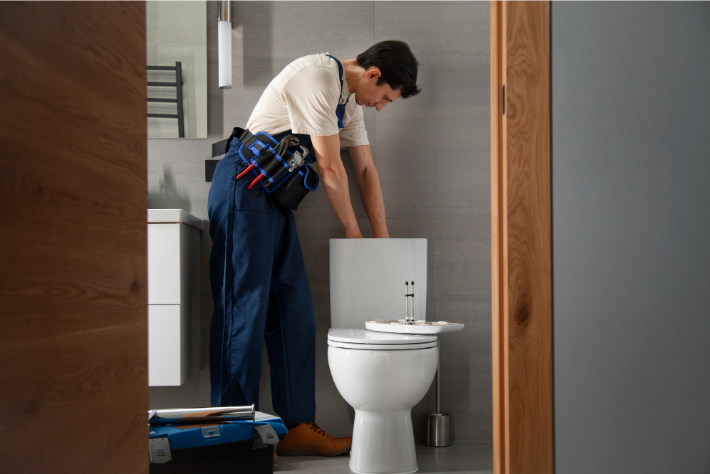
If you have a running toilet in your Conroe, TX home, you already know the sound. The tank fills, the water shuts off, and a few minutes later it starts filling again, or it never fully stops at all. It's easy to ignore because the toilet still flushes fine. That's exactly the problem. A running toilet does not announce itself the way a burst pipe does. It just quietly drains money and water in the background, sometimes for weeks before anyone notices the water bill.
Most homeowners assume a running toilet is a minor annoyance, something to deal with eventually. In reality, it is one of the most common plumbing issues our licensed plumber technicians get called out for across Conroe, The Woodlands, and the rest of Montgomery County. The good news is that the root causes are usually simple and inexpensive to fix once someone identifies the actual part that's failing.
This guide walks through why toilets run, how to tell if yours is losing water even when it looks fine, how much that waste actually costs on a typical Conroe water bill, and when the fix is a quick DIY job versus a job for a professional.
Whether your toilet runs constantly or only every so often, the cause is the first thing to nail down before spending money on parts. The same troubleshooting applies whether you're in Conroe proper, The Woodlands, or Shenandoah, since the plumbing hardware inside a toilet tank doesn't vary by zip code.
In this article, you will learn about:
- Why your toilet keeps running after you flush
- How to check for a silent toilet leak at home
- What a running toilet is really costing you in Conroe
- When to call a professional plumber instead of DIYing it
Keep reading to find out how a five-dollar part could be behind hundreds of dollars in wasted water every year.
Why your toilet keeps running after you flush
A toilet that runs continuously, or restarts on its own a few minutes after a flush, is almost always failing at one of two jobs: holding water in the tank, or knowing when to stop refilling it. Every toilet tank relies on a small set of mechanical parts to do both, and any one of them wearing out can cause the exact same symptom.
Homeowners often assume the toilet itself is failing, but the toilet bowl and tank rarely wear out. It's the internal hardware, the parts that move every single flush, that eventually give in to age, mineral buildup, or plain daily use.
The most common culprits fall into a short list:
- A worn or warped flapper that no longer seals the flush valve completely
- A fill valve that keeps letting water into the tank after it should have shut off
- A float that's set too high, causing the tank to overfill and drain through the overflow tube
- A flush valve seat with mineral buildup or corrosion that prevents a clean seal
- A chain that's too long, too short, or tangled, so the flapper doesn't drop all the way
Most of these issues trace back to one part: the flapper. It's typically an inexpensive rubber, plastic, or silicone part, and it's usually the single most common cause of a toilet that won't stop running.
If your toilet is older, especially if it predates a bathroom remodel or was installed with the home, the flapper has likely never been replaced. Rubber and silicone degrade over time from constant water exposure and, in areas with treated municipal water, from chemical interaction with the water itself.
The flapper and flush valve seal
The flapper sits at the bottom of the tank and lifts every time you flush, letting water rush into the bowl. When you release the handle, the flapper is supposed to fall back and create a watertight seal against the flush valve seat. Once that seal degrades, water seeps past it continuously, and the fill valve keeps trying to compensate.
A flapper doesn't fail all at once. It usually swells, softens, or warps gradually, which is why a running toilet often starts as a faint hiss that gets louder over weeks or months. By the time it's audible from another room, the seal has likely been leaking for a while already.
Mineral deposits in the water supply can accelerate this. Conroe and the surrounding Montgomery County area draw on groundwater with variable mineral content, and scale buildup on the valve seat can keep even a healthy flapper from sitting flush. The same mineral buildup that ages a flapper is often behind clog drain repair calls elsewhere in the house.
Fill valve and float problems
The fill valve is the mechanism that refills the tank after a flush and shuts off once the water reaches the right level. If the fill valve doesn't shut off cleanly, or if the float that tells it when to stop is set too high, water keeps entering the tank and spilling into the overflow tube, which drains straight into the bowl.
This creates a different sound than a flapper leak. Instead of a slow hiss, you'll often hear a continuous trickle or a valve that never fully settles into silence. It can also cause the tank to run intermittently, filling for a few seconds every couple of minutes even when no one has flushed.
- Float balls or float cups can shift out of adjustment over time
- Fill valve washers wear out the same way flapper seals do
- Sediment inside the fill valve can prevent a full shutoff
A stuck float or fill valve can also cause a symptom that looks unrelated: a tank that sounds like it's cycling on and off is sometimes mistaken for shower water temperature fluctuating elsewhere in the house when the two issues are actually independent.
Chain length and handle issues
A surprisingly common cause is one of the simplest to fix: the chain connecting the flush handle to the flapper. If it's too long, it can get caught under the flapper, holding it slightly open. If it's too short, the flapper may not seat fully, or the handle may stick in the down position after a flush.
This kind of issue is easy to check yourself. Take the tank lid off, flush, and watch what the flapper and chain actually do. If the chain is snagging or the handle sticks, that alone might explain a running toilet with no part replacement needed.
How to check for a silent toilet leak at home
Not every running toilet is loud enough to hear. Some leaks are silent, especially small flapper leaks that lose water slowly rather than in an obvious trickle. A silent leak can waste just as much water as a noisy one, sometimes more, because it goes unnoticed for longer.
The good news is that checking for a leak takes about ten minutes and requires nothing more than something already in most kitchen cabinets. It's a habit worth pairing with other routine residential plumbing services checks, since a lot of small leaks hide in plain sight until someone actually looks.
The dye test
The classic method works like this:
- Lift the tank lid and confirm the water level is below the overflow tube
- Add a few drops of food coloring or a dye tablet to the tank water
- Wait ten minutes without flushing
- Check the bowl for any trace of color
According to the Environmental Protection Agency, if color shows up in the bowl within about ten minutes, that confirms a leak, and the darker the color, the larger the leak likely is. Once color turns up, that's confirmation that the flapper or seal is the culprit, and a targeted plumbing diagnosis can pin down exactly which part is failing.
The water meter check
You can pair the dye test with a simple meter check if you want to confirm total household water loss, not just the toilet. Turn off every fixture in the house, note the water meter reading, wait two hours without using any water, then check the meter again.
Any movement points to a leak somewhere in the system, and a running toilet is the most common single source. This same method is useful for catching yard line water leaks or other hidden losses outside the house that a toilet check alone wouldn't reveal.
Signs beyond the dye test
A few other signs point to a running toilet even without doing a dye test:
- The tank refills on its own periodically with no one flushing
- You hear a faint hiss or trickle when the house is quiet
- The water level in the bowl looks slightly higher or lower than normal
- The toilet takes noticeably longer than usual to "settle" after a flush
If you notice any of these, it's worth doing the dye test before assuming the sound will just go away on its own.
What a running toilet is really costing you in Conroe
The reason a running toilet deserves more attention than it usually gets comes down to volume. Toilets use more water per use than almost any other fixture in the house, and when one runs continuously, the losses add up fast.
The Environmental Protection Agency notes that a running toilet can waste about 200 gallons of water in a single day when the leak goes unaddressed, which over a month works out to roughly 6,000 gallons from one fixture alone.
The national picture on household leaks
On a household level, the impact is broader than most homeowners expect. The EPA's WaterSense program reports that household leaks nationwide waste nearly one trillion gallons of water every year, and about 10% of homes have leaks significant enough to waste 90 gallons or more per day, with toilets and worn flappers among the most common causes.
That kind of loss rarely comes from one dramatic failure. It's usually the slow accumulation described in this guide to plumbing drain repair and similar maintenance topics: small issues that compound quietly until the bill forces the issue.
What it means for a Conroe water bill
That waste shows up directly on a local water bill. The City of Conroe's utility rate structure charges residential customers per 1,000 gallons above a base allowance, with rates that increase in tiers as usage climbs. A running toilet doesn't just add a flat fee, it can push a household into a higher consumption tier for the entire billing period, quietly increasing every gallon's cost, not just the wasted ones.
Here's what that looks like in practical terms for a typical household:
- A slow leak losing 2 gallons per hour adds up to nearly 1,500 gallons a month
- A worn flapper losing 200 gallons a day can add 6,000+ gallons in a single billing cycle
- Sewer charges in Conroe are tied to water usage, so the waste often gets billed twice, once for water and once for sewer
For homes outside Conroe's city limits, rates are typically higher still, which makes catching a running toilet early even more worthwhile financially. Anyone dealing with a high water bill that seems disconnected from actual usage should treat a running toilet as one of the first, and easiest, things to rule out.
When the cost points to a bigger issue
Sometimes a running toilet is only part of the story. If the bill spike is larger than a single toilet could explain, it's worth checking for hidden slab leak symptoms or other issues that share the same "quiet but expensive" pattern as a worn flapper.
- Compare the bill increase against the estimated toilet leak volume
- Rule out irrigation or outdoor fixtures before assuming it's all indoor
- Ask for a full-system check if more than one fixture shows signs of trouble
When to call a professional plumber instead of DIYing it
Plenty of running toilet fixes are within reach for a comfortable DIYer. A basic flapper replacement, an adjusted float, or a re-seated chain are all quick, low-risk repairs that don't require specialized tools. If the dye test confirms a leak and the fix looks like a straightforward part swap, that's a reasonable weekend project.
That said, there are situations where calling a plumber makes more sense than continuing to troubleshoot on your own.
- The flush valve seat itself is cracked, corroded, or covered in mineral buildup that a new flapper can't fix
- The toilet is old enough that replacement parts no longer match the tank's design
- Water is leaking from the base of the toilet or the tank bolts, which points to a wax ring or gasket issue rather than the internal mechanism
- You've replaced the flapper and fill valve and the toilet is still running
- The water bill has spiked and you can't find the source after checking every fixture
A toilet that keeps running after a legitimate DIY attempt is often a sign of a deeper issue, like a cracked overflow tube, a warped flush valve seat, or even a slow crack in the tank itself. Those aren't always visible during a quick inspection, and misdiagnosing them means paying for parts that were never going to solve the problem. This is true for homeowners in Lake Conroe and Panorama Village just as much as in Conroe proper, since older tank designs and hardware wear out the same way regardless of neighborhood.
There's also a simple time-versus-cost argument. A technician who diagnoses running toilets regularly can usually identify the actual failure point in minutes, where a homeowner might go through two or three part replacements before finding the real cause. Considering how much a running toilet can add to a water bill in the meantime, a same-visit diagnosis often pays for itself.
If your garbage disposal or other fixtures are also acting up, it's worth having a technician look at the whole plumbing system rather than treating each symptom separately, since related issues sometimes share a cause, like household water pressure that's running too high. This is also a good time to review general plumbing system summer readiness if the toilet issue turned up during the hotter months, when usage and strain on the system are both higher.
Signs the problem is bigger than the toilet
A running toilet is sometimes the most visible symptom of a household-wide issue rather than an isolated fixture problem. If you're also noticing high water pressure at other fixtures, or a bill that's climbed without an obvious explanation, a plumber can check whether pressure or a hidden leak elsewhere in the system is compounding the toilet issue.
- Multiple fixtures showing wear at the same time
- Water pressure that feels noticeably stronger than it used to
- A water bill that's climbed steadily over several months, not just one cycle
What a professional inspection usually includes
When a Benjamin Franklin Plumbing technician comes out for a running toilet call, the visit typically covers more than just the toilet itself. Technicians check the flapper, fill valve, float, and flush valve seat, but they'll also glance at supply line connections and the shutoff valve, since a sticking shutoff can sometimes mimic a running toilet's symptoms.
- Full internal tank inspection, not just a flapper swap
- A check of water pressure at the fixture
- Confirmation that the wax ring and base connections aren't contributing to the issue
Getting ahead of the next leak
Once a running toilet is fixed, the smartest move is making sure it doesn't quietly start again in six months. Toilets in homes with harder water or older plumbing tend to need flapper replacements more frequently than the manufacturer's estimate suggests, so a periodic check is worth building into a regular home maintenance routine, alongside broader seasonal leak prevention steps for the rest of the house.
- Annual flapper and fill valve inspection, even without symptoms
- A quick dye test once or twice a year as a habit, not just when something seems off
- Considering a WaterSense labeled replacement toilet if the current one is old enough that parts are hard to source
Homeowners in nearby communities face the same underlying issue. A sewer inspection in Shenandoah or outdoor plumbing maintenance in Montgomery County often turns up the same worn fittings and mineral buildup that cause a toilet to run, which is why a whole-home check tends to catch more than a single fixture visit.
Conclusion
A running toilet rarely feels urgent, and that's exactly what makes it worth taking seriously. It doesn't flood a bathroom or leave a puddle on the floor. It just keeps drawing water in the background, day after day, until a water bill finally makes the cost impossible to ignore. By the time most Conroe homeowners notice, the leak has usually been running for weeks.
The fix is often simple. A flapper, a float adjustment, or a new fill valve can solve the vast majority of running toilet cases, and none of those repairs require tearing into walls or replacing the toilet itself. What matters most is catching the leak and identifying the actual failed part instead of guessing.
If your toilet has been running, restarting on its own, or you've noticed an unexplained jump in your water bill, it's worth having it looked at before another billing cycle passes. Benjamin Franklin Plumbing serves homeowners throughout Conroe and Montgomery County with straightforward diagnostics and upfront repairs, backed by an on-time guarantee.
For ongoing peace of mind on issues like this, ask about the Benjamin Franklin Plumbing club membership program, which includes regular plumbing checkups designed to catch small leaks like this before they turn into a bigger bill.

 Your Privacy Choices