The outdoor plumbing on your Montgomery County property handles conditions that indoor plumbing never faces. Direct sunlight, soil movement, freezing temperatures, flooding rains, root intrusion, and constant exposure to the elements all act on the hose bibs, yard lines, irrigation systems, outdoor faucets, and sewer cleanouts that sit outside the climate-controlled envelope of your home. Outdoor plumbing maintenance in Montgomery County has to account for every one of those variables across all four seasons, because each season introduces a different set of stresses that the one before it did not.
Montgomery County stretches from the southern edge of The Woodlands and Shenandoah through Conroe, Willis, and the communities surrounding Lake Conroe, covering a wide range of lot sizes, soil conditions, landscaping densities, and housing ages. What all of these properties share is a subtropical climate with hot, humid summers, mild but occasionally freezing winters, heavy seasonal rainfall, and clay-bearing soil that moves with moisture changes. That combination means outdoor plumbing components age faster, fail more unpredictably, and require more attention than their indoor counterparts.
The good news is that the maintenance itself is straightforward. Most of it requires no specialized tools, and the tasks are tied to predictable seasonal transitions that make scheduling easy.
In this article, you will learn about:
- Spring startup checks that catch winter damage early
- Summer maintenance that prevents heat-related failures and water waste
- Fall preparation that protects the system before cold weather arrives
- Winter precautions for the freezes that hit Montgomery County every few years
- Year-round habits that extend the life of every outdoor plumbing component
Keep reading to build a seasonal maintenance routine that keeps your outdoor plumbing reliable, efficient, and out of the emergency repair category.
Spring startup checks that catch winter damage early
Spring is the reset point for your outdoor plumbing. Whatever the winter did to your hose bibs, irrigation lines, yard pipes, and outdoor fixtures, spring is when you find out. Running a thorough inspection in March or early April catches damage while it is still minor and before the high-demand summer season puts stress on every component.
The inspection is a walk-around process that takes less than an hour and covers every outdoor plumbing element on the property.
Inspect every hose bib and outdoor faucet
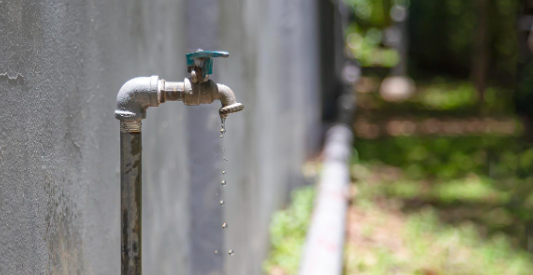
Walk the perimeter of the house and open each outdoor faucet fully. Watch the spigot, the wall penetration, and the handle area while water flows.
- A drip from the spout with the valve fully open means the seat washer has worn or cracked. Winter freeze-thaw cycles accelerate washer degradation, and a washer that was marginal in November may have failed by March.
- Water seeping around the handle stem indicates a packing nut or O-ring failure. Tightening the packing nut a quarter turn may stop the seep, but if the O-ring is cracked, replacement is the durable fix.
- Moisture, staining, or efflorescence on the wall around the hose bib mounting plate is the most serious finding. It suggests that the connection between the hose bib and the supply pipe behind the wall has been compromised, potentially by a freeze event that cracked a fitting or pipe section inside the wall cavity.
That third condition can send water into the wall framing, insulation, and drywall without any visible leak at the faucet itself. The EPA advises drying wet building materials within 24 to 48 hours to prevent mold colonization, so a wall leak that has been seeping since a January freeze may have already created conditions that require remediation beyond just the plumbing repair.
If you have frost-free hose bibs, also known as sillcocks, check that the long stem valve inside the wall is seating properly. These units are designed to shut off water deep inside the heated wall cavity rather than at the exterior face, but they can still fail if the stem washer wears or if the unit was left with a hose attached during freezing weather, which traps water in the valve body.
Walk the irrigation system zone by zone
If your property has an in-ground sprinkler or irrigation system, spring is when you recommission it after the winter shutdown. Turn the controller to manual mode and run each zone individually while you walk the coverage area.
- Look for heads that do not pop up, spray erratically, or produce weak, uneven patterns. Damaged risers, cracked heads, and clogged nozzles are common after a winter of soil movement and debris accumulation.
- Watch for water bubbling up from the ground near a head or along a buried line. Subsurface leaks waste water continuously during every irrigation cycle and saturate the soil around the foundation, which creates a separate set of problems in clay-bearing soil.
- Check for overspray hitting the house, the driveway, sidewalks, or the street. Misaligned heads waste water and direct moisture toward surfaces where it causes damage rather than benefit.
The EPA's WaterSense program recommends inspecting irrigation systems each spring before use to identify frost or freeze damage and notes that an irrigation system with a leak the diameter of a dime can waste approximately 6,300 gallons per month. In Montgomery County, where irrigation seasons run from March through October or later, that leak can waste more than 50,000 gallons before the system is shut down for winter.
Check cleanouts and outdoor drain access points
Your sewer cleanout, typically a capped pipe near the foundation wall, should be visible and accessible at the start of the season. If landscaping, mulch, or soil has buried the cleanout over the winter, clear it now. In an emergency backup, the plumber needs immediate access to this point to begin clearing the line, and a buried cleanout adds delay and cost to every service call.
If your property has outdoor area drains, such as French drains, catch basins, or channel drains along the driveway or patio, flush them with a garden hose to clear accumulated sediment, leaves, and debris from the winter. Clogged area drains cause standing water during spring and summer storms, which directs moisture toward the foundation and can overwhelm the drain system if the blockage is severe enough.
Summer maintenance that prevents heat-related failures and water waste
Summer is the highest-demand, highest-stress season for outdoor plumbing in Montgomery County. Temperatures regularly exceed 95 degrees for weeks at a time, the soil dries and contracts between rain events, and household water consumption surges with irrigation, pool use, car washing, and recreational activity. The maintenance focus in summer is on preventing heat-related component failure, managing water pressure under peak demand, and catching leaks before they waste thousands of gallons.
Protect fixtures and exposed pipe from heat damage
Outdoor plumbing fixtures absorb radiant heat from walls, hardscape, and direct sunlight. In the Montgomery County summer, surface temperatures on south-facing and west-facing walls can exceed 140 degrees, and the hose bibs mounted to those walls absorb that heat directly into their valve bodies.
Sustained heat accelerates the degradation of rubber washers, O-rings, and gaskets inside outdoor valves. A hose bib that sealed perfectly in April may develop a drip by July as the heat hardens and cracks the internal rubber components. Check outdoor faucets again at midsummer, especially those on sun-exposed walls, and replace any washers that show signs of cracking or compression set.
If your property has any exposed PVC or CPVC pipe running along an exterior wall or to an outbuilding, UV exposure is a direct threat. These materials are not UV-rated and will become brittle after prolonged sun exposure, eventually cracking under normal operating pressure. According to the National Institute of Standards and Technology, polymer degradation from UV radiation and thermal cycling is cumulative, and the failure is often sudden rather than gradual. Wrapping exposed plastic pipe with UV-resistant insulation or rerouting it through a shaded path prevents this failure mode entirely.
Monitor water pressure during peak usage
Summer demand peaks can drop water pressure throughout the house when multiple outdoor fixtures, irrigation zones, and indoor fixtures are running simultaneously. A moderate pressure drop under heavy demand is normal. A persistent or worsening pressure decline over the course of the summer is not.
Test your static water pressure with a gauge attached to an outdoor hose bib, with all other water off. A healthy reading falls between 40 and 80 psi. If the reading exceeds 80 psi, the International Plumbing Code requires a pressure-reducing valve, and your system may already have one that needs servicing. If the reading is below 40 psi or has dropped noticeably from a previous measurement, water may be leaving the system through a hidden leak in a yard line, an irrigation pipe, or beneath the slab.
Run the water meter test if the pressure reading raises concern. Turn off every fixture and appliance inside and outside the house, record the meter reading, wait two hours, and check again. If the meter has moved, you have a confirmed leak, and professional leak detection is the next step.
Manage irrigation for efficiency and foundation protection
Overwatering is as damaging as underwatering in Montgomery County's clay-bearing soil. Excess irrigation saturates the soil around the foundation, causing the clay layers to swell and exert lateral pressure on the slab. When the irrigation stops and the soil dries, it contracts, pulling away from the foundation and leaving voids that allow the slab to settle unevenly.
According to the USDA Natural Resources Conservation Service, the Conroe soil series that extends across Montgomery County includes argillic horizons with significant clay content. That clay responds to moisture changes by expanding and contracting, and the effect is most pronounced when the moisture source is localized, as it is with a sprinkler system that waters the same perimeter zones repeatedly.
Water deeply but infrequently, adjust timers to match actual conditions rather than running a fixed schedule, and add a rain sensor if your system does not have one. The goal is to support the landscape without creating the moisture extremes that stress the foundation and the buried plumbing lines running beneath it.
Fall preparation that protects the system before cold weather arrives
Fall is the transition season when you prepare outdoor plumbing for the stresses that winter will bring. In Montgomery County, hard freezes are not annual events, but they do occur every few years, and when they arrive, the damage to unprotected outdoor plumbing can be immediate and severe.
The fall maintenance window, typically October through mid-November, is when you winterize the system, address any deferred repairs, and set the outdoor plumbing up to survive whatever the winter delivers.
Winterize the irrigation system
If your irrigation system has an automatic drain feature, activate it according to the manufacturer's instructions. If it does not, a manual drain or blowout is necessary to clear standing water from the supply line, the valve manifolds, and the lateral pipes running to each head.
Standing water in an irrigation line that freezes can crack PVC pipe, split fittings, and rupture valve bodies. The damage may not become apparent until the system is turned back on in the spring, at which point the first irrigation cycle sends pressurized water through every crack and split, turning hidden damage into active leaks.
A professional blowout using compressed air is the most thorough method for clearing the system. The air pressure must be calibrated to avoid damaging the pipe, which typically means using a compressor regulated to no more than 50 psi for PVC residential systems. If you are unsure how to perform the blowout safely, a plumber or irrigation specialist can handle it in a single visit.
Disconnect and drain outdoor hoses
A garden hose left connected to a hose bib during a freeze traps water in the valve body. Even frost-free sillcocks rely on the water draining out of the valve body after the handle is closed, and an attached hose prevents that drainage. The trapped water freezes, expands, and cracks the valve body or the pipe section immediately behind it inside the wall.
Disconnect every garden hose in the fall. Drain the hoses fully and store them in a protected location. Close the interior shutoff valve for each hose bib if your house has individual shutoffs, then open the exterior faucet briefly to drain any remaining water from the line between the shutoff and the spigot.
This is the single most effective freeze protection step for outdoor plumbing. According to the Insurance Information Institute, water damage and freezing claims are among the most common and most expensive homeowners insurance claim categories in the United States. A disconnected hose and a closed shutoff valve prevent the most common residential pipe freeze scenario entirely.
Inspect and insulate vulnerable pipe runs
Identify any outdoor pipe that is exposed to the elements and cannot be drained for the winter. Common examples include supply lines to detached garages or workshops, outdoor kitchen supply runs, pool equipment supply connections, and any pipe that runs through an uninsulated crawl space or along an exterior wall without conditioned space behind it.
Insulate these pipes with foam sleeves or heat tape rated for outdoor use. The insulation does not need to withstand sustained arctic conditions, but it does need to protect the pipe through the 24- to 72-hour freeze events that hit Montgomery County during occasional winter cold snaps.
Pay special attention to pipe runs on north-facing walls and in areas that are shaded throughout the day during winter. These locations lose heat fastest and are the first to reach freezing temperatures when a cold front moves through.
Winter precautions for the freezes that hit Montgomery County every few years
Montgomery County does not experience prolonged winter cold, but the freezes that do occur are often sudden, dropping temperatures from the 60s into the low 20s or teens within 12 to 24 hours. That rapid transition is harder on plumbing than a gradual cooling because the thermal mass of the soil and the building structure does not have time to buffer the temperature change.
The precautions below apply to every freeze event, regardless of how brief it is expected to be.
Open cabinet doors and maintain heat
When a freeze is forecast, open the cabinet doors beneath kitchen and bathroom sinks on exterior walls. This allows the heated air from the house to reach the supply pipes inside the cabinet, keeping them above freezing even if the wall cavity behind them drops to dangerous temperatures.
Maintain the thermostat at a minimum of 55 degrees throughout the house, even if you are away. Lowering the heat to save energy during a freeze event is a false economy. The cost of running the heater for two days is negligible compared to the cost of repairing a burst pipe and the water damage it causes.
If your home has outdoor plumbing connections that cannot be shut off or drained, such as a supply to an occupied guest house or a livestock watering line, allow the faucet to drip slowly during the coldest hours. Moving water resists freezing, and the small amount of water wasted during a drip is insignificant compared to the damage a frozen pipe produces.
Know where the main shutoff is
If a pipe does freeze and burst, the first action is to shut off the main water supply to the house. The main shutoff valve is typically located where the supply line enters the house, often in the garage, a utility closet, or near the water meter at the street.
Locate the main shutoff now, before you need it. Verify that the valve turns smoothly and shuts off completely. A gate valve that has not been operated in years may be seized, corroded, or unable to close fully. If the valve does not work, replace it before the next freeze. A ball-type quarter-turn shutoff valve is the most reliable residential option and can be installed by a licensed plumber in a single visit.
Responding to a burst pipe
If you discover a burst pipe after a freeze, shut off the main water supply immediately, then open a faucet to relieve remaining pressure in the system. Document the damage with photos for your insurance claim, and call a plumber for repair.
Do not attempt to thaw a frozen pipe with an open flame. A heat gun, a hair dryer, or warm towels applied gradually are the safe methods. A torch or space heater directed at a frozen pipe can cause a fire in the wall cavity or damage the pipe material further.
If the burst is in a supply line inside the wall or beneath the slab, the water damage may be significant by the time it is discovered. Professional water damage restoration should begin within the EPA's 24-to-48-hour mold prevention window to minimize secondary damage.
Year-round habits that extend the life of every outdoor plumbing component
Beyond the seasonal tasks, a few ongoing practices protect outdoor plumbing across all conditions and all seasons. These habits require no scheduled maintenance window. They are simply part of how you use and monitor the system as a homeowner.
Monitor your water bill monthly
Your water bill is the earliest and most reliable indicator of a hidden outdoor leak. A yard line leak, an irrigation pipe crack, or a slow-dripping hose bib that you have not noticed can waste hundreds or thousands of gallons per month, and the bill will show the increase before any other symptom appears.
According to the EPA, the average household wastes roughly 9,400 gallons of water per year from leaks, and ten percent of homes have leaks severe enough to waste 90 gallons or more per day. Comparing your monthly usage to the same month in the prior year gives you a baseline for detecting anomalies, and a sustained increase without a corresponding change in behavior is always worth investigating.
Keep vegetation away from exposed plumbing
Shrubs, ground cover, and vines that grow around outdoor faucets, cleanouts, and meter boxes create two problems. They obstruct access when you need to operate a valve or when a plumber needs to reach the component for service. They also trap moisture against the fixture and the adjacent wall, which accelerates corrosion on metal components and creates a damp environment that can deteriorate mortar, siding, and framing over time.
Maintain a clear zone of at least 12 inches around every hose bib, cleanout cap, and meter box. Trim vegetation back from these access points annually, and redirect irrigation heads so they are not watering directly onto the foundation wall or an outdoor plumbing fixture.
Schedule a professional evaluation every two to three years
Even with diligent seasonal maintenance, some outdoor plumbing conditions require professional tools and expertise to detect. Slow leaks in buried yard lines, early-stage root intrusion in sewer laterals, corroded supply connections behind walls, and failing pressure regulators are all conditions that a homeowner cannot see or test without specialized equipment.
A professional plumbing inspection every two to three years that includes the outdoor system gives you a professional assessment of conditions that are invisible to the untrained eye. For homes with mature trees near the sewer line, a camera inspection of the lateral should be part of that evaluation. For homes with older supply lines or irrigation systems, a pressure test and a visual survey of accessible fittings rounds out the assessment.
The cost of a biennial inspection is a small fraction of the cost of the emergency it prevents. The inspection also creates a documented record of your system's condition that is valuable for insurance purposes, for home sale preparation, and for planning future repairs on your own timeline rather than in response to a crisis.
Conclusion
Outdoor plumbing in Montgomery County operates in an environment that tests it year round. Summer heat degrades seals and drives peak demand. Fall is the window to prepare for winter's unpredictable freezes. Spring reveals whatever damage the cold months caused. And throughout the year, soil movement, root growth, UV exposure, and mineral-laden water all work against every outdoor pipe, valve, and connection on the property.
The maintenance that protects against all of that is not complicated. It is seasonal walk-arounds, targeted component checks, hose disconnection, irrigation system management, pressure monitoring, and periodic professional evaluation. Each task takes minutes. The cumulative effect is an outdoor plumbing system that lasts longer, wastes less water, and stays out of the emergency category.
If your outdoor plumbing has not been evaluated recently, or if you have noticed a pressure change, a rising water bill, or a fixture that is not performing the way it should, call Benjamin Franklin Plumbing of Conroe to schedule an inspection. A professional set of eyes on the system now prevents the costly surprises that show up when the next season shift hits.

 Your Privacy Choices