
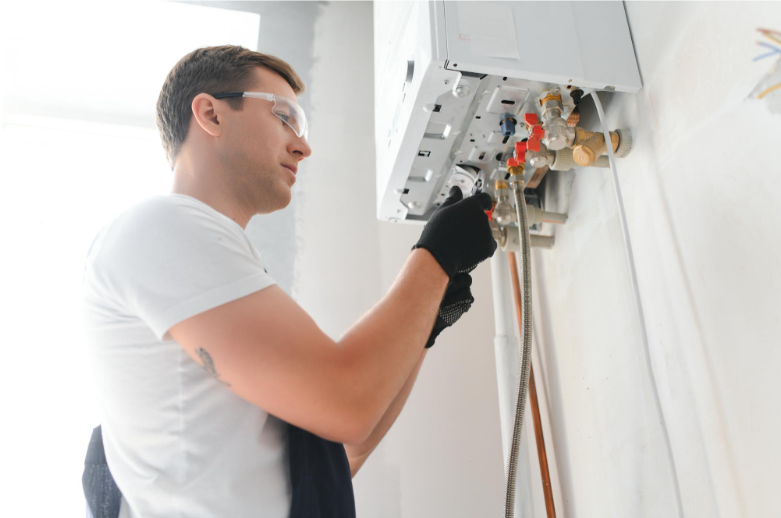
Your water heater runs quietly in the background every day, heating water for showers, laundry, dishes, and everything in between. Most homeowners in Montgomery County do not think about it until the morning they step into a cold shower or find a puddle spreading across the garage floor. By that point, the unit is either failing or already done.
Learning how to extend your water heater lifespan in Montgomery County starts well before that moment, and the steps involved are simpler and cheaper than the emergency replacement they prevent.
According to the U.S. Department of Energy, water heating accounts for roughly 18% of a typical home's energy use, making it the second-largest energy expense after heating and cooling. That share means an inefficient or aging water heater does not just risk a cold shower. It quietly inflates your utility bill month after month.
A tank that should last 10 to 15 years can fail in half that time if sediment, corrosion, and hard water go unchecked, and Montgomery County's water conditions make all three of those threats worse than the national average.
The maintenance tasks that add years to a water heater are not complicated. They take an hour or two per year, cost very little, and pay for themselves in lower energy bills and a longer equipment life. This article walks through each one, explains why Montgomery County's water quality makes them especially important, and covers the warning signs that tell you maintenance is no longer enough.
In this article, you will learn about:
- What Montgomery County water does to a water heater over time
- The annual maintenance routine that adds years to any tank
- Anode rod replacement and why it matters more here than in most areas
- Temperature and pressure settings that protect the tank and your energy bill
- Warning signs that your water heater is nearing the end
Keep reading to get ahead of the most expensive appliance failure most homeowners never see coming.
What Montgomery County water does to a water heater over time
Water quality is the single biggest variable in how long a water heater lasts. Two identical tanks installed on the same day in different locations can have lifespans that differ by five or more years depending on what is in the water flowing through them. In Montgomery County, the water supply draws from the Gulf Coast aquifer system, and the mineral content in that groundwater creates conditions inside the tank that accelerate sediment buildup, corrosion, and efficiency loss.
Understanding what your water does to the tank is the foundation for every maintenance task that follows. If you skip the context and jump straight to flushing, you will do the work but may not do it often enough or thoroughly enough to make a real difference.
Hard water and sediment accumulation
Water hardness in Montgomery County is notably high. Testing by the Texas Commission on Environmental Quality in parts of the county has measured hardness levels around 161 parts per million, or roughly 9.3 grains per gallon. The USGS classifies water above 120 ppm as hard and above 180 ppm as very hard, which puts much of Montgomery County right at or near the upper boundary.
Hard water contains dissolved calcium and magnesium that precipitate out of solution when heated. Inside a water heater tank, those minerals settle to the bottom as a layer of chalky, off-white sediment. A small amount of sediment is normal, but in hard water areas the buildup accelerates significantly.
That sediment layer does two things:
- It insulates the bottom of the tank from the burner or heating element, forcing the unit to work harder and run longer to heat the same volume of water. The thicker the layer, the more energy the heater wastes.
- It traps heat against the bottom of the tank, which accelerates corrosion of the steel lining and weakens the glass or enamel coating that protects the tank wall from direct contact with water.
Over several years, unchecked sediment buildup reduces efficiency, increases operating costs, and shortens the tank's structural life. Homeowners in Montgomery County who flush their tanks annually remove the sediment before it reaches the thickness where damage begins.
Corrosion from dissolved minerals
The same minerals that form sediment also promote electrochemical corrosion inside the tank. Water with a high mineral content is more conductive than soft water, which means the chemical reaction between the steel tank walls and the water accelerates. The anode rod, a sacrificial metal rod designed to corrode in place of the tank, absorbs much of this reaction, but only as long as it has material left to give.
In soft water areas, an anode rod might last five to seven years. In Montgomery County's hard water, the rod degrades significantly faster, sometimes reaching the point of failure in two to three years. Once the rod is consumed, the corrosion shifts to the tank walls, and at that point no amount of flushing or maintenance can reverse the damage.
This is why anode rod inspection and replacement is the single most impactful maintenance task for Montgomery County homeowners, a topic covered in detail in its own section below.
How sediment affects the rest of your plumbing
Sediment does not stay confined to the water heater. When it loosens and breaks free during temperature changes or heavy draw periods, it travels through the hot water lines and into fixtures throughout the house. Faucet aerators clog, shower valves behave erratically, and dishwasher and washing machine inlet screens accumulate debris that reduces flow.
In extreme cases, sediment traveling through the system can partially block supply lines, causing water pressure drops that show up only on the hot water side. If your hot water pressure is noticeably lower than your cold water pressure, sediment in the heater or the hot water lines is a likely cause.
Flushing the tank regularly prevents most of these downstream problems and keeps the entire residential plumbing system running cleanly.
The annual maintenance routine that adds years to any tank
A water heater that receives annual maintenance in Montgomery County can realistically reach 12 to 15 years of service. A unit that gets no attention in this water quality environment often fails between 6 and 8 years. The difference comes down to a short list of tasks that take about an hour once a year and cost almost nothing in materials.
None of these tasks require specialized plumbing knowledge. A homeowner with a garden hose, an adjustable wrench, and a bucket can handle all of them. The only caveat is knowing when to stop and call a professional, which this section also covers.
Flushing the tank to remove sediment
Flushing is the most important annual maintenance task for any tank water heater in a hard water area. The process drains several gallons of water from the bottom of the tank, carrying accumulated sediment out through the drain valve.
Here is the process:
- Turn off the gas supply (for gas heaters) or the circuit breaker (for electric heaters). Never drain a tank while the burner or element is actively heating.
- Connect a standard garden hose to the drain valve at the bottom of the tank and run the other end to a floor drain, a driveway, or a bucket.
- Open a hot water faucet inside the house to break the vacuum and allow the tank to drain freely.
- Open the drain valve and let water flow until it runs clear. The first few gallons will look cloudy or carry visible particles. When the stream clears, the loose sediment is gone.
- Close the drain valve, disconnect the hose, close the hot water faucet you opened earlier, and restore power or gas.
If the water never clears, or if chunks of calcium and mineral come out in pieces rather than fine particles, the sediment has hardened into a thick layer that may need professional removal. A plumber can use a descaling solution or a more aggressive flush to break up compacted deposits that a garden hose cannot move.
The entire flush takes 20 to 30 minutes and should be done at least once a year. Homes with exceptionally hard water, or homes where the water heater has gone several years without a flush, benefit from doing it every six months until the sediment is under control.
After a flush, the heater operates more efficiently because the burner or element can heat water directly through the tank bottom instead of through an insulating layer of mineral deposits. That efficiency gain translates directly to lower energy costs, and over the life of the unit it more than covers the time spent on the maintenance.
Checking the temperature and pressure relief valve
The T&P (temperature and pressure) relief valve is a safety device that opens if the temperature or pressure inside the tank exceeds safe limits. If the valve fails, the tank can overpressure, which in extreme cases leads to a catastrophic failure.
Testing the valve is simple:
- Place a bucket under the discharge pipe connected to the valve (the pipe usually runs down the side of the tank and terminates a few inches above the floor).
- Lift the lever on the valve briefly, then release it.
- Water should flow freely through the discharge pipe while the lever is open and stop cleanly when you release it.
If no water flows, the valve is stuck or blocked. If water continues to drip after you release the lever, the valve is not reseating properly. Either condition means the valve needs replacement, which is a straightforward job for a plumber and an inexpensive part.
A T&P valve that has never been tested is more likely to be stuck than one that is tested annually. Make this part of your annual routine, and do not skip it just because the tank seems to be operating normally.
Inspecting the area around the tank
While you are already at the water heater for a flush and a valve test, take a few minutes to inspect the area around the unit.
Look for these warning signs:
- Moisture, rust stains, or mineral deposits on the floor around the base of the tank
- Corrosion on the fittings at the top of the tank where the cold water inlet and hot water outlet connect
- Scorch marks, soot, or discoloration around the burner area (gas units only)
- A pilot light that burns yellow or orange instead of blue (gas units), which indicates incomplete combustion
- Water stains on the wall behind the tank that might indicate a slow leak from the tank or a fitting
Any of these signs warrants closer investigation. Some, like a yellow pilot light or soot near the burner, are service calls rather than DIY tasks because they involve combustion safety.
Catching a small leak or a corroded fitting during an annual inspection prevents the kind of sudden tank failure that floods a garage, a utility closet, or a laundry room without warning.
Anode rod replacement and why it matters more here than in most areas
The anode rod is the unsung hero of water heater longevity. It is a metal rod, typically magnesium or aluminum, suspended inside the tank from the top. Its sole purpose is to corrode instead of the tank walls. As long as the rod has material remaining, the electrochemical reaction that causes rust targets the rod rather than the steel lining of the tank.
In Montgomery County's hard water, the anode rod works harder and depletes faster than it does in areas with softer water. This makes checking and replacing the rod one of the highest-value maintenance tasks a homeowner can perform, yet it is also one of the least commonly done because most people do not know the rod exists.
How the rod protects the tank
The anode rod works through a process called cathodic protection. The rod is made from a metal that is more electrochemically reactive than the steel tank. When both metals are in contact with the same water, the more reactive metal (the rod) corrodes preferentially, pulling the corrosive reaction away from the less reactive metal (the tank).
This protection continues until the rod is consumed, at which point it can no longer attract the corrosion away from the tank walls. Once the rod is gone, the tank itself becomes the target, and the interior coating starts to break down. Rust forms on the inside, weakens the walls, and eventually produces a leak that is not repairable.
The rod does not fail suddenly. It deteriorates gradually, thinning from the outside in. A rod that started at roughly three-quarters of an inch in diameter may be down to a thin wire after three years in hard water. At that point, it is still providing some protection, but far less than a fresh rod. Replacing it before it reaches the wire stage keeps continuous, full protection on the tank.
When to check and how to tell it needs replacing
For Montgomery County homes on hard water, check the anode rod every two years. If the rod is thinner than half an inch in diameter, heavily coated in calcium, or broken into segments, replace it. If it still has solid material and roughly half its original diameter, it is good for another year.
Checking the rod involves:
- Shutting off the water and power or gas to the heater.
- Locating the hex-head fitting on top of the tank (it may be visible or hidden under a plastic cap).
- Using a 1-1/16-inch socket and a breaker bar to loosen the rod.
- Pulling the rod straight up out of the tank and inspecting it visually.
If the rod is stuck due to mineral buildup on the threads, do not force it with excessive torque, because cracking the fitting can damage the tank. A plumber with the right tools and technique can break a stuck rod free without risking the tank.
Replacement rods are available at hardware stores and plumbing supply houses for roughly $20 to $40. Flexible segmented rods are available for tanks installed in tight spaces where a full-length rod cannot be pulled straight up due to ceiling clearance. The replacement threads into the same fitting, and the entire job, including draining a gallon or two to reduce weight, takes about 30 minutes.
Magnesium versus aluminum rods
Magnesium rods provide stronger cathodic protection but corrode faster, especially in hard water. They are the better choice for most applications, but they may produce a sulfur or rotten-egg smell in water with high sulfate content because the magnesium reacts with sulfate-reducing bacteria.
Aluminum rods corrode more slowly and do not produce the sulfur smell, but they offer weaker cathodic protection. In extremely hard water, an aluminum rod may not deplete fast enough to keep up with the corrosive demand, leaving the tank partially unprotected.
For most Montgomery County homes, a magnesium rod replaced every two to three years offers the best balance of protection and cost. If a sulfur smell develops after a rod change, switching to an aluminum-zinc rod usually eliminates the odor without significantly compromising protection. A plumber familiar with the local water conditions can recommend the right rod material for your specific water chemistry.
Temperature and pressure settings that protect the tank and your energy bill
The thermostat and the incoming water pressure both affect how hard the water heater works and how quickly it wears. Adjusting both to the right levels reduces stress on the tank, lowers energy consumption, and eliminates unnecessary wear on the T&P valve and the internal components.
These are set-and-check adjustments, not recurring maintenance tasks. Get them right once, verify them annually, and they protect the tank around the clock with zero additional effort.
Setting the thermostat to the right temperature
Most water heaters ship from the factory with the thermostat set to 140 degrees Fahrenheit. The U.S. Department of Energy recommends lowering the setting to 120 degrees for most households. That 20-degree reduction delivers several benefits at once:
- It reduces energy consumption by an estimated 3% to 5% for every 10 degrees you lower the setting, which translates to real savings on every utility bill.
- It slows the rate of mineral precipitation inside the tank, because calcium and magnesium drop out of solution faster at higher temperatures. Lower temperature means slower sediment accumulation.
- It reduces the risk of scalding, which is especially important in homes with young children or elderly residents.
- It decreases the thermal stress on the tank walls, fittings, and connections, extending the service life of every component.
The thermostat is usually accessible behind a panel on the front of the tank (gas units) or behind one or two access panels on the side (electric units). Adjust it with a flathead screwdriver and verify with a thermometer at the closest hot water faucet after 24 hours.
Some households need 140 degrees, for example, homes with a dishwasher that does not have an internal heating booster. In that case, the tradeoff is faster sediment buildup and higher energy use in exchange for adequate dishwasher performance. For everyone else, 120 degrees is the better setting.
Checking and managing water pressure
Excessively high incoming water pressure, anything consistently above 80 psi, puts stress on every component in the plumbing system, including the water heater. The T&P valve may weep or cycle unnecessarily, connections fatigue faster, and the tank absorbs higher static loads around the clock.
Montgomery County municipal water pressure varies by neighborhood, time of day, and distance from the nearest pumping station. Some areas consistently run above 80 psi during low-demand periods, especially late at night and early in the morning.
Testing the pressure is easy. A pressure gauge that threads onto a hose bib costs less than $15 at any hardware store. Attach it, turn the faucet on fully, and read the gauge. Take readings at different times of day to capture the range.
If the pressure regularly exceeds 80 psi, a pressure-reducing valve installed on the main supply line protects the water heater, the fixtures, and every connection in the house. This is a one-time installation that a plumber completes in about an hour, and it pays for itself by reducing wear across the entire system.
An expansion tank is also worth considering if your home has a pressure-reducing valve or a backflow preventer on the main line. These devices prevent heated water from expanding back into the municipal supply, which means the expanding water has nowhere to go except into the tank walls and the T&P valve. An expansion tank absorbs that pressure safely.
Warning signs that your water heater is nearing the end
Even with diligent maintenance, every water heater eventually reaches a point where repair is no longer practical and replacement is the smarter investment. Recognizing the warning signs early gives you time to plan, compare options, and schedule the installation on your terms rather than scrambling after a sudden failure.
A well-maintained tank water heater in Montgomery County can last 12 to 15 years. A neglected one may fail in 6 to 8. Regardless of maintenance history, the signs below indicate the tank is approaching or past its functional limit.
Rust-colored hot water
Discolored water that appears only on the hot side, not the cold, points to corrosion inside the water heater tank. This usually means the anode rod is fully consumed and the tank walls are rusting from the inside.
If the unit is relatively young, less than 8 years old, replacing the anode rod and flushing the tank may resolve the discoloration and buy several more years of service. If the unit is older, the interior corrosion has likely progressed too far for a rod change to reverse it, and the rust will continue until the tank develops a leak.
Run the hot water at several fixtures throughout the house to confirm the discoloration is consistent and not isolated to one faucet, which would point to a corroded pipe section or a deteriorating fitting rather than the tank itself.
Rumbling, popping, or banging sounds
A water heater that has accumulated a thick layer of hardened sediment produces audible noise during heating cycles. The sediment traps water beneath it, and as the burner heats the bottom of the tank, the trapped water flashes to steam and pops through the sediment layer. The result is a rumbling, popping, or banging sound that may be loud enough to hear from the next room.
A flush may resolve the noise if the sediment has not hardened into a solid crust. If flushing does not quiet the tank, the sediment is too compacted to remove without professional descaling, and the tank has likely been operating under stress long enough that its remaining lifespan is limited.
Visible leaking from the tank body
Any water pooling beneath the tank or dripping from the side walls, as opposed to dripping from a fitting or valve, means the tank itself has corroded through. This is not a repairable condition. The tank needs to be replaced before the leak worsens and causes water damage to the surrounding area.
Before assuming the leak is from the tank body, check the fittings at the top (inlet and outlet connections), the T&P valve discharge pipe, and the drain valve at the bottom. Leaks at those points are repairable. A leak from the tank wall itself is not.
If you discover a tank leak, shut off the water supply and the gas or electricity to the unit immediately. A plumber can advise on the best replacement option based on your household size, energy source, and whether a standard tank, a tankless unit, or a hybrid heat pump model fits your needs and budget.
Age alone as a factor
Even a water heater that shows no visible symptoms deserves closer attention once it passes the 10-year mark. Internal corrosion may be well advanced without producing discolored water, noise, or visible leaks. The risk of a sudden, catastrophic failure increases with every year beyond the expected service window.
A professional inspection that includes pulling the anode rod, flushing the tank, testing the T&P valve, and checking the combustion components (gas units) gives you a clear picture of how much life the unit has left. That information lets you budget for a replacement on your schedule rather than reacting to a failure on a Saturday morning.
Conclusion
A water heater in Montgomery County faces harder working conditions than most homeowners realize. The hard water that flows through the Gulf Coast aquifer deposits minerals inside the tank every day, and without regular maintenance those deposits shorten the unit's life by years. Flushing the tank annually, replacing the anode rod every two to three years, setting the thermostat to 120 degrees, and keeping an eye on water pressure are small investments of time that pay off in lower energy bills, fewer emergency calls, and a unit that reaches its full service life.
If your water heater is making noise, producing discolored water, or approaching the 10-year mark without recent maintenance, now is the time to act. A flush and an anode rod check can tell you whether the unit has years of life left or whether planning a replacement makes more sense than another season of deferred maintenance.
Benjamin Franklin Plumbing serves Montgomery County homeowners with upfront pricing, 24/7 availability, and the on-time guarantee that keeps your plumbing and your schedule running smoothly. Whether the job is a routine water heater flush or a full replacement, you get a clear diagnosis, honest options, and work that is done right the first time.

 Your Privacy Choices