
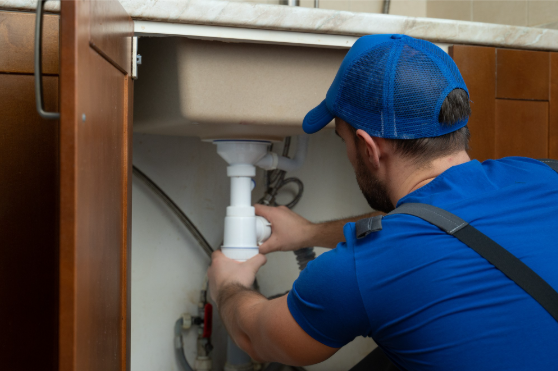
If you are wondering why drains keep backing up in Northland, MO, the answer may be deeper than the fixture that overflowed. A kitchen sink can clog because of grease in its branch drain, but a basement floor drain that rises when a toilet flushes may point to the home's main sewer line.
Older houses add more possibilities. Long-established neighborhoods north of the Missouri River can have mature trees, remodeled plumbing, aging drain materials, shifted joints, low pipe sections, or years of buildup inside lines that still appear to drain normally between incidents.
That is why repeated plunging is not a complete diagnosis. Professional drain cleaning should start by identifying where flow is restricted and whether the pipe itself is contributing to the problem.
In this article, you will learn about:
- How the backup pattern reveals where the problem may be
- Why clogs return in older Northland plumbing systems
- How plumbers distinguish buildup from pipe damage
- Which cleaning, repair, and maintenance steps can reduce repeat backups
Keep reading to understand what your drains are telling you before another slow fixture becomes an unsanitary overflow.
How the backup pattern points to the problem
The fixture where wastewater appears is not always the place where the blockage began. Water follows the available path, so a restriction downstream can force wastewater out of a lower drain elsewhere in the house.
Before using another product or tool, notice which fixtures are affected and what happened immediately before the backup. Those details help separate a local clog from a main-line problem.
One slow fixture usually narrows the search
A single slow sink, tub, shower, or toilet often suggests a restriction in that fixture's trap or branch drain. Hair and soap can accumulate in a bathroom drain, while cooled grease and food residue can narrow a kitchen line.
If nearby fixtures drain normally, the problem may still be limited. A plumber can inspect the affected branch, confirm that the fixture and venting are working properly, and choose an appropriate clearing method.
Common local-clog clues include:
- Water draining slowly from only one fixture.
- A toilet that clogs without affecting a nearby sink or tub.
- Standing water that clears after the fixture is no longer used.
- A sink backup that follows disposal or dishwasher use.
These clues are useful, but they are not guarantees. Separate branches may connect behind a finished wall or below the floor, and an obstruction near that connection can affect fixtures in a pattern that is not obvious from the room layout.
If the same fixture repeatedly slows after it has been cleared, the line may retain residue, have poor slope, or contain a damaged section. The overview of common clogged-drain causes can help identify daily habits, but recurrence deserves a closer look at the pipe.
Several fixtures can indicate a main sewer restriction
When a toilet flush makes a tub gurgle, a washing machine discharge raises water in a floor drain, or multiple fixtures slow together, the restriction may be in a shared drain or the building sewer. That line carries wastewater from the home toward the public sewer or private treatment system.
The lowest open drain often shows the problem first. In a Northland home with a basement, that may be a shower, utility drain, toilet, or floor drain rather than the upstairs fixture that released the water.
Stop running water when multiple fixtures are backing up. Every flush, shower, dishwasher cycle, and laundry load sends more volume toward a line that may already be full.
A plumber who handles clogged drains can determine whether the restriction is in a branch, a shared interior line, or the main sewer lateral. If sewage is actively entering living space, request emergency plumbing service and keep people and pets away from the affected area.
Rain-related backups need careful separation
A backup during or after heavy rain does not prove that stormwater entered through the roof or foundation. Groundwater can enter damaged sanitary pipes through cracks and open joints, while an improperly connected sump pump or drain can also add flow where local rules do not allow it.
Public wastewater systems also differ across the Northland. A North Kansas City utility document says the city has two sanitary sewer lift stations, at Bedford and 19th Avenue, that pump its sewage before Kansas City, Missouri, provides final wastewater treatment.
Timing still matters. A backup that occurs only during wet weather may justify checking the private lateral, cleanout, foundation drainage, and utility conditions. A blockage that also returns during dry weather points more strongly toward restricted flow or structural trouble on the private side.
Do not route a sump pump into a sanitary drain as a quick fix. Have the discharge arrangement reviewed for the property, and ask the local wastewater utility whether a public-system incident was reported at the time of the backup.
Why clogs return in older Northland plumbing
An older pipe is not automatically a failed pipe. However, age gives residue, corrosion, root entry, soil movement, and past alterations more time to change the inside of the drain system.
Recurring backups usually happen because the previous response removed only enough material to restore temporary flow, or because a structural condition keeps creating a place for debris to collect.
Buildup reforms when the pipe is not fully cleaned
A cable may open a path through a soft obstruction without removing material adhered around the pipe wall. Grease, soap residue, sludge, mineral scale, food particles, and paper products can then catch new waste and close the opening again.
An EPA report based on reported sanitary sewer events found that 74% of overflow causes were blockages among communities reporting more than 100 events in one year. Within reported blockage events, grease accounted for 47%, grit and other debris for 27%, roots for 22%, and a grease-root combination for 4%.
Those municipal figures do not predict the cause inside one house, but they show why material matters. A recurring kitchen backup calls for different questions than a root-filled yard lateral.
Avoid pouring fats, oils, and grease into the sink, even with hot water. Do not flush wipes, hygiene products, paper towels, or other items simply because packaging suggests they can pass through a toilet.
Roots exploit joints and defects
Tree roots do not crush every sewer pipe they approach. They are more likely to enter through an existing joint gap, crack, or defect where moisture and nutrients are available, then expand inside the line and catch waste.
This is especially relevant on established lots with mature landscaping and older laterals. Cutting roots can restore flow, but it does not seal the opening that allowed them into the pipe.
Warning patterns can include:
- Backups that return after a predictable interval.
- Gurgling or slowing across several fixtures.
- Root fragments recovered during mechanical cleaning.
- A camera image showing root masses at joints or cracks.
- Depressions, unusual moisture, or sewage odor along the lateral route.
Surface signs alone cannot establish the diagnosis. Wet ground may come from irrigation, runoff, groundwater, or a supply-line leak, and healthy trees may stand near an intact sewer.
When several indicators overlap, review the signs of sewer-line trouble and arrange a camera inspection after access is restored. A visible defect may require sewer line repair rather than repeated root cutting alone.
Pipe shape and past remodeling can create traps
Wastewater depends on a continuous route and appropriate slope. A belly in the line can hold water and solids, an offset joint can snag paper, and a partially collapsed section can restrict flow even after loose debris is removed.
Interior changes also matter. A remodeled kitchen or bath may connect to older piping with different diameters, fittings, or alignment. An abandoned section, poor transition, or undersized branch can turn normal use into a recurring problem.
Drain material influences the inspection, but the material name alone does not decide the remedy. Cast iron can develop internal scaling, clay can separate at joints, and plastic can be damaged or poorly supported. The actual condition and location of the defect matter more than an assumption based on age.
Older-home experience is one reason to use a provider equipped for broad residential plumbing diagnosis. If the backup is connected to one remodeled room, the evaluation may also need to cover its bathroom plumbing or kitchen branch configuration.
How plumbers find and correct the actual cause
The goal is not simply to make standing water disappear. A durable result identifies the obstruction, restores an appropriate opening, and determines whether the surrounding pipe can keep carrying waste.
The order of work depends on access and severity. A camera cannot see through opaque sewage or a dense blockage, so the line may need to be opened before its condition can be evaluated.
Diagnosis starts with the system map and symptoms
A plumber may ask which fixture backed up first, whether the event followed rain, which appliances were running, and how previous clearing was performed. The location of cleanouts, basement fixtures, additions, and large trees helps establish the probable route of the drain and lateral.
Testing may involve running fixtures in a controlled sequence, observing the cleanout, checking accessible piping, and comparing the response at different elevations. The technician should also distinguish sewage from clean-water leakage before opening a sewer line.
Prepare these details for the visit:
- List every slow, gurgling, or backed-up fixture.
- Note the water use that immediately preceded the event.
- Record whether the problem occurred during dry or wet weather.
- Locate prior invoices, camera recordings, or repair diagrams.
- Identify recent remodeling, excavation, or tree work near the line.
This history can shorten the search, but it does not replace inspection. Two backups that look alike at the floor drain can have different causes several feet apart.
Benjamin Franklin Plumbing® of Kansas City provides plumbing repair across the metro. The diagnosis for a home in Kansas City, MO should still be tied to that property's layout and utility connection rather than to a metro-wide assumption.
Clearing and camera inspection answer different questions
Mechanical cabling can break through many localized obstructions and retrieve some roots or debris. Hydrojetting uses controlled high-pressure water to remove material from more of the pipe wall, but it is not appropriate for every pipe condition.
A camera inspection shows visible roots, cracks, offsets, corrosion, standing water, and collapse after the line is clear enough to see. It also helps locate a defect from the surface and document whether cleaning removed the restriction.
The correct sequence depends on risk. Forcing powerful equipment through a severely deteriorated or collapsed line can worsen damage, so the plumber should consider the material and condition before selecting a cleaning method.
Store-bought chemicals do not show why a drain is blocked and may expose occupants or technicians to caustic material. The risks of chemical drain cleaners are especially relevant when a line may need mechanical service.
Structural defects need a repair plan
Cleaning is a maintenance or blockage-removal service. It cannot close a crack, raise a belly, reconnect a separated joint, or rebuild a collapsed pipe.
When inspection finds damage, the repair plan should identify the defect's location, length, material, depth, access constraints, and connections. A targeted excavation may fit an isolated problem, while more extensive deterioration can justify replacing a longer section.
Trenchless sewer work may reduce surface excavation for qualifying lines, but it is not a universal answer. The existing pipe geometry, severity of collapse, access, branch connections, and local requirements determine whether a trenchless method is feasible.
Ask for the camera findings and the reason behind the proposed scope. A sound recommendation should connect the observed defect to the recurring symptom and explain what follow-up verification will confirm that the line is flowing correctly.
How Northland homeowners can reduce repeat backups
Prevention begins with a diagnosis-based schedule, not a universal promise that every drain needs the same treatment. A house with a sound modern lateral and careful drain use has different needs from an older property with recurring root entry.
Homeowners also need to know where private maintenance ends and public utility responsibility begins. The boundary and reporting process can vary by municipality and by the specific connection.
Match maintenance to the known risk
Keep records of cleaning dates, recovered material, camera findings, repaired sections, and symptoms. The interval between repeat events can reveal whether buildup is gradual, roots are regrowing, or a defect remains unresolved.
Gladstone's public approach illustrates the value of planned maintenance at a much larger scale. A 2023 city action stated that Gladstone cleans about 25% of its sanitary sewer collection system, or 150,000 linear feet, each year using contractors and city staff.
A homeowner's schedule will not mirror a municipal program, but the principle carries over: inspection and cleaning are most useful when they reflect system history and condition. Maintenance should be more deliberate when a line has known root entry, recurring grease, limited slope, or older materials.
The local Kansas City plumbing team notes that many homes benefit from annual professional drain cleaning, with more frequent attention possible for older pipes, large trees, or recurring slow drains. Use that as a discussion point, then adjust the interval to the actual findings at your home.
Change what enters the drain system
Drain care is not complicated, but consistency matters. Keep grease in a container for disposal, use sink strainers, remove hair from accessible stoppers, and put wipes and hygiene products in the trash.
Run only the waste and paper the system is designed to carry. A garbage disposal does not make grease, fibrous food, coffee grounds, bones, or large food loads harmless to the branch drain.
Watch for early changes between scheduled visits:
- A fixture drains more slowly than it did the previous week.
- A toilet bubbles when another fixture empties.
- Sewer odor appears near a drain or cleanout.
- The lowest drain reacts to laundry or dishwasher discharge.
- A recently cleared line begins repeating the same pattern.
Acting at the slow-drain stage gives the plumber more options than waiting for sewage to cross the floor. It also makes it easier to test the system without an active overflow limiting access.
Seasonal home plumbing maintenance can include checking accessible drains and cleanouts. Moisture that does not contain sewage may need separate leak repair rather than drain cleaning.
Know who to call and what to document
If neighboring properties are affected at the same time or wastewater is emerging from a public manhole, report the condition to the appropriate utility. If only your house is affected, a plumber can evaluate the private system while the utility confirms whether it has a known public-side issue.
Service rules are address-specific across the Northland. Homeowners in Gladstone may deal with different utility contacts, permit procedures, and responsibility boundaries than nearby jurisdictions.
The same address-specific checks apply in Riverside and other communities north of the Missouri River. The Northland is a connected region, but it is not a single sewer utility or permitting authority.
Photograph the affected fixtures from a safe distance, note the time and weather, save cleanup and service records, and request copies of inspection footage. Do not enter a sewage-contaminated area to improve the documentation.
Once the cause is confirmed, compare the necessary scope rather than choosing from a generic menu. Current special offers may affect cost, but the selected service still needs to address the documented blockage or defect.
Conclusion
Repeated backups are a pattern, not a diagnosis. The number of affected fixtures, the lowest point that overflows, the timing around rain or water use, and the interval after prior cleaning all help identify where the investigation should begin.
In older Northland homes, the lasting answer may be thorough cleaning, root removal, a focused pipe repair, or a larger sewer correction. A camera-based evaluation after flow is restored can show whether the line is clean and intact or whether a defect will keep catching waste.
Good drain habits and condition-based maintenance can reduce avoidable clogs, but they cannot repair a separated joint or collapsed section. When symptoms return, use the history to move beyond another temporary opening and toward a documented solution.
For ongoing plumbing maintenance, priority scheduling, and repair benefits, join Benjamin Franklin Plumbing® of Kansas City through its Club Membership Program.

 Your Privacy Choices