Comparing trenchless vs. traditional sewer repair in Johnson County, KS, is not as simple as choosing less digging or more digging. The right method depends on what the camera shows, whether the existing pipe can support rehabilitation, and what sits above and around the damaged line.
Trenchless methods can renew or replace a sewer lateral through limited access points. Traditional repair exposes the affected pipe in an open trench, giving the crew direct access to defects, connections, changes in grade, and surrounding soil.
Both approaches have a place in residential work. A professional sewer line repair recommendation should connect the method to the actual defect, the route of the lateral, local requirements, and the homeowner's priorities.
In this article, you will learn about:
- How do trenchless and traditional sewer repairs differ?
- Which property conditions determine the better method?
- How do disruption, cost, and service life compare?
- What should Johnson County homeowners do before deciding?
Keep reading to understand where each method performs well and what evidence should guide the final choice.
How do trenchless and traditional sewer repairs differ?
Traditional excavation removes soil above the damaged section so a plumber can see, remove, and replace the pipe. Trenchless work uses the existing route and one or more access points to install a liner or pull replacement pipe with much less surface excavation.
“Trenchless” is an umbrella term, not one procedure. Benjamin Franklin Plumbing® of Kansas City offers trenchless sewer repair, but the specific technique still has to match the pipe's material, shape, structural condition, and connections.
What happens during traditional open-trench repair?
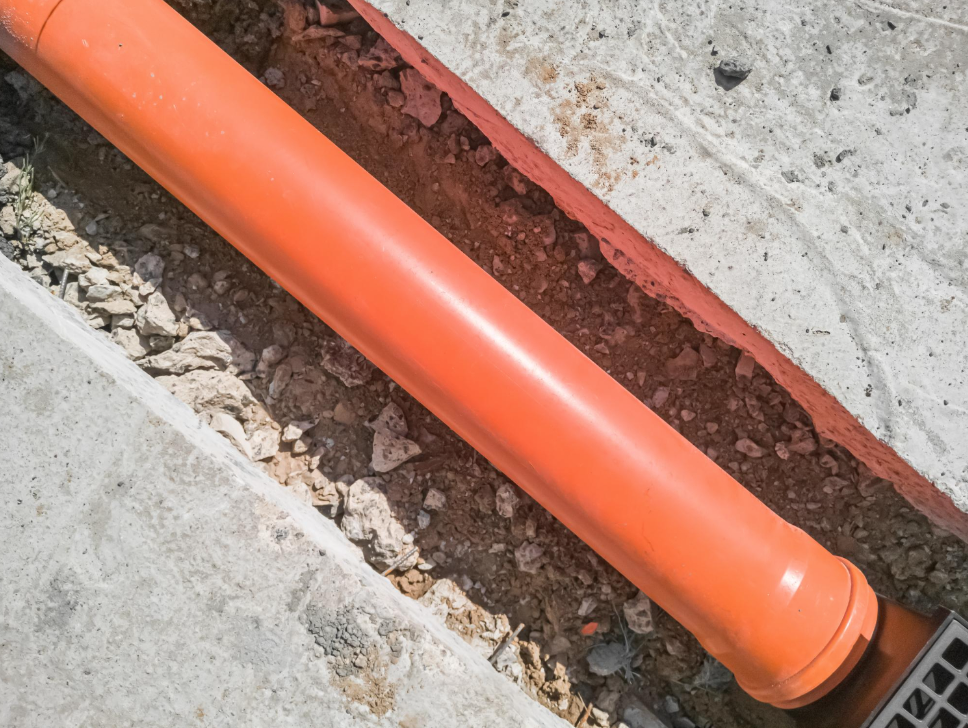
Open-trench work begins by locating the damaged section and marking nearby utilities. The crew then excavates above the pipe, removes the failed material, installs the replacement, reconnects the line, and tests the completed work.
The visible access is the method's greatest strength. It allows direct correction of a collapsed section, severe offset, poor bedding, improper slope, or configuration that cannot be addressed from inside the existing pipe.
- Confirm the defect and repair limits with inspection and locating.
- Identify utilities, access restrictions, and permit requirements.
- Excavate the pipe and stabilize the work area.
- Remove or repair the damaged section and rebuild connections.
- Test the sewer line before backfilling the trench.
- Restore the excavated surface according to the agreed scope.
The amount of excavation depends on whether the repair is local or the full lateral needs replacement. A single failed section in open lawn is a different project from a line beneath a driveway, patio, mature landscaping, retaining wall, or finished addition.
Surface restoration must be discussed before work begins. Soil and basic backfill may be part of the plumbing scope, while concrete, paving, irrigation, sod, specialty landscaping, or structural work may require separate arrangements.
How does cured-in-place pipe lining work?
Cured-in-place pipe, commonly shortened to CIPP, places a resin-saturated liner inside the cleaned host pipe. The liner is shaped against the inside of the existing line and cured, creating a new pipe within the old route.
Lining can bridge cracks and leaking joints while reducing the need to excavate the full alignment. It normally requires the host pipe to be cleaned and prepared well enough for the liner to fit and cure as designed.
That requirement matters. A severely collapsed pipe, major change in alignment, incompatible diameter transition, or condition that prevents preparation may make lining impractical without preliminary excavation or another method.
An EPA retrospective study reported that, at the time of its evaluation, CIPP liners had been in service for up to 30 years in the United States and nearly 40 years in the United Kingdom. That history supports the technology's established use, but it does not guarantee the life of a particular residential installation.
How is pipe bursting different from lining?
Pipe bursting replaces the old pipe rather than forming a liner inside it. A bursting head travels through the existing alignment, breaks or displaces the old pipe outward, and pulls new pipe into place behind it.
This method can be useful when the old lateral needs full replacement and the route can accommodate the bursting process. It still requires access pits, reconnection of the home and main, and enough clearance from neighboring utilities and structures.
The EPA's pipe bursting fact sheet documents applications across existing pipe diameters from 2 to 48 inches and pull lengths exceeding 1,000 feet. Those figures show the method's broader technical range, not the size or length that will be appropriate for a Johnson County home.
Pipe material, soil, depth, nearby utilities, bends, previous repair fittings, and the ability to pass a pulling cable can all limit the method. Some obstacles may require an access excavation even when most of the alignment remains trenchless.
Which property conditions determine the better method?
A sewer camera inspection gives the plumber a view inside the lateral, but a sound decision uses more than video alone. The line also has to be located, the depth and route confirmed, and the observed defect interpreted in the context of flow, grade, access, and property features.
Johnson County's mix of established neighborhoods, remodeled homes, mature trees, and newer development creates varied sewer conditions. A method that protects landscaping in one yard may be unnecessary in another, while a line beneath hardscape may make reduced excavation especially valuable.
Is the existing pipe suitable for rehabilitation?
Lining relies on a host route that can be cleaned and prepared. Longitudinal cracks, leaking joints, small gaps, and root-entry points may be candidates when the pipe retains a workable shape and alignment.
A complete collapse, pronounced belly, severe offset, or section with the wrong slope often requires direct correction or replacement. A liner follows the available route, so it cannot lift a sunken pipe back to the proper grade.
Pipe bursting is less dependent on the old pipe remaining structurally sound, but it has its own constraints. The pulling path, soil response, existing material, nearby utilities, and connections must support safe replacement.
Some recurring blockages begin with grease, debris, or improper items in the line, while others are symptoms of structural damage. Understanding the common causes of clogged drains helps explain why clearing and repairing are not interchangeable services.
This is why recurring symptoms should not be treated as proof that one method is best. Sewer line trouble can originate from roots, buildup, a local break, poor alignment, or failure across a longer section, and each finding changes the repair options.
What sits above and beside the lateral?
The route may pass beneath lawn, mature trees, fences, driveways, patios, utility crossings, or an addition. Trenchless repair becomes more attractive when full excavation would disturb high-value or difficult-to-restore surfaces.
Traditional work may still be efficient when the failed section is shallow, short, and easy to reach. Direct excavation can also avoid forcing a trenchless method through a site where nearby utilities, obstructions, or ground conditions create additional risk.
Local layout matters in established communities such as Prairie Village, where mature landscaping and decades of improvements may sit over the original lateral. The crew needs a current view of the property rather than relying on assumptions based on the neighborhood.
Homes in Leawood can present similar questions about hardscape, additions, and established trees. Each route still needs to be located and evaluated on its own.
Utility locating is necessary for both approaches. Pipe bursting can displace material outward, while open excavation can expose multiple buried systems, so known and private utilities must be addressed in the work plan.
What should the inspection establish first?
The inspection should show where the defect begins and ends, whether the pipe holds standing water, and how many connections or direction changes affect the repair. It should also identify material transitions and prior patches when the camera can reach them.
A useful proposal connects those findings to the recommended method. Before comparing prices, homeowners should understand the evidence behind each option.
- The pipe material, diameter, depth, and approximate route.
- The defect type and its exact location or length.
- Whether the pipe is open enough to clean and prepare.
- The presence of bellies, offsets, bends, transitions, or prior repairs.
- The location of utilities, structures, trees, and hardscape.
- The access pits, trench length, and restoration each option requires.
- Permit, inspection, and connection requirements.
Camera footage is most valuable when it is paired with a clear explanation. Ask the plumber to identify the defect on screen and show how it supports lining, bursting, a spot repair, or conventional replacement.
If roots or buildup block the view, professional drain cleaning may be necessary before the full condition can be evaluated. Clearing flow is not the same as repairing a cracked or failed pipe, so the post-cleaning inspection matters.
Chemical drain cleaners cannot correct roots, a collapsed lateral, bad grade, or separated joints. Repeatedly pouring chemicals into a line can delay the inspection needed to identify the actual failure.
How do disruption, cost, and service life compare?
Trenchless work often reduces excavation, but reduced digging does not mean no digging, no restoration, or automatic savings. Access pits, cleaning, bypassing, equipment setup, reconnections, and curing or pullback all contribute to the project.
Traditional repair can create more visible disruption, yet it may be the more direct and economical choice for a short, accessible defect. The best comparison uses complete scopes for two methods that can both solve the diagnosed problem.
Which method is easier on the yard and hardscape?
Trenchless repair generally confines surface work to access points instead of opening the entire pipe route. That can preserve more lawn, landscaping, pavement, and outdoor living space.
The EPA notes that trenchless rehabilitation can reduce surface disturbance, traffic detours, tree removal, construction noise, and emissions from construction equipment compared with traditional dig-and-replace work.
“Reduced” is the accurate word. Entry and exit pits may still affect the yard, and a connection, obstruction, or unexpected condition can require targeted excavation.
Traditional repair provides a clear restoration footprint. When the route runs through open lawn and the damage is localized, that footprint may be acceptable and easier to plan than specialized trenchless setup.
Is trenchless sewer repair always faster or cheaper?
No. Trenchless work may shorten excavation and restoration, but the total schedule still depends on inspection, cleaning, permitting, materials, equipment availability, access, curing, reconnection, and final testing.
Cost comparisons should include the surfaces affected by each method. A lower plumbing price followed by extensive driveway or landscape replacement may cost more overall, while a simple open-trench repair in an accessible yard may beat a trenchless alternative.
Ask for comparable scopes rather than a price per foot alone. One proposal may include full replacement and testing, while another may cover a shorter rehabilitation segment with separate access or restoration costs.
Current special offers may apply to qualifying services, but they should not determine the repair method. The pipe condition and a complete long-term solution come first.
How long should a repaired sewer line last?
Service life depends on product design, installation quality, pipe preparation, soil, groundwater, loading, connections, and future use. A broad marketing claim cannot substitute for the specifications and warranty attached to the proposed system.
For context, an EPA-supported performance assessment reported that samples from nine North American cities indicated properly designed and installed CIPP should meet or likely exceed a typical 50-year expected design life. Homeowners should treat that number as industry context, not a guarantee for every liner.
New pipe installed through bursting or excavation also depends on material, bedding, connections, and site conditions. The contractor should explain the selected pipe, applicable standards, workmanship coverage, and manufacturer warranty.
The most durable choice is the method that corrects the actual failure. A well-installed liner cannot fix poor grade, and a new excavated section will not solve a separate defect left farther down the lateral.
What should Johnson County homeowners do before deciding?
Start by confirming whether the problem is in the private lateral or the public system. Several slow drains in one home may suggest a lateral problem, while similar issues at multiple nearby properties can justify contacting the sewer utility.
An active sewage backup deserves prompt attention. Stop using affected fixtures and contact the team about emergency plumbing service and the earliest available appointment.
The county's wastewater infrastructure provides important context. Johnson County Wastewater reports serving more than 500,000 customers across 16 cities and more than 172 square miles, with over 2,300 miles of sewer mains, 42 miles of force mains, and 32 pump stations.
Who is responsible for the service lateral?
Johnson County Wastewater explains that the pipe connecting a home to the public sanitary sewer main is private property. The homeowner is responsible for maintaining, repairing, and replacing that lateral and its connection to the public main.
The county's Roots in Lateral Program identifies open-cut repair and cured-in-place lining as options for private laterals. It also recommends a CCTV inspection by a licensed plumber when roots or damage are suspected.
Responsibility can differ when the defect is in the public main or another utility's infrastructure. Confirming the location before authorizing major work helps prevent confusion about which party should respond.
Homeowners in Overland Park and other JCW-served communities should contact the appropriate wastewater provider when the evidence points beyond the private lateral. Not every address in Johnson County is necessarily served by the same utility.
Are permits and inspections required?
Johnson County Wastewater states that a sewer repair permit is required for a damaged or collapsed service line. Its residential permitting guidance also says the sewer repair permit has no fee, although related street restoration or local requirements may still apply to a particular project.
The permit application calls for the property information and contact details for the owner, applicant, and exterior plumber. That is one reason to ask who will obtain the permit and coordinate inspections before work starts.
Requirements can vary by wastewater provider, city, right-of-way involvement, and exact scope. A project that affects a street, sidewalk, public connection, or other regulated area may need more coordination than work contained entirely on private property.
Do not treat a no-fee county sewer repair permit as proof that the project has no administrative or restoration costs. The proposal should identify which approvals are included and who is responsible for each one.
What questions help you choose confidently?
Ask the plumber to show where the line failed and explain why each proposed method can or cannot correct it. A homeowner should not have to choose between “trenchless” and “traditional” based only on a sales label.
The comparison becomes clearer when both proposals describe access, restoration, testing, warranties, and exclusions in the same level of detail.
- Is the pipe structurally suitable for lining?
- Can pipe bursting follow the current route without risking nearby utilities?
- Does the line have a belly, offset, collapse, or grade problem that requires excavation?
- How many access pits or how much open trench will be needed?
- Which surfaces will be disturbed, and who restores them?
- How will branch connections and the public-main connection be handled?
- What permits, inspections, testing, and warranties are included?
If the diagnosis supports more than one method, compare the total property impact and expected result, not only the initial plumbing price. The least disruptive option is valuable only when it also resolves the defect reliably.
An experienced residential plumbing team should be willing to explain the tradeoffs in plain language and document the agreed scope before work begins.
Conclusion
Trenchless sewer repair can protect more of the yard and hardscape, while traditional excavation provides direct access to conditions that a liner or bursting head cannot correct. Neither method is automatically better for every Johnson County property.
The decision should follow camera findings, locating, pipe condition, grade, soil, utility clearances, connections, access, and restoration needs. A complete proposal makes those factors visible and explains why the recommended method fits the line.
Homeowners should also confirm ownership, permits, inspections, and the boundary between plumbing work and surface restoration. Those details turn a broad method comparison into a realistic project plan.
For routine plumbing checks, priority scheduling, and member repair benefits, review the Benjamin Franklin Plumbing® of Kansas City Club Membership Program.

 Your Privacy Choices