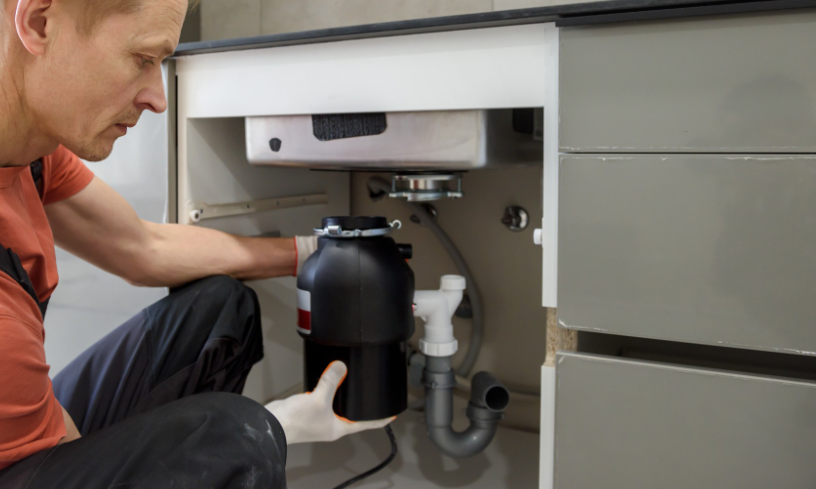
A garbage disposal is one of those appliances nobody thinks about until it stops working, and then it becomes the only thing on your mind. One day it is quietly grinding through dinner scraps, the next it is humming at you and refusing to spin, or worse, leaking onto everything stored under the sink.
Kansas City homes run their disposals hard. Between weeknight cooking, holiday gatherings, and the occasional potato peel nobody should have sent down there in the first place, these units take a beating year-round. Most problems fall into a short list of predictable causes, and knowing which one you are dealing with changes whether a fix takes five minutes or requires a new unit entirely.
Benjamin Franklin Plumbing of Kansas City has been in homes across the metro since 1955, and disposal calls are some of the most common service requests the team handles. This guide walks through what actually goes wrong with a garbage disposal, what you can safely troubleshoot yourself, the warning signs that mean it is time to stop poking around under the sink, and what a proper installation actually involves.
In this article, you will learn about:
- Why garbage disposals jam, hum, or stop working
- Warning signs that mean it is time to call a plumber
- What is safe to put down a disposal, and what ruins one
- Choosing and installing a new garbage disposal the right way
Keep reading to find out whether your disposal needs a quick reset or a full replacement, and what to expect either way.
Why garbage disposals jam, hum, or stop working
Most disposal complaints trace back to one of three things: a mechanical jam, an electrical issue, or a plumbing problem downstream of the unit. Sorting out which category applies is usually the fastest way to figure out whether this is a homeowner-fixable problem or a call to a plumber.
The disposal itself is a fairly simple machine. A motor spins a plate lined with metal impellers, and centrifugal force throws food waste against a shredding ring until the particles are small enough to flush through the drain with running water. When any part of that chain gets interrupted, the whole system backs up.
Below are the three most common failure patterns homeowners run into, roughly in order of how often Benjamin Franklin techs see them on service calls across Kansas City, Overland Park, and Lee's Summit.
The disposal hums but will not spin
A humming disposal that will not turn usually means the motor is receiving power but the impeller plate is physically stuck, most often on a fibrous object like a fruit pit, a piece of bone, or a wad of potato peels. The motor tries to engage and stalls against the obstruction, which produces that low buzzing sound instead of the normal grinding noise.
This is almost always a jam, not a dead motor, which is good news because jams are frequently fixable without a service call. Turn off the disposal and the switch at the wall first. Never reach into a disposal with your hand, even when it is unplugged, since the blades stay sharp regardless of power state.
Most units have a hex-shaped hole on the bottom of the housing, accessible from underneath the sink. A disposal wrench, or a standard 1/4-inch hex key in a pinch, fits into that hole and lets you manually rotate the impeller plate back and forth to work the jam loose. Once it spins freely in both directions, restore power and try running it briefly with cold water.
The disposal does not turn on at all
Silence when you flip the switch points toward an electrical problem rather than a jam, and there are a few usual suspects. Nearly every disposal has a small red reset button on the underside of the unit that trips when the motor overheats, and pressing it firmly often resolves the issue instantly.
If the reset button does not bring it back, check the circuit breaker next, since disposals sometimes share a circuit with the dishwasher and a simultaneous load can trip it. A disposal that stays completely dead after a reset and a breaker check usually has a failed motor, a bad internal switch, or a wiring problem, and at that point it is a job for a licensed plumber rather than a homeowner project.
Electrical faults inside a disposal are not a homeowner repair, since the unit sits on a dedicated circuit tied directly into the home's wiring. Attempting to open the motor housing to chase a wiring fault risks a shock and typically voids whatever warranty remains on the unit anyway.
The disposal runs but water backs up or leaks
A disposal that spins normally but leaves standing water in the sink, or drips underneath, points to a plumbing issue rather than a motor problem. Leaks typically come from one of three spots: the sink flange where the unit mounts, the dishwasher connection, or the discharge pipe leading to the drain trap.
A slow drain with the disposal running usually means a clog further down the line, not a disposal failure at all, and running the unit longer only pushes ground waste deeper into a pipe that is already struggling to keep up. Persistent leaks near the mounting flange often mean the plumber's putty seal has dried out and needs to be redone, which is straightforward on a newer unit but is frequently a sign of age on an older one.
A quick way to narrow down a leak's source is to dry every visible connection point with a paper towel, then run the disposal briefly and check each spot again. Whichever connection shows moisture first is almost always the actual source, rather than the point where water eventually pools lowest in the cabinet.
Warning signs that mean it is time to call a plumber
Not every disposal problem is a five-minute fix, and knowing when to stop troubleshooting saves both time and water damage. A few patterns consistently mean the unit needs professional attention rather than another round of the reset button and the hex wrench.
Grinding metal-on-metal sounds, rather than the normal chopping noise, usually mean the impellers have come loose from the plate or something metal made it into the chamber. Continuing to run a disposal in that condition risks damaging the motor housing itself, turning a repairable problem into a full replacement.
A persistent burning smell after use is one of the clearer signals that the motor is overheating repeatedly, even if the reset button keeps bringing it back online. Watch for these patterns specifically:
- Humming with no rotation that does not clear after manually freeing the impeller plate
- Repeated tripping of the reset button within the same day
- Water pooling under the sink cabinet after normal use
- Rust-colored water or visible corrosion on the unit's housing
- A disposal older than 10 to 12 years showing any of the above
Corrosion and age
Corrosion is a particularly reliable sign of a unit near the end of its life, since most standard disposals are rated for roughly 8 to 12 years of typical household use before internal seals and bearings start failing. Rust visible on the outer housing usually means moisture has already been sitting against the metal for some time.
Once a unit is leaking from the housing itself rather than a fitting, replacement is almost always more cost-effective than repair. A leaking housing means the internal seal separating the motor compartment from the wet side of the unit has failed, and that seal is not something a technician replaces piecemeal.
Repeated breaker trips or reset failures
A disposal that trips its reset button or the household breaker more than once in the same day is telling you something specific: the motor is drawing more current than it should, usually because it is straining against a partial jam or a failing bearing. One trip after grinding something tough is normal. Repeated trips without an obvious cause are not.
Continuing to reset and restart a motor that keeps tripping accelerates the wear on the windings inside it, and that pattern tends to end in a full motor failure rather than a gradual decline. At that point, a technician can usually tell within a few minutes whether the fix is a simple part or a full unit.
When standing water points elsewhere
Standing water that will not drain even after the disposal runs is often mistaken for a disposal problem when the real issue sits further down the line. If a plunger and a manual impeller check both fail to clear things up, that points to a clog or a deeper sewer line problem beyond the disposal's reach.
Pushing more ground food into a stuck pipe only makes the eventual cleanout more difficult, since it adds volume to whatever is already blocking the line. A technician with a camera can usually confirm within minutes whether the blockage sits in the branch line under the sink or further out toward the main.
What is safe to put down a disposal, and what ruins one
Disposals handle a surprisingly narrow range of food waste well, and the gap between what people assume is fine and what actually is fine causes a large share of the drain cleaning calls Benjamin Franklin Plumbing runs across Kansas City and Lee's Summit. Understanding that gap prevents most jams before they start.
Soft food scraps, small bits of cooked vegetables, and citrus peels in small quantities all grind down without much trouble, and running cold water before, during, and after use keeps waste moving through the trap instead of settling in the pipe. Cold water also helps solidify any incidental grease so it grinds into small pieces rather than coating the pipe walls.
Foods that cause jams and clogs
The items that cause the most damage tend to be the ones that seem harmless. Here is what consistently causes jams, motor strain, or downstream clogs:
- Fibrous vegetables like celery, corn husks, and onion skins, which wrap around the impeller instead of shredding
- Starchy foods like pasta, rice, and potato peels, which expand and turn into paste that clogs the trap
- Coffee grounds, which accumulate into dense, sludge-like buildup over time
- Bones, fruit pits, and eggshell membranes, which are hard enough to damage the impeller blades
- Anything non-food, including produce stickers, twist ties, or paper
Small quantities of any single item rarely cause an immediate jam on their own. The real damage builds gradually, from months of the same habit repeated meal after meal, until the pipe or the impeller finally gives out.
Grease is the biggest culprit
Grease and cooking fat deserve special mention, since they cause problems well beyond a single kitchen. According to the U.S. Environmental Protection Agency, grease from restaurants, homes, and industrial sources is responsible for roughly 47 percent of reported sewer blockages nationwide, because it solidifies on pipe walls and gradually restricts flow.
Pouring grease down a disposal instead of into a sealed container simply moves that same problem into a homeowner's own line before it ever reaches the municipal system. The grease does not disappear once it clears the disposal chamber, it just relocates further down the pipe where it is harder to reach.
Why scraping first still matters
Food sent down a drain in general is not a neutral disposal method either. Wasted food that reaches a landfill instead is responsible for 58 percent of the methane landfills release into the atmosphere, according to the EPA, since it decays faster than most other waste and generates methane, a potent greenhouse gas, well before slower-decaying materials do. Sending food waste down the drain shares the same problem, since it decays rapidly in the sewer system too, before it ever reaches a treatment plant. Beyond the environmental cost, the EPA estimates the average household loses roughly $728 a year to wasted food, a figure that has less to do with the disposal itself and more to do with how much edible food ends up scraped into it in the first place. A disposal is meant for scraps left on plates and in pans, not a substitute for scraping food into the trash first.
Composting or scraping larger scraps into the trash before rinsing dishes reduces strain on both the disposal and the sewer line it feeds into, and it is one of several small habits that reduce water waste at home beyond just the kitchen sink. Kansas City households that get in the habit of running cold water for a few extra seconds after grinding, and keeping grease out entirely, tend to get years more service out of the same unit compared to households that treat the disposal as a catch-all.
Choosing and installing a new garbage disposal the right way
When a disposal is beyond repair, either from age, motor failure, or housing corrosion, replacement becomes the more sensible option, and picking the right unit matters more than most homeowners expect. Horsepower, feed type, and noise insulation all affect how the new unit performs day to day.
Disposal motors generally range from 1/3 horsepower up to 1 horsepower. A 1/3 horsepower unit handles a household of one or two people with light cooking habits reasonably well, while a busier kitchen, a larger household, or anyone who cooks daily and grinds more than the occasional scrap benefits from 3/4 horsepower or higher.
Picking the right size and features
A few factors are worth weighing before settling on a specific model:
- Household size and how often the kitchen actually cooks from scratch
- Whether the kitchen has a septic system, which generally calls for a disposal rated for septic-safe use
- Noise insulation level, since some models run noticeably quieter than others at the same horsepower
- Sink flange size, which needs to match the existing sink cutout or be adapted during install
- Whether a dishwasher connects to the same unit, which affects how the discharge side is plumbed
Continuous-feed models, which run while the switch is held or toggled and let you add scraps while the unit operates, are the most common choice in residential kitchens across the Kansas City metro. Batch-feed models, which only run once a stopper is locked into place, are worth considering in households with small children in the kitchen regularly.
What a proper installation actually involves
Installing a garbage disposal correctly involves more than bolting a new unit where the old one sat. The mounting assembly needs a proper plumber's putty or gasket seal against the sink flange, the electrical connection needs to be wired correctly, and the discharge tube needs to be pitched properly toward the drain trap so waste does not settle and re-clog immediately after install.
A dishwasher knockout plug, if applicable, has to actually be removed before the dishwasher line connects, which is a step that gets missed often enough on DIY installs to cause a flooded cabinet on the first dishwasher cycle. Getting the discharge pitch wrong is just as common, and it tends to show up weeks later as a slow drain rather than an immediate failure.
Why professional installation holds up longer
Homeowners across Kansas City and the surrounding suburbs call in professional installation for a straightforward reason: a disposal that is improperly sealed, wired, or pitched tends to fail again within months. That holds just as true in Blue Springs and Gladstone as it does closer to downtown.
Independence and Olathe homeowners run into the same install mistakes. So does Greenwood, where diagnosing a bad install after the fact usually costs more than doing it correctly the first time. Benjamin Franklin Plumbing's technicians have all apprenticed under a master plumber, and every job comes with the company's promptness guarantee, meaning if there is a delay, the homeowner does not pay for the visit.
Conclusion
A humming, leaking, or dead garbage disposal is rarely a mystery once you know what to look for, and plenty of the issues covered here are things a homeowner can safely check before ever picking up the phone. The reset button, the hex wrench trick, and a quick look under the sink solve more problems than people expect.
That said, grinding noises, repeated tripping, standing water, or a unit already past ten years old are all signs that continuing to troubleshoot risks turning a simple fix into a bigger repair. Kansas City's mix of older housing stock and heavy year-round kitchen use means disposals here work harder than in a lot of other markets, and catching a failing unit early usually saves both money and a flooded cabinet down the line.
Benjamin Franklin Plumbing of Kansas City has been serving homeowners across the metro, including Lee's Summit, Overland Park, Leawood, Prairie Village, Blue Springs, Gladstone, Independence, Olathe, and Greenwood, since 1955, and every technician has apprenticed under a master plumber before ever showing up at a customer's door. Whether the fix is a quick repair or a full replacement, get in touch through the Benjamin Franklin Plumbing Club Membership program to have a licensed technician take a look before a minor jam turns into a bigger repair.

 Your Privacy Choices