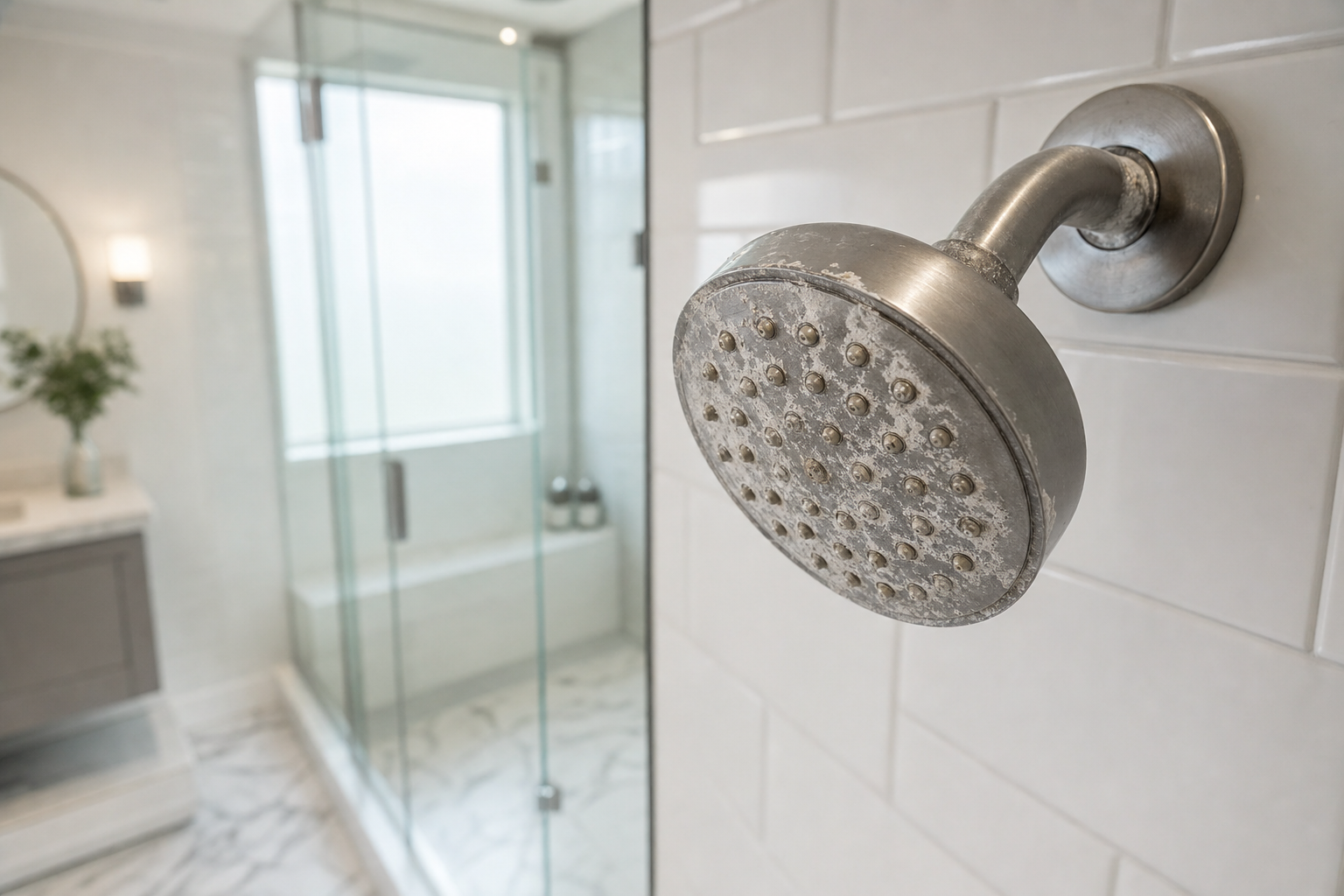
If you've lived in Draper or anywhere in Salt Lake County for more than a few months, you've seen the evidence: white crusty buildup around your faucets, spots on every glass that comes out of the dishwasher, and a showerhead that barely trickles. This isn't a maintenance failure on your part. It's a hard water Utah plumbing issue, and it affects nearly every home in the Salt Lake Valley. Left unaddressed, it quietly raises your utility bills, shortens the life of your appliances, and can lead to costly pipe repairs down the road.
Here's what's actually happening, and what you can do about it.
How Hard Is Salt Lake Valley Water, Really?
Very hard. That's not an opinion -- it's measurable.
Water hardness is measured in milligrams per liter (mg/L) of dissolved minerals, primarily calcium and magnesium. The national average sits around 170 mg/L. Salt Lake Valley water typically measures between 200 and 400+ mg/L, well into the "very hard" classification used by water quality experts.
The reason comes down to geography. Utah's water travels through limestone and mineral-rich rock in the Wasatch Range before reaching your tap, picking up calcium and magnesium along the way. Water above 180 mg/L is classified as "very hard" -- much of Draper, Sandy, South Jordan, and surrounding Salt Lake County sits at or above that threshold year-round.
What Hard Water Is Actually Doing to Your Pipes and Appliances
The minerals in hard water don't just pass through your plumbing harmlessly. They deposit on every surface they touch, forming limescale -- that white, chalky buildup you see on fixtures. Inside your pipes and appliances, where you can't see it, the same process is happening continuously.
Water heater efficiency: As limescale builds up on your water heater's heating elements and tank walls, the heater has to work harder to transfer heat through the mineral coating. Studies show this reduces water heater efficiency by 20 to 30%, which shows up directly on your energy bill. Over time, the same buildup accelerates corrosion and can shorten a water heater's lifespan by years.
Pipe scale buildup: In older homes with metal pipes, limescale narrows the interior pipe walls over time, reducing water pressure and flow. Newer PEX and CPVC pipes are more resistant, but fixture connections and valves are still affected.
Appliances: Dishwashers, washing machines, and ice makers see reduced efficiency and shorter service lives. Mineral deposits clog internal components and force heating elements to work harder.
Soap and cleaning products: Hard water reacts with soap to form residue rather than a clean lather, so you use more shampoo and detergent for the same results.
Signs Your Draper Home Has a Hard Water Problem
You don't need a water test to suspect hard water. Here are the most common indicators:
- White or yellowish scale building up around faucet bases, showerheads, and drain openings
- Spotty dishes and glassware coming out of the dishwasher even after a full wash cycle
- Low water pressure from showerheads or aerators that used to flow fine
- Dry, itchy skin and dull hair after showering -- minerals strip moisture and leave residue
- Soap scum that's difficult to clean off shower walls and tub surrounds
- Higher-than-expected energy bills without an obvious explanation
- A water heater that seems to be working harder or takes longer to recover between uses
If you're checking off three or more of these, hard water is almost certainly a factor in your home.
Water Softeners: What Actually Works
The most effective solution for hard water Utah plumbing problems is a salt-based water softener. These systems use a process called ion exchange to remove calcium and magnesium from your water before it reaches your pipes and appliances. Hard water flows through a resin tank filled with sodium-charged beads; the calcium and magnesium ions swap places with sodium ions, and softened water continues through your home.
Salt-based softeners are the gold standard for Utah's high-mineral water and provide whole-home protection.
Salt-free water conditioners are an alternative. Rather than removing minerals, they alter their structure so scale is less likely to form. They require no salt or electricity, but they're generally less effective in very hard water conditions like those found across Salt Lake County, and they don't provide the skin, hair, or soap benefits of a true softener.
A professionally installed water softener typically runs $800 to $2,500 installed, depending on the system size and your home's water usage. For most homeowners, that investment pays for itself within a few years through reduced energy costs, fewer appliance repairs, and extended plumbing life.
At Benjamin Franklin Plumbing of Draper, we size and install water softeners matched to your home's actual water usage and hardness level.
When to Call a Plumber vs. Handle It Yourself
Some hard water fixes are genuinely DIY-friendly. Soak a showerhead in white vinegar overnight to dissolve scale and restore flow. Clean faucet aerators every few months. Use a rinse aid in your dishwasher.
But for whole-house problems, call a professional. Reduced water pressure throughout the house, a water heater losing efficiency, or wanting a water softener installed right the first time -- those require an expert.
Improper installation is more common than people realize -- an undersized unit, a misconfigured bypass valve, or the wrong system size for your household can mean the softener isn't doing its job.
Draper plumbing services from a licensed professional mean the work is done right, sized correctly, and backed by a guarantee. As a Forbes Top Ranked Plumbing Company for 2024, Benjamin Franklin Plumbing of Draper stands behind every installation with our punctuality guarantee: if we're late, you don't pay.
Ready to Stop Fighting Your Hard Water?
Hard water is a fact of life in the Salt Lake Valley, but damage to your plumbing doesn't have to be. Whether you're starting to notice the signs or you've been dealing with scale buildup for years, the right water softener installed by a professional can protect your pipes, extend the life of your water heater and appliances, and make a noticeable difference in your daily water quality.
Benjamin Franklin Plumbing of Draper serves Draper, Sandy, South Jordan, West Jordan, Riverton, Herriman, Cottonwood Heights, Murray, Salt Lake City, and the surrounding Salt Lake County and Utah County area.
Call us at (801) 650-5881 to schedule a water quality assessment or get a quote on water softener installation. We'll give you a straight answer on what your home actually needs.

 Your Privacy Choices