
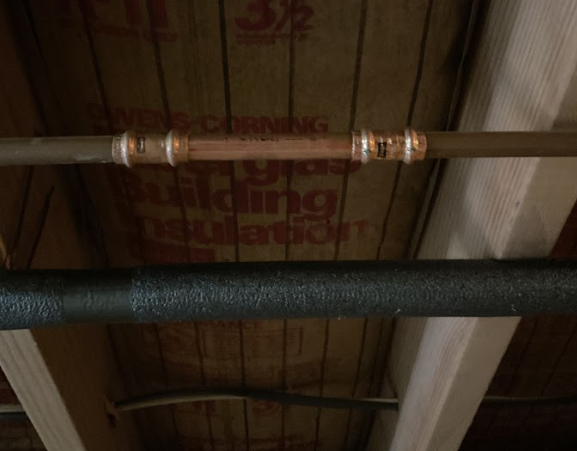
If you have lived in East Cobb or the broader Marietta area for any length of time, you have probably heard a neighbor mention a pinhole leak. Or you have had one yourself. Maybe two. The first one gets patched and you move on — until three months later when a water stain appears on a different ceiling in a different part of the house. At that point you start to wonder whether something larger is happening inside your walls.
You are right to wonder. Pinhole leaks in copper plumbing are so common across East Cobb and Marietta that the Cobb County-Marietta Water Authority — the water system that serves nearly 200,000 homes and businesses in the county — has formally investigated the problem and commissioned research with Virginia Tech specifically to understand what is happening in local homes. This is not a problem that is unique to your house. It is a documented, widespread regional phenomenon, and understanding it is the first step toward making the right decision about your own plumbing.
What Is a Pinhole Leak — and Why Is It Different From a Normal Pipe Leak?
A pinhole leak is a small, puncture-sized hole that develops in a copper pipe due to progressive internal corrosion. Unlike a fitting that pulls loose or a joint that cracks under stress, a pinhole develops gradually from within the pipe wall itself. The copper corrodes at a specific spot, thinning from the inside until it breaks through. By the time water appears on the outside, the degradation that caused it has often been progressing for months.
What makes pinhole leaks especially problematic in a finished home is that the pipe looks completely normal from the outside. There is no discoloration, no visible damage, no warning you can see during a casual inspection. A pipe heading toward failure looks identical to a pipe that is fine — which is why homeowners are almost always caught off guard, and why the damage is often significant by the time a leak is discovered.
Once water reaches a wall cavity or ceiling space, it soaks into insulation, wicks along wood framing, and saturates drywall. In Georgia's warm, humid climate, the conditions for mold growth develop quickly — typically within 48 to 72 hours of sustained moisture. What starts as a plumbing repair can become a remediation project if the leak is not caught early.
Why East Cobb and Marietta Are Ground Zero for This Problem
The housing age factor: 1980s construction dominates
The East Cobb area experienced explosive residential development during the 1980s and early 1990s. Neighborhoods like Indian Hills, Walton Chase, Shallowford Falls, and communities throughout the Sandy Plains and Lower Roswell Road corridors were largely built during this era. Marietta's established neighborhoods — including areas near the historic Marietta Square, Whitlock Heights, and the developments that spread north and east toward Canton Road — carry a similar construction timeline. The median construction year for Marietta housing stock sits around 1986.
Copper pipe installed in an 1986 home is now approximately 40 years old. Copper is a durable material, but its practical service life in residential plumbing is typically 25 to 50 years depending on water chemistry, installation quality, and water pressure. The East Cobb and Marietta housing stock is hitting that window now — and doing so at scale, across thousands of homes simultaneously.
The CCMWA investigation: a documented regional issue
What elevates this beyond the normal aging-pipe story is the role of local water chemistry. The Cobb County-Marietta Water Authority (CCMWA) serves approximately 197,000 homes and businesses across Cobb County and several adjacent municipalities. CCMWA has publicly acknowledged the pinhole leak phenomenon and taken it seriously enough to commission formal engineering studies. In 2012, CCMWA worked with HDR Engineering to evaluate copper pipe samples from homes that had experienced pinhole leaks. They followed that with a formal partnership with researchers at Virginia Polytechnic Institute and State University — Virginia Tech — to analyze additional samples and identify contributing factors.
The research identified several potential contributing factors: water chemistry interactions with copper pipe over time, installation-related issues such as excessive solder flux left on pipe connections during the original construction, water pressure levels, and in some cases electrolysis related to how the home's electrical system is grounded to the copper plumbing. No single cause was identified as universal — the phenomenon appears to involve multiple factors working together, with water chemistry and pipe age as the dominant variables in most affected homes.
The significance of CCMWA's investigation is that it confirms what East Cobb and Marietta homeowners have been experiencing for years is a real, documented pattern — not bad luck, not poor-quality pipes, and not something that can simply be patched and forgotten. The water authority's own research supports the conclusion that copper pipe systems in this area face elevated corrosion risk compared to national norms.
East Cobb specifically: a near-epidemic designation
The problem is widespread enough across East Cobb that local plumbing professionals have described pinhole leaks in the area as approaching epidemic levels. This language reflects the volume of calls East Cobb plumbers receive for this specific issue — not isolated leaks, but a pattern of homes seeing one repair, then another, then another, across the same neighborhoods and the same construction vintage. If you have had a pinhole leak repaired in your East Cobb or Marietta home and your neighbors have too, you are both part of the same regional pattern.
The Single Biggest Mistake Cobb County Homeowners Make
Treating each pinhole leak as an isolated incident is the most common — and most expensive — mistake we see. The impulse is understandable: fix the problem in front of you, move on. But in a home where the copper pipe system is experiencing pitting corrosion driven by water chemistry and age, repairing one pinhole does not address the underlying degradation that is affecting the pipe throughout the home. The next leak may appear six months later in a wall on the other side of the house. Then another. Each repair carries a service cost, and each leak carries a risk of water damage between the time it starts and the time it is found.
At a certain point — typically after two or three pinhole leaks in the same home — the cumulative cost of ongoing repairs exceeds the cost of whole-home repiping. More importantly, each repair that gets done instead of a repipe is another window of time during which an undetected leak can develop into a serious water damage event.
If your East Cobb or Marietta home was built in the 1980s and you have had at least one pinhole leak, the right conversation to have with a plumber is not 'how do we fix this one' but 'what is the overall condition of my copper system and at what point does repiping make sense.' We have that conversation with Cobb County homeowners regularly, and the answer varies by home — but it starts with an honest assessment.
Warning Signs of a Pinhole Leak Already in Progress
Pinhole leaks in East Cobb homes are often active for days or weeks before they become visible. These are the signs worth acting on immediately:
- A water bill that has increased noticeably without any change in your household usage — even a 10 to 15 percent unexplained increase is worth investigating
- The faint sound of running or dripping water when all faucets, toilets, and appliances are off — most noticeable late at night when the house is quiet
- A new water stain or discoloration on a ceiling, wall, or floor — even a small one that seems minor
- A musty or damp smell from inside a wall, a closet, or from below a floor — particularly in a finished basement
- Noticeably reduced water pressure throughout the home, especially if the change happened gradually
- Soft, spongy, or slightly warm flooring in an area with no obvious explanation — a warm spot on tile or hardwood can indicate a hot water line leaking beneath a slab
- Green oxidation or staining visible at copper pipe connections near your water heater or under sinks
Any one of these signs warrants a call to a licensed plumber for a leak detection assessment. Modern thermal imaging cameras and acoustic detection equipment can locate a pinhole leak inside a wall or ceiling precisely, without opening large sections of drywall unnecessarily. The earlier the leak is found, the smaller the repair and the lower the risk of mold and structural damage.
Your Options Once Pinhole Leaks Are Identified
Spot repair
Appropriate for a first leak in a home where a professional assessment confirms the rest of the copper system looks healthy. This fixes the immediate problem and is the right call when the broader system is genuinely in good shape.
Whole-home repiping with PEX
The permanent solution for a home where the copper has begun to show systemic pitting corrosion. PEX — cross-linked polyethylene — is the modern replacement material of choice for whole-home repipes across the Atlanta metro. It is flexible, highly durable, resistant to the corrosion mechanisms that affect copper in Cobb County's water chemistry, and carries a long service life. Most whole-home repipe projects in a Marietta or East Cobb home are completed in one to two days, with targeted wall access rather than widespread drywall removal. Once the job is done, the risk of future copper pinhole leaks is eliminated.
Pressure management
If high water pressure is a contributing factor in your home — pressure consistently above 80 PSI accelerates copper corrosion — installing or calibrating a pressure-reducing valve (PRV) can slow progression. This is a worthwhile complementary measure but is not a substitute for addressing a copper system that is already significantly degraded.
Delaying a repipe in a home with documented systemic copper failure typically costs more in the long run — not less. Each month of delay is another month of potential in-wall water damage accumulating silently. We have seen East Cobb homes where a homeowner patched leaks for two years before finally repiping, and the water damage remediation cost more than the repipe itself.
Benjamin Franklin Plumbing® of Marietta — Serving East Cobb and All of Cobb County
Our licensed plumbers serve homeowners throughout Marietta, East Cobb, Smyrna, Sandy Springs, Vinings, Cumberland, and the surrounding Cobb County communities. We diagnose and repair copper pinhole leaks, perform whole-home repiping with PEX, and provide honest system assessments that tell you what condition your plumbing is actually in — not just the section around the most recent leak.
If you have had a pinhole leak in your Marietta or East Cobb home and want to understand whether you are looking at an isolated incident or the beginning of a pattern, a plumbing assessment is the right place to start. We provide flat-rate pricing before any work begins, every technician is licensed, insured, background-checked, and drug-tested, and we arrive on time — or we pay you $5 for every minute we are late.
Marietta, East Cobb, and Cobb County homeowners: call us at (770) 999-9871 or book an appointment online. We serve Marietta, Smyrna, Sandy Springs, Vinings, Cumberland, Powers Park, and the surrounding area. Available 24 hours a day, 7 days a week.

 Your Privacy Choices