
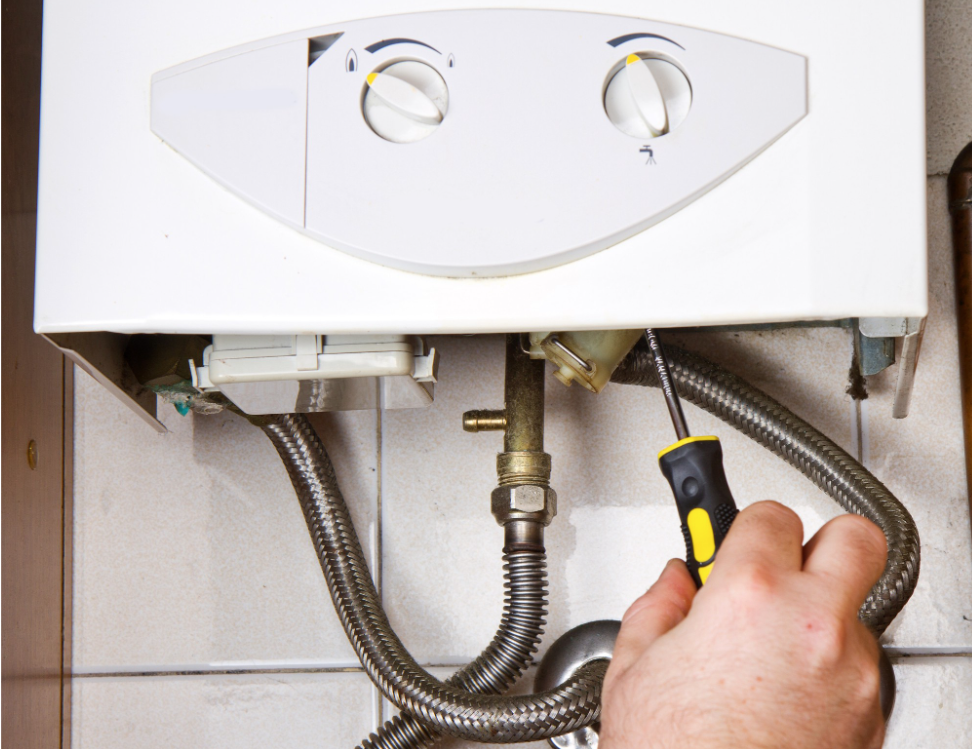
If you are searching for water heater repair in Prairie Village, KS, you are probably dealing with a cold shower, a strange noise from the utility closet, or a puddle that should not be there. Most water heater problems give off warning signs well before a full failure, and knowing what those signs mean helps you decide how urgently to act.
Not every water heater problem calls for a full replacement. A surprising number of issues trace back to a single failed part, sediment buildup, or a setting that simply needs adjusting, all of which are straightforward repairs rather than reasons to replace a unit that still has years of life left.
This is true for a home in Prairie Village itself. It holds just as true nearby in Overland Park, since both areas share the same water quality and similar housing ages.
This guide covers the most common water heater problems homeowners run into, how to tell a repair situation from a replacement situation, how plumbers actually diagnose the issue, and what to weigh when deciding between fixing and replacing. None of this requires guessing at what is wrong before making a call.
A water heater that keeps underperforming, even after small fixes, is usually telling you something specific about what is actually wrong. A water heater that isn't keeping up with demand often points to one particular cause rather than the unit failing across the board.
In this article, you will learn about:
- Common water heater problems in Prairie Village homes
- Signs your water heater needs a repair, not a full replacement
- How plumbers diagnose and repair water heater problems
- Repair versus replace: making the right call
Keep reading to understand exactly what is going on inside your water heater, and how to tell whether a repair or a replacement actually makes sense.
Common water heater problems in Prairie Village homes
Water heater problems tend to fall into a handful of predictable categories, and most of them have specific, identifiable causes rather than being a mystery. Knowing which category your problem falls into is the first step toward the right fix.
Every cause below shows up regularly across Prairie Village homes, whether the unit is a standard tank model or a tankless system. None of these problems are unusual, which is part of why a plumber can usually diagnose them quickly once they know what to look for.
No hot water or inconsistent temperature
A complete loss of hot water on an electric unit often points to a failed heating element or a tripped breaker, while the same symptom on a gas unit frequently traces back to a pilot light that will not stay lit or a faulty thermocouple. Inconsistent temperature, where water starts hot and turns lukewarm partway through a shower, usually means the tank cannot keep up with demand rather than failing to heat at all.
- A cold start with no hot water at any point: check the breaker or pilot light first
- Hot water that runs out quickly: often a sizing issue or a failing heating element
- Water that fluctuates between hot and cold: can point to a failing thermostat
These symptoms are worth noting carefully before calling a plumber, since the exact pattern narrows down the likely cause significantly. A plumber arriving with a clear description of the symptom pattern can often diagnose the issue faster than starting from scratch.
Sediment buildup and Prairie Village's hard water
Sediment buildup inside the tank is one of the most common causes of reduced performance and unusual noises, and it happens faster in homes with harder water. Minerals settle to the bottom of the tank over time, insulating the heating element or burner from the water above it and forcing the unit to work harder to reach the same temperature.
Hard water speeds up this buildup considerably compared to homes with softer water, which is part of why water heaters in this part of the metro often need more frequent flushing than manufacturer guidelines alone would suggest. A tank that has never been flushed can accumulate a significant layer of sediment within just a few years.
- Sediment settles at the bottom of the tank, below the heating element or burner
- The insulating layer forces the unit to run longer to reach the same temperature
- Popping or rumbling sounds during heating cycles usually mean this sediment layer has built up significantly
A rumbling or popping sound during a heating cycle is one of the clearest signs of sediment buildup, since it is caused by water boiling underneath the trapped mineral layer. This sound alone is often enough to confirm the cause before any other diagnosis happens.
Leaks, rust, and a failing tank
A leak from a water heater can come from several different sources, and not all of them mean the tank itself has failed. A loose fitting, a failing pressure relief valve, or a drain valve that will not fully close can all cause visible water without the tank itself being compromised.
Rust-colored water or visible rust on the tank exterior is a more serious sign, since it usually means the tank lining has broken down internally and corrosion has begun. Once a tank starts rusting from the inside, a leak repair at a fitting will not fix the underlying problem, since the tank itself is the source.
- Water pooling directly under the tank rather than at a visible fitting
- Rust-colored water coming from hot water taps specifically
- Visible rust or corrosion on the tank's exterior seams
Any active leak from the tank body itself, rather than a fitting or valve, generally means the tank is approaching the end of its service life regardless of age. A tank actively spraying or pooling a significant amount of water is an emergency plumbing services situation rather than something to schedule for later in the week.
Standard and tankless water heaters fail in different ways, but the diagnostic questions above apply to both categories in roughly the same order.
Signs your water heater needs a repair, not a full replacement
Plenty of water heater problems get treated as a reason to replace the whole unit when a targeted repair would solve the issue for a fraction of the cost. Knowing the difference protects your budget without leaving you stuck with an unreliable unit.
The signs below point toward a repair being the right call, assuming the underlying tank itself is still structurally sound.
The unit is still relatively young
A water heater under about six or seven years old, showing a single isolated problem rather than multiple symptoms at once, is usually a strong repair candidate. Most components, heating elements, thermostats, thermocouples, and valves, are individually replaceable without touching the tank itself.
The ENERGY STAR program notes that a typical water heater lasts around 13 years, and that a household of four can save more than $330 a year on energy costs by replacing an aging unit with a certified model once it actually reaches that point, rather than before.
- Unit age under 6 to 7 years: repair is almost always the better financial move
- Unit age 7 to 10 years: repair still often makes sense for an isolated issue
- Unit age past 10 to 12 years: replacement becomes worth considering even for a repairable problem
Age alone should not be the only factor, but it is a useful starting point before weighing the other signs below.
The problem is isolated to one component
A single, clearly identified failure, a bad heating element, a stuck valve, a failed thermocouple, is exactly the kind of problem a repair solves completely. These parts are designed to be replaceable, and doing so restores full function without needing to touch anything else in the system.
This is different from a unit showing multiple unrelated problems at once, like a failing element combined with visible tank corrosion. Multiple simultaneous issues usually mean the unit as a whole is reaching the end of its useful life, even if each individual problem could technically be repaired on its own.
A plumber diagnosing the issue should be able to tell you clearly whether the problem is isolated or part of a bigger pattern. That distinction matters more than any single symptom on its own.
Repair cost is a fraction of replacement cost
A repair that costs a fraction of full replacement, fixing a single component rather than swapping the entire unit, is a straightforward financial decision in most cases. The math changes only when repair costs start approaching a meaningful percentage of what a new unit would cost installed.
This comparison only makes sense once a plumber has actually diagnosed the specific problem, since a rough guess at repair cost before diagnosis is not a reliable way to make the decision. Getting an actual quote for the specific repair needed is worth doing before assuming replacement is the only option.
Weighing repair cost against the unit's remaining expected lifespan, not just the sticker price of the repair itself, gives a clearer picture of whether the investment makes sense.
How plumbers diagnose and repair water heater problems
A proper diagnosis walks through the most likely causes systematically rather than guessing and replacing parts one at a time. Understanding this process helps set expectations for what a repair visit should actually look like.
None of the steps below require opening up the tank itself in most cases, since the majority of water heater problems originate in replaceable components rather than the tank structure.
Checking the thermostat and heating element or burner
For electric units, a plumber tests the heating element and thermostat for continuity and proper function, since a failed element is one of the most common causes of reduced or absent hot water. For gas units, the pilot light, thermocouple, and burner assembly get checked in a similar sequence.
- Test the thermostat setting and function first, since a simple setting issue is the easiest fix
- Check the heating element or burner assembly for signs of failure
- Confirm gas supply and pilot light function on gas units specifically
This sequence moves from the simplest, cheapest possible cause toward more involved diagnosis, which keeps the repair cost as low as possible when the fix turns out to be simple. Jumping straight to a more expensive assumption without ruling out the simple causes first wastes money unnecessarily.
Flushing sediment and testing the anode rod
Flushing the tank removes accumulated sediment and often restores performance on its own, especially when rumbling or reduced hot water volume was the primary complaint. This is one of the most cost-effective repairs available, since it requires no replacement parts at all in most cases.
The anode rod, a sacrificial metal rod designed to corrode instead of the tank itself, gets inspected during a thorough diagnostic visit as well. A heavily corroded anode rod is cheap to replace and meaningfully extends the tank's remaining lifespan when caught before the tank itself starts corroding.
Both of these checks are quick, inexpensive, and often solve problems that seemed more serious before the diagnosis happened. Skipping them in favor of jumping straight to a parts replacement misses an easy, affordable fix.
Testing the pressure relief valve and connections
The pressure relief valve is a critical safety component, and a plumber tests it to confirm it opens and closes properly rather than assuming it works because the tank has not visibly failed. A stuck or leaking relief valve is a straightforward, inexpensive repair that should never be ignored given its safety function.
Connections, fittings, and the drain valve all get checked for the source of any visible leak, since not every leak actually originates from the tank itself. A loose fitting tightened correctly solves the problem entirely without any further work needed.
A sump pump working overtime near a water heater in a basement utility area is sometimes the first sign that a slow leak has been going on longer than anyone noticed. That pattern is worth mentioning to a plumber even if the water heater itself seems to be functioning normally.
Repair versus replace: making the right call
Once a diagnosis is complete, the decision between repair and replacement comes down to a few consistent factors rather than a single hard rule. Weighing all of them together gives a clearer answer than focusing on just one.
None of these factors alone should make the decision. Looking at them together is what actually leads to the right call.
Age and warranty status
A unit still under manufacturer warranty is almost always worth repairing, since parts and sometimes labor may be covered depending on the warranty terms. An older unit well past its warranty period changes this calculation, since the homeowner bears the full cost of the repair either way.
- Under warranty: repair is almost always covered and worth pursuing
- Past warranty, under 10 years old: repair usually still makes financial sense
- Past warranty, over 10 to 12 years old: replacement becomes reasonable to consider seriously
Checking warranty status before assuming a repair is the default option can meaningfully change the actual out-of-pocket cost either way.
Frequency of repairs
A unit that has needed one repair in several years of service is a very different situation than one needing a second or third repair within a short window. Repeated repairs on the same unit, even when each individual fix is inexpensive, add up and signal a unit that is generally wearing out rather than experiencing an isolated failure.
A water heater repair or replacement decision should factor in this repair history, not just the most recent problem in isolation. Two or more repairs within a year or two is generally a signal to start seriously considering replacement, even if each individual repair would otherwise make sense on its own.
Tracking repair history, even informally, helps make this pattern visible rather than treating every repair as a standalone decision.
Energy efficiency and long-term cost
An older water heater, even one that is functioning adequately, is likely operating less efficiently than a new unit built to current standards. This efficiency gap matters more the longer a homeowner plans to stay in the home, since the energy savings compound over years of use.
Plumbing repairs that keep an aging, inefficient unit running longer than its useful life sometimes cost more in cumulative energy bills than the price difference of replacing it sooner. This calculation matters most for a unit already showing its age in other ways, not for a young unit with a single isolated issue.
Weighing the energy cost difference alongside the repair-versus-replace decision gives a more complete financial picture than looking at the repair invoice alone. Technicians who handle residential plumbing across the metro see this exact tradeoff repeat across similar homes and can usually walk through the numbers quickly once a diagnosis is in hand.
Conclusion
Water heater problems in Prairie Village homes usually come down to a handful of familiar causes: a failed component, sediment buildup accelerated by hard water, or a tank that has started to corrode. Most of these are repairable, and a repair is often the financially smarter choice as long as the underlying tank is still sound.
The decision between repair and replacement comes down to age, warranty status, repair history, and efficiency, weighed together rather than any single factor in isolation. A proper diagnosis is what actually reveals which situation you are in, rather than guessing based on symptoms alone.
If your water heater is acting up and you are not sure whether it needs a repair or a replacement, Benjamin Franklin Plumbing of Kansas City can diagnose your Prairie Village home's water heater and give you a clear, honest answer either way.

 Your Privacy Choices