
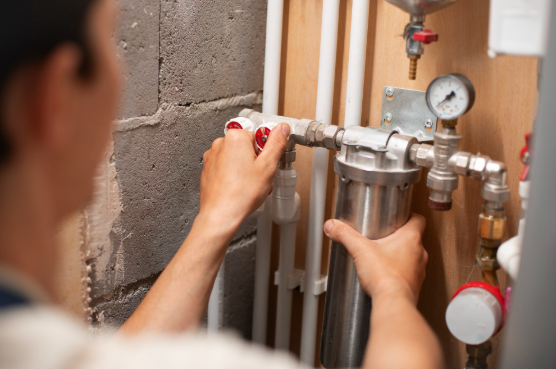
If you're staring at a water stain on the ceiling or you just got a quote for a whole-home repipe, the question comes up fast: PEX or copper? Both materials move water safely through a house, but they behave very differently once they're inside your walls, especially in a market like Kansas City where old galvanized and copper lines are common in homes built decades ago.
The short answer is that neither material is universally "better." PEX costs less, installs faster, and handles freeze cycles better. Copper lasts longer, resists UV and rodents, and has a track record measured in generations rather than decades. Which one makes sense for your house depends on your budget, your home's age, and how long you plan to stay in it.
Homeowners across Kansas City, Lee's Summit, Overland Park, Leawood, Prairie Village, Blue Springs, Gladstone, Greenwood, Independence, and Olathe are dealing with a housing stock where a meaningful share of homes still run on original copper or, in older pockets, galvanized steel.
That means repiping decisions here aren't hypothetical, and a drain cleaning call is often the moment a bigger piping problem first comes to light.
In this article, you will learn about:
- What PEX and copper actually are and how they perform
- Cost, lifespan, and installation differences that matter for a real repiping decision
- Warning signs your Kansas City home may already need a repipe
- What working with Benjamin Franklin Plumbing looks like from quote to finished job
Keep reading to see which material actually fits your home, your budget, and how long you're planning to stay in it.
What PEX and copper actually are
Before comparing the two head to head, it helps to know what each material is built from and why plumbers reach for one over the other on a given job. PEX and copper solve the same problem in almost opposite ways, and the difference shows up the moment a plumber opens a wall during a residential plumbing inspection.
Copper has been the standard for water supply lines since the mid-20th century. It is a rigid metal pipe, cut to length and joined with soldered or compression fittings at every turn, which means a typical bathroom or kitchen run may need a dozen or more individual joints.
PEX, short for cross-linked polyethylene, is a flexible plastic tubing that became common in residential plumbing starting in the 1990s. Instead of rigid runs with many joints, PEX is typically installed as a "home-run" system, with individual lines running from a central manifold directly to each fixture.
How copper pipe is made and installed
Copper pipe comes in rigid lengths that a plumber cuts, deburrs, and joins using heat and solder, or in some cases compression or press fittings. Every elbow, tee, and transition is a separate connection point, and each one is a potential future leak site, which is exactly what a leak repair technician looks for first when a home has aging copper.
The installation process is slower than PEX by a wide margin, since soldering requires an open flame, careful prep, and time for joints to cool and set. That labor time is a major reason copper repipes cost more than PEX repipes for a comparable home.
Copper also comes in different wall thicknesses, commonly labeled Type M, L, or K, with thicker walls used for higher-pressure or higher-durability applications. Most residential supply lines in Kansas City, Overland Park, and Leawood homes use Type M or L.
How PEX pipe is made and installed
PEX is manufactured through a cross-linking process that binds polyethylene molecules together, which is what gives the tubing its flexibility and heat tolerance. There are three common types, PEX-A, PEX-B, and PEX-C, and they differ mainly in the degree of cross-linking and the fittings used to join them.
Because PEX bends around corners and through joist bays without needing fittings at every turn, a plumber can often run a single continuous line from the manifold to a fixture. Fewer joints generally means fewer potential leak points over the life of the system.
PEX connections are made with crimp rings, cinch clamps, or expansion fittings rather than heat, which is faster to install and doesn't carry the fire risk that soldering does in an occupied home.
Why the choice matters more in an older market
In a city where a large share of homes predate the 1990s, the piping decision isn't just about new construction preferences. It's about what's already failing and what should replace it, and it connects directly to broader plumbing repairs that a lot of Kansas City homeowners already schedule for other reasons.
- Homes with original galvanized steel supply lines are past their expected service life almost everywhere in the metro, regardless of which replacement material comes next.
- Homes with original copper from the 1960s through 1980s are approaching the far end of copper's typical lifespan and may show early signs of pinhole leaks.
- Renovated or partially updated homes sometimes mix PEX and copper, which is fine structurally but worth flagging to your plumber so transitions are installed correctly.
Knowing which category your home falls into is the first real step toward deciding whether a full repipe, a partial repipe, or ongoing monitoring makes the most sense.
Cost, lifespan, and performance differences
Once you understand what each material is, the real decision comes down to three practical factors: what it costs upfront, how long it's expected to last, and how it performs under Kansas City's specific conditions. None of these numbers exist in a vacuum, so it helps to look at them together rather than picking whichever sounds best in isolation.
Manufacturers generally rate copper for 50 to 70 years of service life under normal water conditions, while PEX carries a typical expected lifespan in the 30 to 50 year range. Those numbers assume correct installation and reasonably neutral water chemistry, which is where a licensed plumber's judgment matters more than the spec sheet.
Cost is where the two materials diverge the most sharply. PEX repipes typically run meaningfully cheaper than copper for a comparable home, driven mostly by labor time rather than material cost, since PEX installs in a fraction of the time copper does.
- PEX material costs less per foot than copper, and that gap has grown as copper commodity prices have risen in recent years.
- PEX installation labor is significantly lower because there's no soldering, fewer fittings, and faster runs through walls and joist bays.
- Copper's higher upfront cost is partly offset by its longer expected service life, so the cost-per-year-of-service gap is smaller than the sticker price gap.
Freeze resistance is where Kansas City's climate actually shifts the calculation. PEX flexes slightly when water inside it freezes, which makes it meaningfully less likely to split than rigid copper during a hard freeze.
That matters here, where the metro sees genuine cold snaps most winters and unheated spaces like crawlspaces and garages are common failure points, the same spaces covered in a typical plumbing winter checklist.
Copper still wins on a few fronts PEX can't match. It's not vulnerable to UV degradation, so exposed exterior runs hold up better. It's also more resistant to damage from rodents and pests, which matters in older homes with crawlspace access points.
What affects PEX lifespan specifically
PEX isn't indestructible, and a few conditions can shorten its expected service life well below that 30 to 50 year range. Chlorine levels and water temperature are the two biggest variables a plumber will flag before recommending PEX for a given home, which is part of why a proper water heater inspection matters alongside a repiping decision.
Extremely hot water, generally above 180 degrees Fahrenheit sustained over time, and water with high chlorine content can both accelerate degradation in PEX tubing. Most residential water heaters don't run anywhere near that threshold, but it's worth confirming your setup if you're on a private well or an unusually hot water heater setting.
UV exposure is the other real limitation. PEX degrades with direct or even extended indirect sunlight exposure, so any exterior runs, exposed basement windows, or unfinished areas with natural light need to route PEX away from direct exposure or use UV-rated tubing.
What affects copper lifespan specifically
Copper's failure mode is almost the opposite of PEX. Instead of environmental exposure, it's water chemistry that does the damage over time, specifically through a process called pinhole leaking, the same corrosion process the EPA tracks when it evaluates lead exposure risk tied to aging home plumbing.
- Highly acidic water accelerates internal pipe corrosion, which is the leading cause of copper pinhole leaks in residential systems.
- Hard water, a genuine local factor for homeowners who have already asked how to tell if you have hard water, can leave mineral scale inside copper pipes over decades, gradually narrowing the interior diameter.
- Improper grounding of electrical systems to copper plumbing can create stray electrical currents that accelerate corrosion at specific points.
Homeowners on well water in the outer parts of the metro, including areas near Blue Springs and Greenwood, should have water tested before committing to a copper repipe, since acidic well water can cut years off copper's expected lifespan.
Reading the real cost comparison
Sticker price alone doesn't tell the whole story, and a fair comparison needs to account for labor, fittings, and long-term maintenance together, not just the material cost per foot.
A typical two-bathroom, single-story home repipe with PEX generally costs less than the same job in copper, largely because copper's labor time runs so much higher. Larger homes, multi-story layouts, and homes with limited crawlspace or attic access tend to widen that gap further, since copper's rigid runs are harder to route through tight or awkward spaces.
That said, price isn't the only variable worth weighing. A homeowner planning to stay in a house for decades may find copper's longer service life worth the higher upfront cost, while someone repiping ahead of a sale or a shorter-term hold often leans toward PEX for the lower total investment.
Warning signs your Kansas City home may need a repipe
Most homeowners don't wake up one day and decide to repipe. It's usually a slow accumulation of small problems, or one dramatic failure, that forces the decision. Knowing what to watch for can mean catching a problem before it becomes a burst pipe and a flooded floor.
Low or inconsistent water pressure across multiple fixtures is often the first sign something is wrong inside the walls, especially in homes old enough to have accumulated internal corrosion or mineral buildup. This is the exact complaint that shows up in why is my water pressure low, and aging supply lines are one of the more common root causes.
Discolored water, particularly water with a brownish or reddish tint right after you turn on a tap that's been off for a while, is a strong indicator of internal pipe corrosion. This shows up most often in homes with original galvanized steel lines, which corrode from the inside out over time.
The following signs, taken together, are what a licensed plumber looks for when deciding whether a home is a repipe candidate rather than a repair candidate:
- Frequent pinhole leaks appearing in different locations over a short period, rather than one isolated failure
- Visible green or blue staining around copper fittings, which signals active corrosion
- Water pressure that drops noticeably when two fixtures run at once
- A persistent metallic or "swimming pool" taste or smell in tap water
- Pipes that feel unusually thin, brittle, or show pitting when a plumber inspects an exposed section
- A home built before the 1990s that has never had its original supply lines replaced or inspected
Age alone doesn't automatically mean a home needs a repipe, but it's a strong enough signal to justify a professional inspection rather than waiting for a failure.
Kansas City's owner-occupied housing rate sits above 55 percent, according to the U.S. Census Bureau, and a metro built up in waves over many decades means supply-line age varies significantly from one block to the next.
A separate American Housing Survey release found the median occupied home in the Kansas City area was built in 1977, several years older than the 1974 national median, which puts a large share of local supply lines close to or past the end of copper's typical service window.
When one repair signals a bigger problem
A single leak doesn't necessarily mean the whole system needs replacing, but certain patterns tell a different story. If a plumber has patched the same section of pipe more than once, or if leaks keep showing up in different rooms within the same year, that's usually a sign of systemic corrosion rather than a one-off failure.
Homes that have had water heater replacements, appliance installations, or bathroom remodels sometimes end up with a patchwork of old and new pipe. That mixed system can create galvanic corrosion at the connection points, where two different metals meet and accelerate deterioration.
A plumber assessing whether to recommend a full repipe versus a targeted repair will generally look at the age of the original system, the frequency of recent repairs, and whether the home's water chemistry has likely contributed to the wear pattern. The same underlying corrosion risk is why the EPA's Lead and Copper Rule Improvements now require most water systems nationwide to replace lead service lines within 10 years and lower the lead action level to 10 micrograms per liter, since older supply lines are the primary pathway for lead exposure in drinking water.
What happens if you wait
Delaying a needed repipe rarely makes the eventual job cheaper, and it often makes it more disruptive. A slow leak inside a wall cavity can go undetected for months, leading to mold growth, warped subfloors, or damaged drywall that turns a plumbing job into a much larger restoration project.
- A minor pinhole leak left unaddressed can, over weeks or months, saturate insulation and framing before it ever becomes visible on a ceiling or wall.
- Corroded galvanized pipe restricts water flow gradually, so pressure loss often gets blamed on the water utility before anyone suspects the pipes themselves.
- Insurance coverage for water damage sometimes excludes claims tied to gradual leaks versus sudden failures, so a slow-building problem can end up costing the homeowner more out of pocket than a sudden burst would.
Catching these signs early, and having a professional confirm what's actually happening inside the walls, is almost always cheaper than waiting for a full failure. It's the same logic behind routine maintenance tips that catch small issues before they become emergencies.
Getting a professional diagnosis before you decide
None of the warning signs above are something a homeowner should diagnose alone, since pressure loss and discolored water can also point to problems with the municipal supply, a failing water heater, or a single bad fixture rather than the whole system. A camera inspection or pressure test is the only reliable way to know whether you're looking at a targeted repair or a full repipe.
A plumber will typically start with the easiest fixtures to rule out first, then move to isolating sections of the home's plumbing to narrow down where pressure drops or discoloration originates. This process usually takes less than an hour for a typical single-family home and gives homeowners a clear answer instead of a guess.
- Ask whether the diagnosis included checking pressure at more than one fixture, since a single low-pressure faucet rarely means the whole system needs attention.
- Request to see any visible corrosion or staining the technician found, rather than taking a repipe recommendation on faith.
- Get the recommendation in writing, including whether a partial repipe (just the worst-affected section) is a reasonable middle option before committing to a full-home job.
Why Kansas City homeowners choose Benjamin Franklin Plumbing for repiping
Repiping a home is invasive work. It means opening walls, working around finished spaces, and trusting someone to do it right the first time, since redoing a botched repipe is far more disruptive than the original job. That's where the contractor you choose matters as much as the material.
Benjamin Franklin Plumbing has served the Kansas City metro, including Overland Park, Lee's Summit, Leawood, and Prairie Village, since 1955, which means decades of experience with the specific housing stock and water conditions found across this region.
That kind of local tenure matters when a plumber is assessing whether your home's original piping, water chemistry, and layout point toward PEX, copper, or a hybrid approach.
Every technician who shows up to a job has trained under master plumbers before working independently, which matters most on a job like a full repipe where a single bad connection can mean a leak inside a finished wall months later. Benjamin Franklin Plumbing is also BBB accredited, giving homeowners an independent record of how the company handles disputes and customer service.
- On-time arrival is backed by the company's promptness guarantee, summarized as "if there's any delay, it's you we pay," so a missed appointment window isn't just an inconvenience, it comes with accountability.
- Technicians walk homeowners through material options, PEX, copper, or a hybrid approach, based on the home's age, water source, and layout, rather than defaulting to whichever material is fastest to install.
- Upfront pricing is provided before work begins, so there's no guessing what a repipe will cost once walls are already open.
What to expect during a repiping estimate
A repiping job starts with an in-home assessment, not a phone quote. A technician needs to see the home's layout, current pipe material, wall and floor access, and any visible signs of existing damage before recommending a material or providing a firm price.
During that visit, expect the plumber to check water pressure at multiple fixtures, look for visible corrosion or staining at exposed pipe sections, and ask about the home's history, including any past leaks, remodels, or well water use. This is also the point where a homeowner should ask about warranty coverage and expected disruption to daily life during the job.
For homes throughout Kansas City, Blue Springs, Gladstone, Greenwood, Independence, and Olathe, that in-person assessment is what turns a generic PEX-versus-copper decision into a recommendation that actually fits the specific house.
Reaching the Kansas City team
Homeowners across the metro can reach the Lee's Summit, MO-based team directly for a repiping estimate. Call (816) 239-2685 to schedule an in-home assessment, or ask about the Heroes Club discount program if you're a first responder, teacher, or veteran considering a repipe.
Protecting your investment after the repipe is done
A finished repipe is still a plumbing system, and even the best materials benefit from periodic checks rather than being forgotten once the walls are closed back up. This is especially true in the first year, when any weak connections or improperly seated fittings are most likely to show themselves.
Ongoing membership coverage gives homeowners a way to catch small issues, a slightly loose fitting, a drop in pressure at one fixture, before they turn into the kind of problem that justified the repipe in the first place. It also means the same technicians who understand your home's plumbing history are the ones doing future checks, rather than starting from scratch with someone new each time.
Homeowners who've just invested in a full repipe often find it makes sense to pair that work with the Club Membership program, which includes regular plumbing checks designed to catch developing issues early rather than after they've caused damage.
Conclusion
Choosing between PEX and copper isn't about finding the objectively superior material. It's about matching the material to your home's age, your water conditions, your budget, and how long you expect to stay in the house. PEX offers a lower upfront cost, faster installation, and better performance during hard freezes, while copper offers a longer track record, resistance to UV and pests, and a service life that can stretch past half a century when water conditions cooperate.
For a metro where a large share of homes were built decades before either material became standard, the right call almost always starts with an honest look at what's actually happening inside the walls right now, not just a comparison of specs on paper. Warning signs like pressure loss, discolored water, or repeated pinhole leaks are worth a professional assessment long before they become an emergency.
Whichever direction fits your situation, the difference between a repiping job that lasts decades and one that causes problems down the line usually comes down to who does the installation. A rushed or improperly soldered joint, or a poorly planned PEX manifold layout, can undo the benefits of either material.
If you're weighing a repipe for your Kansas City home, Benjamin Franklin Plumbing can walk you through an in-home assessment, explain which material fits your specific situation, and provide upfront pricing before any work begins.

 Your Privacy Choices