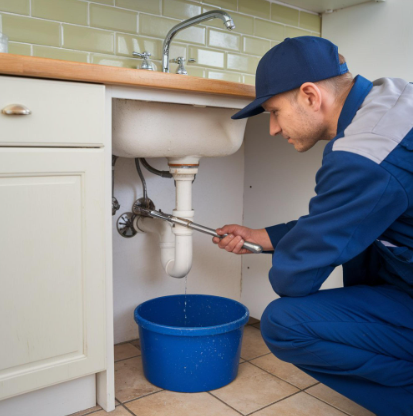
A burst pipe does not wait for a convenient time. It happens at 2 a.m. on a Tuesday, during a family dinner, or right before you leave for work, and within minutes a small drip can turn into standing water across a finished basement. If you are dealing with a plumbing emergency in Lee's Summit right now, the first move is simple: shut off the water at the main valve, then call for help.
Lee's Summit homes face a specific set of plumbing risks tied to the local climate and the age of the housing stock. Basements are the norm here, which means a sump pump failure or an overhead pipe burst can flood a finished lower level in minutes rather than hours. Winters bring hard freezes that split supply lines running through exterior walls and unheated crawl spaces, and older neighborhoods with decades-old cast iron and galvanized piping are especially exposed.
Not every plumbing problem needs a 2 a.m. call, but the ones that do need a fast, correct response from someone who shows up with the right parts the first time. Knowing which is which, and what to do in the minutes before help arrives, saves both money and stress.
In this article, you will learn about:
- What counts as a true plumbing emergency versus something that can wait
- Why Lee's Summit homes are especially prone to certain emergencies
- What to do in the first ten minutes before help arrives
- What to expect when you call an emergency plumber
Keep reading to learn exactly what to do in the minutes after something goes wrong, so a bad night does not turn into a bad month.
What actually counts as a plumbing emergency
Homeowners often either panic over something minor or wait too long on something serious. Both mistakes cost money. A true plumbing emergency is anything that is actively causing property damage, creating a health or safety risk, or cutting off a critical utility like water or heat. Everything else can typically wait for a scheduled appointment.
Active flooding or a burst pipe
Water actively flowing where it should not be is always an emergency. This includes a supply line that has split open, a water heater tank that has ruptured, or a washing machine hose that has blown off its fitting. According to the U.S. Environmental Protection Agency, the average household's leaks alone waste more than 9,300 gallons of water a year, and an active burst can release several gallons per minute, which adds up to a flooded room far faster than most people expect.
The first response matters more than the plumber's arrival time. Shutting off the main water valve stops the flow immediately, while a delay of even fifteen or twenty minutes can mean the difference between a wet floor and ruined drywall, subflooring, and baseboards.
Sewage backup
A sewer line backup is both a plumbing emergency and a health hazard. Wastewater backing up into a tub, floor drain, or toilet carries bacteria and contaminants that should never sit in a living space. Common triggers include a root-clogged main line, a collapsed section of pipe, or heavy rain overwhelming an aging sewer system.
Unlike a clean water leak, sewage contact requires professional cleanup, not just a mop and a fan. If sewage is backing up anywhere in the house, avoid running additional water, including flushing toilets, running the dishwasher, or doing laundry, until a plumber has cleared the clogged drain or blockage.
No heat during a cold snap
Missouri winters routinely push overnight lows well below freezing, and a failed furnace or a burst heating line is not a comfort issue at that point, it is a safety issue. Pipes that were already borderline can freeze solid within hours once indoor temperatures drop, which turns a heating problem into a second plumbing emergency layered on top of the first.
Older Lee's Summit homes with boiler-based heat are particularly vulnerable here, since a boiler failure also means no hot water throughout the house.
Homeowners sometimes wait through a cold night hoping the problem resolves itself, when a plumbing winter checklist completed ahead of the season would have caught it early. It rarely resolves on its own, and the longer pipes sit at or below freezing, the higher the odds one of them splits.
Not every plumbing issue rises to this level, and it helps to know the difference before you're standing in a wet basement at midnight trying to decide whether to make the call.
- A slow drain that empties eventually is an inconvenience, not an emergency
- A dripping faucet wastes water and money but is not actively damaging the home
- A running toilet that refills correctly, just slowly, can typically wait
- A single clogged drain with no backup elsewhere in the house is usually a next-day fix
- Low water pressure that has been gradual, not sudden, is worth investigating but rarely urgent
Understanding this distinction is not about avoiding a service call, it is about knowing when speed matters most so you can prioritize correctly if multiple things go wrong at once, which happens more often than people expect during a hard freeze.
Why Lee's Summit homes are especially prone to plumbing emergencies
Lee's Summit's plumbing risk profile is shaped by three things: the region's freeze-thaw winter pattern, the clay-heavy soil common across Jackson County, and a housing stock that spans everything from historic downtown homes to newer subdivisions with finished basements. The same pattern holds just as true for neighboring Blue Springs and Independence, which sit on similar soil and see the same winter swings. Each of these factors plays a role in which emergencies show up most often.
Freeze-thaw cycling and exterior pipe runs
Missouri does not stay consistently cold the way northern states do. Instead, temperatures swing from well below freezing to a thaw and back again within the same week. This freeze-thaw cycling is harder on plumbing than steady cold, because pipes expand and contract repeatedly rather than freezing once and staying frozen.
Unheated garages, crawl spaces, and attics become genuinely vulnerable once air temperature falls to 20 degrees Fahrenheit or below, according to a Kansas city government utilities notice, which is well within the range Lee's Summit sees most winters. Supply lines running through exterior walls take the brunt of this stress, and older homes without modern insulation standards are the most exposed.
Copper pipe expands very little before it fails, so a hard freeze can crack a line even in a home that has never had a plumbing problem before. A dripping faucet left unaddressed only adds to the strain on aging fixtures, since even a faucet leaking once per second can waste more than 3,000 gallons annually on top of whatever a hard freeze does to the rest of the system. Homeowners in Lee's Summit's older neighborhoods, where original plumbing sometimes dates back decades, should treat any hard freeze warning as a reason to take basic precautions rather than assuming the house has always been fine and always will be.
Soil movement and sewer laterals
Jackson County's clay-heavy soil expands when saturated and contracts as it dries, and that constant movement puts stress on buried sewer laterals running from the house to the main line.
Over years, this cycle can shift pipe joints out of alignment or crack aging clay or cast iron sewer pipe, a slow process that often shows no symptoms until the pipe fails outright during a heavy rain event when the system is under maximum load.
This is part of why a sewer backup can seem to come out of nowhere. The underlying damage built up gradually, and the visible failure happens all at once, usually at the worst possible time. Homeowners farther out in Gladstone and Olathe deal with the same clay-soil movement, so the same warning signs are worth watching for there too, not just in Lee's Summit proper.
Basements as standard construction
Finished basements are common throughout Lee's Summit, which raises the stakes on any plumbing failure that happens above or at ground level. A supply line break on a main floor, a sump pump that quits during a storm, or a water heater failure in a basement mechanical room can all flood a finished living space in a way that would just be a wet garage floor in a home without a basement.
Sump pump reliability matters more here than in many markets. A pump that has not been tested in a year, or one running on an outdated float switch, is a common point of failure during exactly the storm events that most need it working, and testing it is one of the checks covered in a seasonal maintenance walkthrough.
Showering already accounts for nearly 17 percent of a household's indoor water use according to EPA WaterSense, so a failed water heater or a burst supply line feeding that fixture tends to hit the water bill harder than homeowners expect on top of any damage from a flooded basement.
What to do in the first ten minutes
The actions you take before a plumber arrives often determine how much damage the emergency actually causes. Speed and the right sequence of steps matter more than technical skill here, since none of the following requires plumbing expertise.
Find and use the main shutoff valve
Locate your main water shutoff valve today, before an emergency happens, not during one. In most Lee's Summit homes it sits near the water meter, in a basement, a utility closet, or along an exterior wall facing the street. Knowing exactly where it is and confirming it turns freely, since some valves seize up from disuse, can save several critical minutes when it actually matters.
- Shut off the main water valve by turning it clockwise until it stops, which cuts water to the entire house rather than just one fixture.
- Shut off electricity to any area with standing water at the breaker panel, since water and live outlets or appliances are a serious shock hazard.
- Move valuables and furniture away from the affected area if it is safe to do so without wading through standing water.
- Start basic water removal with towels, a wet-dry vacuum, or buckets if the volume is manageable, but do not delay calling for help while doing this.
- Photograph the damage for insurance purposes once the immediate safety steps are handled.
Handle a frozen pipe safely
For a frozen pipe that has not yet burst, the sequence is slightly different. Never use an open flame to thaw a frozen section, since that fire risk is worse than the risk of a burst pipe. A hair dryer, heating pad, or towels soaked in warm water applied directly to the frozen section works safely, starting from the end closest to the faucet and working back toward the blockage.
Patience matters here too. Thawing a pipe too aggressively, with a torch or by blasting it with boiling water, is a common way homeowners turn a frozen pipe into a burst one, since sudden heat against ice under pressure is exactly what cracks copper and PVC alike.
When you cannot find the source
If you cannot locate the source of a leak, or water is coming from somewhere in the ceiling or an inaccessible wall cavity, leak detection equipment can pinpoint the source quickly, but shutting off the main valve is still the right move even before a diagnosis. There is no benefit to waiting for an answer before stopping the water supply, and a few minutes spent hunting for the exact source is a few minutes the water keeps running.
What to expect when you call
Knowing what happens after you dial the phone can reduce the stress of an already stressful situation, especially if this is your first time dealing with a major plumbing failure.
A real person should answer the call, day or night, rather than an automated system that leaves you on hold during an active emergency. Benjamin Franklin Plumbing of Kansas City staffs live phone support around the clock specifically because emergencies do not follow business hours, and a homeowner standing in rising water should never have to wait through a phone tree to reach someone.
Diagnosis and upfront pricing
Once a technician arrives, the first step is confirming the source of the problem, not guessing based on the symptom you described over the phone. A slow leak reported as a burst pipe, or a clog mistaken for a sewer line collapse, are both common enough that an in-person look always comes first. From there, pricing is presented before any work begins, so you are approving a known cost rather than discovering the bill after the repair is finished.
Emergency plumbing costs vary widely depending on the scope of the problem, the accessibility of the pipe or fixture involved, and whether water damage cleanup is also needed. A licensed technician who has seen hundreds of similar calls can usually give a reasonably accurate estimate on the spot, factoring in these variables rather than quoting a flat number that ignores them.
Licensed, background-checked technicians
Not every plumber who shows up to an emergency call is equally qualified, and this matters more during a high-pressure repair than a routine one. Ask whether the technician is licensed and background-checked, and whether the truck is stocked with common parts for the type of failure you are experiencing, since a second trip to a supply house can turn a two-hour fix into an all-day ordeal. Answers to common questions like these are also covered in the plumbing FAQ.
A few questions are worth asking before work begins:
- Is the estimate a flat rate or time-and-materials, and does it change if the job takes longer than expected?
- Does the technician carry parts for common failures like burst copper lines, failed sump pumps, and water heater components?
- What is the warranty on the repair itself, separate from any manufacturer warranty on parts?
These questions take thirty seconds to ask and can prevent a frustrating follow-up call a few weeks later if the repair does not hold. Members of the Hero's Club get these answers upfront as a standard part of every visit, not just the emergency ones.
After the repair
Once the immediate emergency is resolved, it is worth asking the technician what caused the failure in the first place, particularly if it was a frozen pipe or a sewer backup tied to root intrusion. A repair that addresses the symptom without addressing the underlying cause, whether that is aging insulation, an undersized sump pump, or a sewer line overdue for inspection, often means the same emergency repeats within a year or two.
Preventative checks catch these root causes before they become 2 a.m. emergencies again, and homeowners who have already dealt with recurring clogs can see how this plays out in a piece on common causes of clogged drains. A once-a-year inspection of exposed piping, the sump pump, and the water heater takes far less time and money than a repeat emergency call.
Conclusion
Plumbing emergencies in Lee's Summit tend to follow a predictable pattern: a hard freeze splits a line in an exterior wall, aging clay soil shifts a sewer lateral out of alignment, or a sump pump fails during exactly the storm it was installed to handle. None of that is bad luck so much as the ordinary risk of owning a home in this climate on this soil, and knowing the pattern is most of the battle.
What separates a manageable bad night from a genuinely expensive one usually comes down to two things: how fast the water gets shut off, and whether the person who shows up next actually fixes the problem instead of patching the symptom. Both of those are within your control, one by knowing where your main shutoff valve is before you ever need it, and the other by choosing who you call.
Benjamin Franklin Plumbing of Kansas City has answered emergency calls across the metro since 1955, with live phone support, upfront pricing, and licensed technicians who show up ready to fix the actual problem the first time. If a pipe just burst, a drain just backed up, or you are staring down a hard freeze wondering whether your house is ready for it, do not wait until it gets worse.
Join the Benjamin Franklin Plumbing Club Membership program to get priority emergency response and the kind of ongoing checks that catch problems like these before they turn into a flooded basement, or call now if you are already dealing with one.

 Your Privacy Choices