
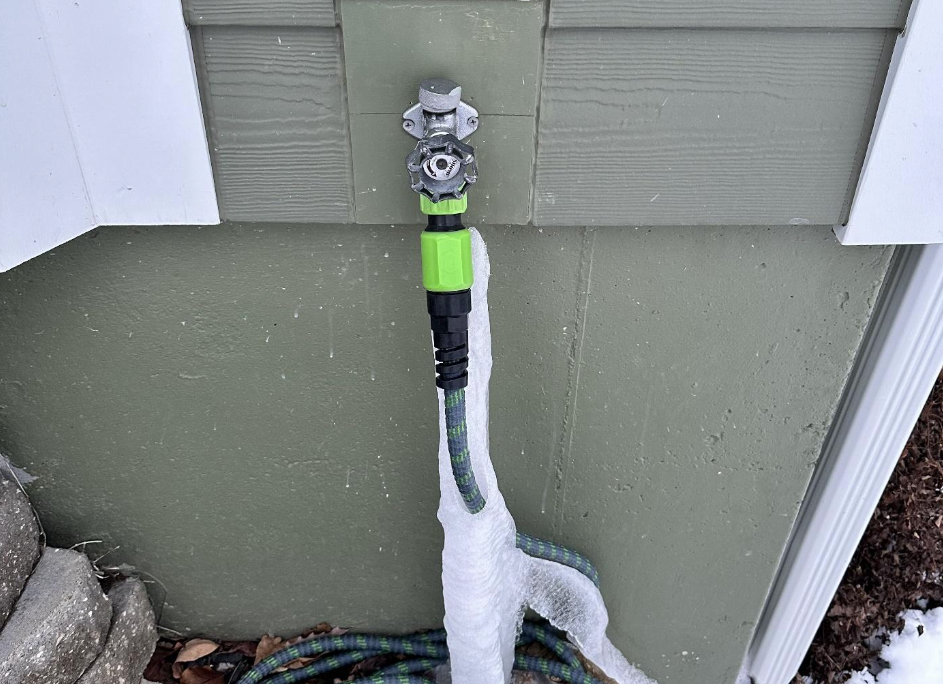
An outdoor faucet is easy to forget once the watering season ends. But when freezing weather arrives, a connected garden hose or an undrained water line can turn into a plumbing repair—and sometimes water damage inside your home.
Preparing your plumbing for a Kansas City winter starts outside, then continues into the basement, crawl space, and other areas where pipes are exposed to cold air. The right approach depends on whether you have a traditional hose bib with an indoor shutoff or a frost-free outdoor faucet.
Here’s how to protect both types and address the conditions that put indoor pipes at risk.
Start by Disconnecting Your Garden Hoses
Before freezing temperatures arrive, disconnect garden hoses from every outdoor faucet, including those behind the house or tucked beside the garage. Drain the hoses and store them for winter.
Remove watering timers, splitters, and other accessories that could trap water or prevent the faucet from draining.
This step matters even if your faucet is labeled “frost-free.” Many standard frost-free faucets rely on an unobstructed outlet to empty after you turn them off. Leaving a hose connected can interfere with that drainage.
Know Which Type of Outdoor Faucet You Have
Homeowners often use the terms hose bib, hose hydrant, and outdoor spigot interchangeably. For winter preparation, the important distinction is where the faucet stops the water.
A traditional hose bib shuts water off near the outside handle, leaving water close to outdoor temperatures. These faucets commonly rely on a separate indoor shutoff so the exposed section can be drained for winter.
A frost-free faucet has a longer stem that places the shutoff farther inside the house. When properly installed, the outer section drains after use, while the water supply connection stays in a heated space. The faucet must slope slightly toward the outdoor outlet to drain correctly.
The handle’s appearance alone may not identify the type. Check the brand and model or have a plumber confirm what is installed. Finding an indoor shutoff also does not automatically mean the outdoor faucet is a traditional model; frost-free faucets may have one too.
Winterizing a Regular Hose Bib With an Inside Shutoff
For a traditional outdoor faucet with a dedicated indoor shutoff, the goal is to stop the supply and drain the section exposed to freezing conditions.
- Disconnect the hose and attachments. The faucet needs an open path for drainage.
- Close the indoor valve supplying that faucet. It may be in the basement, crawl space, or an access panel near the outdoor connection.
- Open the outside faucet. Allow the remaining water to drain.
- Leave the outdoor faucet open for winter, with its indoor supply valve closed.
Some indoor shutoffs have a small drain or bleeder cap to help empty the downstream piping. If yours does, follow that valve’s instructions and use a container to catch the water. Do not loosen unfamiliar fittings or force a stuck valve.
If water continues flowing outside after the line should have drained, the indoor valve may not be closing completely—or you may have selected the wrong valve. Have that checked before relying on it for winter protection.
A traditional hose bib without an accessible indoor shutoff deserves attention before a hard freeze. A plumber can evaluate adding a shutoff and drain or replacing the faucet with a properly installed frost-free model.
Winterizing a Frost-Free Hose Hydrant
For a typical self-draining frost-free faucet, turn the outdoor handle off, disconnect the hose and attachments, and allow the faucet to drain. Unlike a traditional hose bib isolated at an indoor valve, this faucet normally stays closed when its water supply remains on. Follow the instructions for your particular model.
Frost-free does not mean the faucet is protected under every condition. Its performance depends on proper drainage and a supply connection that remains warm enough. Incorrect installation or a freezing space behind the wall can defeat that protection.
A brief release of water after shutting off a self-draining faucet can be normal. Persistent dripping, however, should be inspected.
Freeze damage can also remain hidden until spring. A split in the outer tube of a frost-free faucet may leak inside the wall only when the faucet is turned on again. When you first use it after winter, check the accessible indoor connection and surrounding area for moisture.
Should You Use an Outdoor Faucet Cover?
An insulated faucet cover can add protection against cold air around an outdoor spigot. Choose one that fits securely against the house and install it after completing the appropriate draining steps.
A cover does not create heat, drain trapped water, or repair a leaking valve. Treat it as an additional layer of protection. It cannot make an undrained traditional hose bib or an improperly installed frost-free faucet reliably freeze-resistant.
Protect the Space Around Your Plumbing
A comfortable living room does not necessarily mean the plumbing behind a nearby wall is warm. Pipes may run through a drafty rim-joist area, an unheated crawl space, or a cavity separated from indoor heat.
Insulating these areas requires attention to where the pipes sit. Adding insulation between a pipe and the heated part of the house can leave that pipe on the colder side of the barrier. The aim is to limit exposure to outdoor temperatures while keeping the plumbing within the protected portion of the home.
For crawl spaces and unfinished basements, insulation, air sealing, moisture control, and heating conditions should be considered together. If you are unsure how to improve the space, have it evaluated before covering everything up.
Seal Cracks and Gaps That Let Cold Air In
Insulation and air sealing serve different purposes. Insulation slows heat transfer; sealing gaps helps stop cold air from blowing into the area around your pipes.
Inspect around plumbing penetrations, basement windows, crawl-space access doors, and the joint where the wood framing meets the foundation. Outside, look for failed sealant around the faucet’s wall penetration and unintended openings in siding or foundation joints.
Use an appropriate exterior-rated caulk or sealant for small gaps, following the product’s surface-preparation and temperature requirements. Larger openings may need compatible foam, backing material, or building repair. Plumbing penetrations, sill plates, and rim joists are commonly identified as air-leak locations.
Do not seal intentional drainage openings, required vents, or combustion-air openings. Cracks that are widening, displaced, or admitting water need evaluation beyond a bead of caulk.
Insulate Pipes Where Cold Air Can Reach Them
Pay particular attention to plumbing near exterior walls, in garages, and in unheated basement or crawl-space areas.
Both hot and cold water supply lines can freeze. Properly fitted pipe insulation helps slow heat loss, but it does not generate warmth. During prolonged freezing conditions, an insulated pipe can still freeze if the surrounding space gets cold enough.
Use insulation sized for the pipe, and follow the product instructions for securing seams and covering bends.
If a pipe freezes repeatedly, another layer of foam may not solve the underlying problem. Its location, surrounding drafts, and access to heat all need to be considered.
Keep an Eye on Vulnerable Plumbing During Cold Snaps
Once winter arrives, keep garage doors closed where water lines are present. During severe cold, opening sink cabinet doors can help room heat reach plumbing near exterior walls; move cleaners out of children’s reach first.
Keep indoor temperatures consistent and leave the heat on when traveling. It is recommended to set the thermostat no lower than 55°F during a winter absence, although vulnerable pipe locations may need additional protection.
If a faucet suddenly produces little or no water during freezing weather, a frozen line may be the cause. Never use an open flame to thaw it. If you discover a leak or burst pipe, shut off the main water supply if you can safely reach it and call a plumber.
Get Your Kansas City Plumbing Ready for Winter
A dripping hose hydrant, a shutoff that will not close, or a water line that freezes every year is worth addressing before temperatures drop.
Benjamin Franklin Plumbing of Kansas City helps homeowners with outdoor faucet repair and replacement, shutoff valve repairs, leaking pipes, and other plumbing concerns throughout the metro on both sides of the state line—including Lee’s Summit, Blue Springs, Independence, Overland Park, Olathe, and the Northland.
Our experienced technicians receive ongoing training, and we can handle most calls with fast, same-day service. As a locally owned family business, we focus on repairs that last, with a two-year warranty on standard plumbing repairs.
Not sure whether your outdoor faucet is ready for freezing weather? Contact Benjamin Franklin Plumbing of Kansas City to schedule service before a small problem becomes a winter plumbing emergency.

 Your Privacy Choices