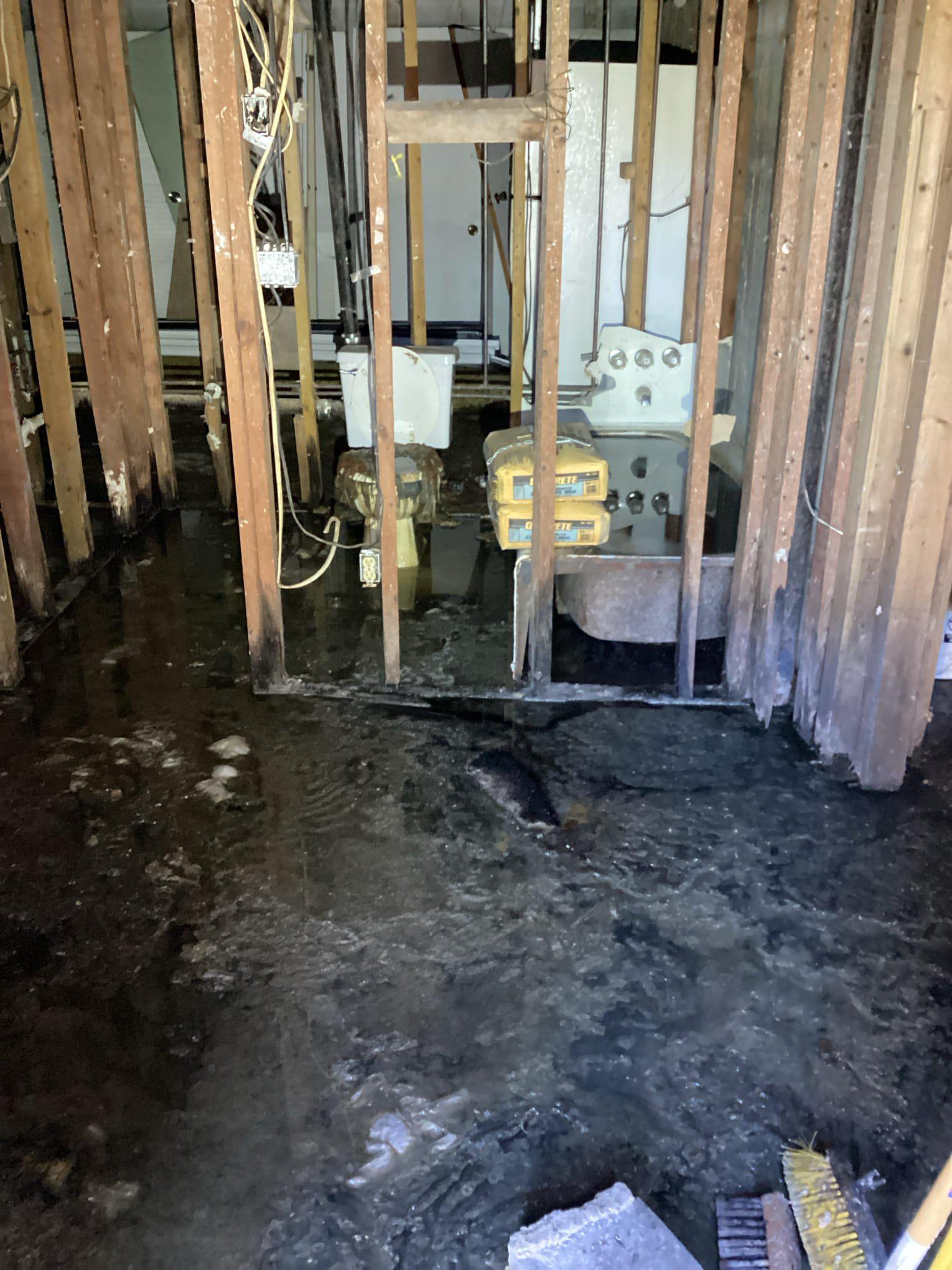
A property manager in the Oak Crest area of Winston-Salem called us after a major sewer backup sent sewage into the basement of a multifamily apartment building. Another company had already attempted to clear the blockage, but the sewer backed up again.
Our team responded the same day and initially expected to find a difficult main sewer clog or a failure in the building's original cast-iron sewer line. Instead, the job turned into something much more unusual. About 60 feet from our access point, we found a solid obstruction that could not be cleared normally.
After locating the problem, excavating the sewer line, and exposing the pipe, we discovered the cause: a fiber optic cable had been bored directly through the building's 4-inch sewer main.
A Major Sewer Backup Was Flooding the Basement of a Winston-Salem Apartment Building
By the time we arrived, this was more than a slow drain or an isolated clogged toilet.
The building's main sewer line was blocked badly enough that sewage had backed up into an unused basement. The property manager's immediate concern was getting the sewer functioning again so the tenants could continue using their bathrooms and preventing additional sewage from entering the building.
Access to the sewer cleanouts was available from the basement, but there were several inches of sewage on the floor. Before beginning drain clearing, we had to make sure our team could safely get equipment to the work area and suited up with the appropriate protective equipment.
We responded within about two hours of the initial call and began working to restore at least partial flow while determining what had caused the backup.
Drain Clearing Found a Solid Blockage About 60 Feet Into the Main Sewer Line
We started with a large Milwaukee battery-powered drain machine.
The initial drain clearing work got the sewer partially flowing, but something did not feel like a normal buildup or everyday drain blockage. At approximately 60 feet into the line, our equipment encountered a solid obstruction.
That changed the diagnosis.
The building dated to roughly the 1960s, and the sewer was an original 4-inch cast-iron line. One possibility was that the aging pipe had broken or collapsed. Instead of repeatedly trying to force drain-cleaning equipment through an obstruction we did not yet understand, we recommended inspecting and locating the problem.
We then ran a Milwaukee sewer camera through the line.
Because the sewer was still holding sewage, the camera could not give us a clear view of exactly what was blocking the pipe. What it did allow us to do was identify the location of the solid obstruction and what we believed was a break or major defect in the sewer line.
That information gave us a target for excavation.
When a Sewer Backup Returns After Drain Cleaning, the Next Step May Be Diagnosis Instead of More Cleaning
A drain machine is extremely useful when the problem is actually a removable blockage.
But a sewer that backs up again shortly after being cleared can be telling you something different.
On this job, another company had already attempted to clear the line. When the backup returned and our equipment encountered a solid obstruction around 60 feet out, continuing to attack the same point with increasingly aggressive drain equipment would not have answered the most important question:
What is physically stopping the sewer from flowing?
The combination of drain clearing, sewer camera inspection, locating equipment, and targeted excavation allowed us to answer that question.
And in this case, the answer was something no amount of ordinary drain cleaning was going to fix.
Excavation Revealed a Fiber Optic Cable Running Directly Through the Sewer Pipe
Before excavation, underground utilities were located through the 811 process. We knew from those markings that a communication line was very close to the section of sewer we needed to expose.
Once we excavated to the sewer line, the cause became obvious.
A fiber optic cable had been bored directly through the cast-iron sewer pipe.
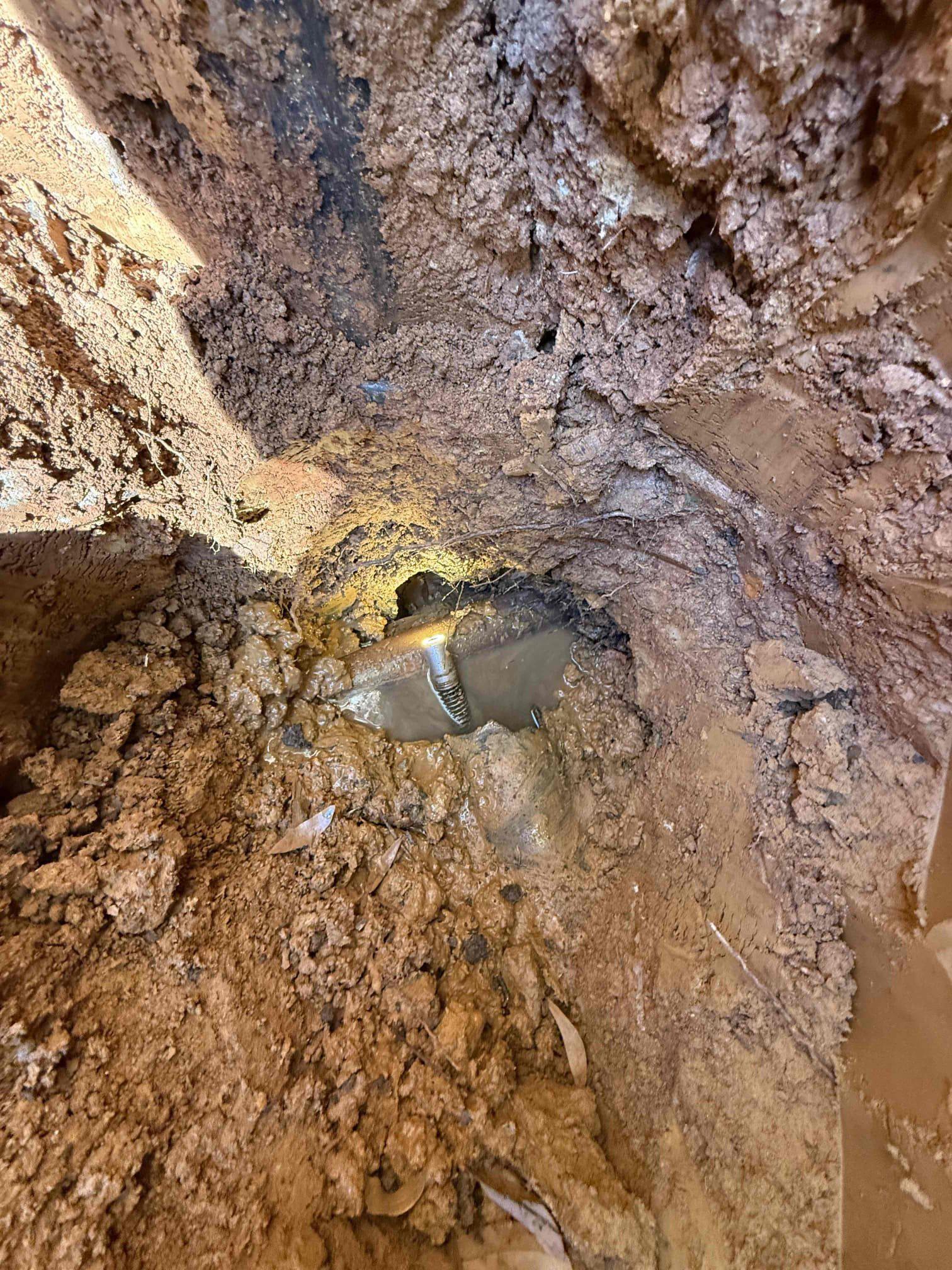
This type of utility intersection is commonly referred to as a cross-bore. The U.S. Pipeline and Hazardous Materials Safety Administration describes a cross-bore as an underground utility installed through or intersecting an existing underground facility, including a sewer line. They also note that cross-bores can remain undiscovered for months or years after the utility installation.
That is essentially what happened on this Winston-Salem sewer line.
After coordinating with the cable company, we learned the fiber line had been installed more than a year earlier. The sewer continued operating during that time, so there was no obvious reason for the property owner to know that a cable was physically passing through the pipe.
The eventual blockage exposed the hidden problem.
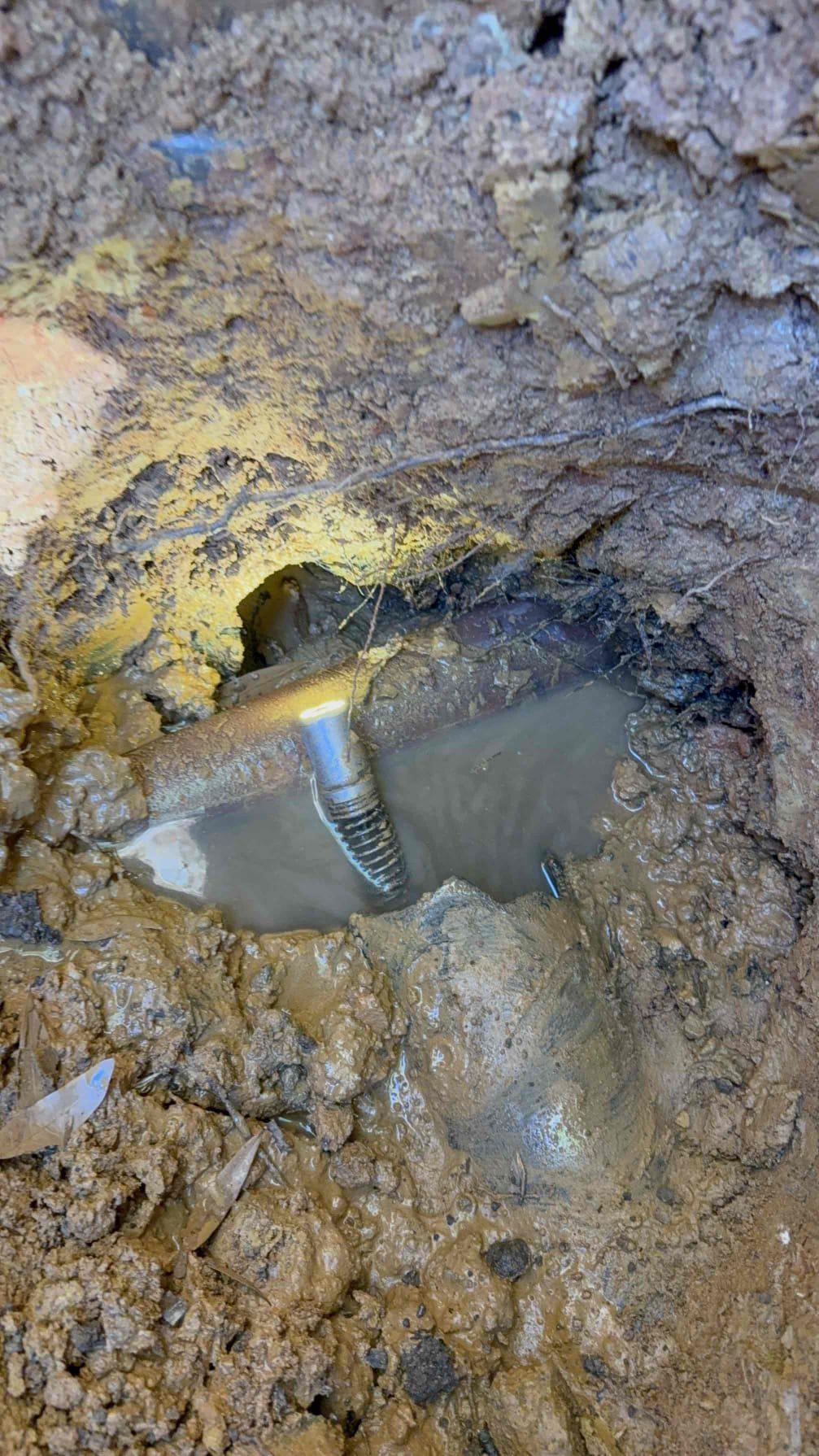
Can a Fiber Optic Cable Really Be Bored Through a Sewer Line?
Yes.
Modern underground utilities are often installed using trenchless boring methods so crews do not have to open a continuous trench across the property. A cross-bore occurs when the new underground utility unintentionally intersects an existing underground facility.
Sewer laterals can be particularly difficult because the problem may be completely underground and may not immediately stop the sewer from functioning. PHMSA notes that cross-bores can remain unnoticed for extended periods after installation.
That is why the timing of the failure does not necessarily tell you when the damage occurred.
On this job, the sewer backup happened more than a year after the fiber installation.
Why Did the Sewer Work for More Than a Year After the Fiber Cable Was Installed?
A cable passing through a sewer pipe does not necessarily block the entire diameter of the pipe immediately.
Wastewater and toilet paper may continue moving around the obstruction. The problem is that anything projecting through a sewer creates a place where material can catch instead of continuing downstream.
In this case, flushable wipes were involved in the eventual blockage.
Unlike toilet paper, wipes do not disperse as quickly in a sewer system. North Carolina wastewater guidance specifically warns that wipes marketed as "flushable" may pass through the toilet but can remain intact long enough to catch in pipes, accumulate, and contribute to sewer backups.
The problem is not simply whether a wipe can make it through the toilet. It also has to travel through the building drain, the sewer lateral, and eventually the municipal wastewater system. Toilet paper is designed to break apart quickly. Many wipes remain intact much longer and can catch on roots, damaged piping, rough pipe surfaces, or, in this unusual case, a fiber optic cable running through the sewer.
Municipal wastewater agencies in North Carolina advise residents to throw wipes in the trash rather than flush them because they can contribute to blockages and sewer backups.
Here, the cable created an obstruction inside the sewer. Wipes caught on it, additional material accumulated, and eventually the line became blocked badly enough to send sewage back into the building.
A sewer with no existing defect may handle them for some time without an obvious problem. The difficulty is that a property owner usually does not know what is happening inside an underground sewer line.
This Winston-Salem property had operated for more than a year with a hidden obstruction before the right combination of material finally stopped the line. Without that blockage, the damaged sewer might have remained hidden even longer.
Why We Discussed Both a Spot Sewer Repair and Full Sewer Line Replacement
Once we exposed the damaged sewer, there were two reasonable approaches to discuss with the property owner.
One was a spot repair, replacing the damaged section where the fiber optic cable penetrated the sewer.
The other was a full replacement of the outside sewer line up to the city sewer connection.
A spot repair was technically possible. If the surrounding sewer had been newer or in particularly good condition, replacing only the damaged section could have been a reasonable solution.
This property presented a different decision.
The sewer was original 4-inch cast iron serving a building from roughly the 1960s. We were already excavating the property to reach the damaged section, and the owner had to decide whether to repair the one known failure or replace the older outside sewer while the project was underway.
The owner chose full sewer line replacement.
That did not mean a spot repair was wrong. It meant the owner preferred to address the aging outside sewer line at the same time rather than leave the remainder of the original line in the ground.
How We Completed the Winston-Salem Sewer Line Replacement
The fiber cable made this replacement more complicated than simply excavating the old sewer and installing new pipe.
Our team had to coordinate with the cable company so its line could be moved out of the sewer path. We also coordinated with the city because work was required at the municipal sewer tap.
Once the affected utilities were addressed, we:
- Excavated the existing outside sewer line
- Removed the old cast-iron sewer piping
- Coordinated relocation of the fiber optic cable away from the sewer
- Installed new PVC sewer piping up to the city tap
- Coordinated with the city for repair of its sewer tap
- Backfilled the excavation after the sewer work was completed
The repair was completed in less than 48 hours once the required underground utility locations were completed.
How We Confirmed the New Sewer Line Was Flowing Properly
Replacing a sewer line is not finished when the pipe is covered.
Before leaving the system in service, we tested the building's drain lines and ran large amounts of water through the plumbing system to confirm that wastewater was moving properly through the replacement sewer.
The major blockage was gone, the building was draining normally again, and no additional backup was observed.
For a multifamily property, that final testing is especially important because the main sewer has to handle wastewater coming from multiple fixtures and occupants rather than a single bathroom.
Who Is Responsible if a Cable Company Damages a Sewer Line?
There is not a universal answer that applies to every utility-damage claim.
If a utility company or its contractor damages a private sewer during underground installation, the property owner should document exactly what was found and contact the utility or contractor involved. Photos of the exposed damage, sewer-camera findings, utility markings, invoices, and records showing the location of the damaged pipe can all be important.
North Carolina's Underground Utility Safety and Damage Prevention Act establishes responsibilities for underground utility operators and excavators, including notification requirements when an excavation damages an underground facility. Exactly who is financially responsible in a particular case can depend on the circumstances of the installation, the location and ownership of the facilities, utility-location requirements, and other facts specific to the damage.
On this and many projects, our role was to get the sewer working again and coordinate the parties necessary to complete the repair. That included communication with the fiber company and coordination with the city for the sewer tap.
If you discover what appears to be utility damage to a sewer line, preserve the evidence before the damaged pipe is removed whenever practical.
Need Help With a Sewer Backup in Winston-Salem?
If your main sewer keeps backing up, our Winston-Salem plumbing team can inspect the line, determine whether you're dealing with a removable blockage or damaged sewer pipe, and explain whether drain cleaning, a spot repair, or sewer line replacement makes the most sense.
For active sewer backups, same-day service may be available. This project was diagnosed on our first visit, and our team arrived within about two hours of the initial call.

 Your Privacy Choices