A garbage disposal that is starting to fail rarely stops working all at once. It sends warning signs first, sometimes for weeks or months, through sounds, smells, leaks, and performance changes that are easy to dismiss as normal wear or a minor inconvenience. Recognizing the signs you need garbage disposal repair in Shenandoah early gives you the option of a targeted fix instead of a full replacement, and it prevents the secondary problems that a failing disposal creates in the rest of your kitchen plumbing.
Shenandoah homeowners rely on their disposals year round, but summer puts extra pressure on the unit. More cooking at home, more fresh produce with fibrous scraps, and more entertaining all increase the volume and variety of material going through the disposal. A unit that was already showing early signs of wear in the spring can reach the point of failure by midsummer if the symptoms are ignored.
The disposal is also a gateway to the rest of your drain system. When it fails, clogs, or leaks, the consequences travel downstream into the drain lines and can affect the entire kitchen plumbing setup. Catching a disposal problem early contains the damage to the unit itself and keeps the drain system clear.
In this article, you will learn about:
- Sounds that indicate mechanical failure is developing
- Performance changes that signal internal wear
- Leaks and where they come from on a disposal unit
- Odor problems and what they actually mean
- Electrical symptoms that point to motor or wiring issues
- When repair makes sense and when replacement is the better option
Keep reading to learn what your garbage disposal is trying to tell you and when to act on it.
Sounds that indicate mechanical failure is developing
A healthy garbage disposal produces a steady, even grinding sound when it is running with food waste, and a smooth hum when it is running empty. Any deviation from those normal sounds is worth investigating, because the disposal's internal components are simple enough that unusual noise almost always points to a specific, identifiable problem.
Listening to the unit rather than ignoring it is the fastest diagnostic tool you have.
Grinding metal or rattling
A hard metallic grinding or rattling sound during operation usually means something has fallen into the grinding chamber that does not belong there. Silverware, bottle caps, small bones that did not process fully, or fragments of glass or ceramic are the most common culprits.
Turn the unit off immediately and disconnect the power before reaching into the chamber. Use a flashlight and needle-nose pliers to locate and remove the object. Running the disposal with a hard foreign object inside will damage the impellers, the shredder ring, or both, and what starts as a simple retrieval becomes a repair or replacement.
If the metallic sound persists after clearing the chamber, the impellers themselves may be damaged or loose. Worn impellers cannot grind food effectively and will leave larger particles in the waste stream that increase the risk of clogs downstream in the kitchen drain and branch line.
Persistent humming without spinning
When you flip the switch and the disposal hums but the grinding plate does not turn, the motor is receiving power but something is preventing rotation. The most common cause is a jam, where food waste or a foreign object has wedged between the impellers and the shredder ring, locking the plate in place.
Most disposals have a hex socket on the underside of the unit that accepts a quarter-inch Allen wrench. Inserting the wrench and manually rotating the grinding plate back and forth can free a minor jam. If the plate moves freely with the wrench but still does not spin when the motor is activated, the issue is more likely internal, either a failed motor capacitor or a motor that has overheated and burned out.
A disposal that hums without spinning draws significant electrical current, which trips the internal overload protector or, in some cases, the kitchen circuit breaker. If you find yourself pressing the reset button on the bottom of the unit repeatedly, the disposal is telling you that the motor is under distress and the problem is beyond a simple jam.
Increasingly loud operation over time
If the disposal has gradually gotten louder over the past several months without any single dramatic change, the internal components are wearing. The bearings that support the motor shaft, the mounting assembly that connects the unit to the sink flange, and the impeller plate itself all degrade with use.
Increased noise from bearing wear often comes with increased vibration, which you may feel through the countertop or hear as a rattle in the cabinet. A disposal that vibrates excessively can loosen its mounting connections over time, which leads to leaks at the sink flange, the most common and most problematic leak point on the unit.
Performance changes that signal internal wear
The disposal's job is to reduce food waste into particles small enough to flow through the drain line without causing a clog. When the unit stops doing that job effectively, the evidence shows up in the sink, the drain, and the dishwasher connection.
Performance degradation is gradual, so the homeowner often adjusts their behavior around it, running the water longer, feeding the disposal more slowly, avoiding certain foods, without recognizing that the unit is failing.
Food waste not processing fully
If you are finding partially ground food fragments in the sink basin after running the disposal, or if the drain seems to carry visible particles that it used to handle without issue, the impellers or the shredder ring have dulled. These components do not actually have blades. They use centrifugal force to throw food waste against a stationary shredder ring, and both surfaces wear down over years of use.
Dull grinding components cannot reduce fibrous materials like celery, asparagus stalks, or corn husks at all, and they struggle with starchy foods like potato peels and pasta that a healthy disposal processes without trouble. If you find yourself avoiding the disposal for foods it used to handle easily, the unit has lost grinding capacity and repair or replacement should be on the schedule.
Frequent or recurring clogs
A disposal that sends poorly processed waste downstream is a direct contributor to recurring drain clogs. The larger particles settle in the branch line, accumulate at elbows and transitions, and combine with grease and soap residue to form blockages that restrict flow.
If you are clearing the kitchen drain more often than you used to, the disposal may be the root cause rather than the drain itself. A plumber who evaluates the clog and finds oversized food particles in the blockage will often trace the issue back to a disposal that is no longer grinding effectively.
According to the U.S. Environmental Protection Agency, fats, oils, and grease combined with solid food waste are the leading contributors to residential sewer blockages. A failing disposal that cannot reduce food waste to the proper particle size amplifies this problem by introducing larger solids into a system designed for fine slurry.
Slow drainage during and after use
If the sink drains slowly while the disposal is running or takes longer than usual to empty after the unit shuts off, the disposal chamber may not be evacuating waste efficiently. This can result from worn impellers, a partially clogged discharge opening, or a blockage developing in the short section of pipe between the disposal outlet and the main drain branch.
Slow drainage during operation is different from slow drainage at other times. If the sink drains normally when the disposal is not in use but struggles when it is running, the issue is almost certainly in the disposal or its immediate discharge connection rather than further downstream. If the drain is slow all the time, the problem may be in the branch line or the main drain, and the disposal may simply be masking or contributing to a larger issue.
Leaks and where they come from on a disposal unit
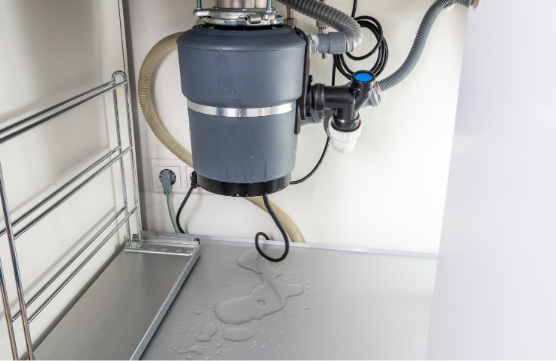
A garbage disposal has several potential leak points, and identifying where the water is coming from determines whether the fix is a simple tightening, a gasket replacement, or a unit replacement. Leaks from a disposal are particularly damaging because they occur inside the cabinet, where they can soak the cabinet floor, damage the subfloor, and create conditions for mold growth without being immediately visible.
Check under the sink periodically, especially during the summer months when the disposal is working harder.
Leaking from the top at the sink flange
The most common disposal leak originates at the mounting assembly where the unit connects to the sink drain opening. This connection relies on a combination of plumber's putty or a rubber gasket, a mounting ring, and a snap ring or bolts that hold the unit against the underside of the sink.
Over time, vibration from the disposal loosens the mounting hardware, and the seal between the flange and the sink deteriorates. Water running through the sink, whether from the faucet or from the disposal itself, seeps through the failed seal and drips down the outside of the unit.
If you see water on top of the disposal body or running down its sides, dry the area, pack paper towels around the flange connection, and run water through the sink without activating the disposal. If the paper towels get wet, the flange seal has failed. Retightening the mounting hardware may resolve the issue temporarily, but if the putty or gasket is degraded, a reseal is necessary.
Leaking from the side at the dishwasher connection
Most garbage disposals have a dishwasher inlet on the side of the unit, connected by a hose that carries the dishwasher's drain water into the disposal chamber. The connection is secured with a hose clamp.
If water appears on the side of the disposal during or immediately after a dishwasher cycle, the hose clamp may be loose or the hose itself may be cracked. Tightening the clamp or replacing the short section of hose is a straightforward fix. If the leak persists, the inlet fitting on the disposal body may be cracked, which typically requires unit replacement since the housing is not serviceable.
Leaking from the bottom
Water dripping from the very bottom of the disposal, not from a connection point but from the unit's base plate, indicates an internal seal failure. The internal seals protect the motor from the water and food slurry inside the grinding chamber. When these seals fail, water migrates into the motor housing.
A bottom leak is generally not repairable. The internal seals are not designed to be accessed or replaced in most residential disposal models, and a unit that is leaking from the bottom is also at risk of motor failure from water intrusion. This is a clear signal that garbage disposal replacement is the appropriate next step.
Odor problems and what they actually mean
A garbage disposal that smells bad is telling you something specific about what is happening inside the grinding chamber and the discharge line. The odor is not just unpleasant. It indicates bacterial activity on organic residue that the disposal has not fully processed or flushed away.
Persistent odor despite regular cleaning warrants a closer look at the unit's condition.
Trapped food residue inside the chamber
The most common source of disposal odor is food residue trapped beneath the splash guard, on the underside of the grinding plate, and in the grooves of the shredder ring. Even a well-functioning disposal leaves behind a thin film of organic material after each use, and in the warm, humid climate of Southeast Texas, that residue supports rapid bacterial growth.
Regular cleaning helps. Grinding ice cubes with a tablespoon of baking soda, running cold water through the unit for 30 seconds after each use, and periodically cleaning the splash guard flaps with a brush all reduce the bacterial film. But if the odor persists despite these measures, the grinding chamber may be retaining waste because the impellers are worn, the discharge opening is partially blocked, or the unit is not draining fully after each cycle.
Odor originating from the drain line below the disposal
If the smell is coming from the sink drain rather than the disposal itself, the issue may be downstream. A partial blockage in the branch line beneath the disposal can trap food waste in standing water, producing a sewage-like odor that rises back through the drain and into the kitchen.
This is a different problem than a dirty disposal, and it requires a different solution. A professional drain cleaning that clears the branch line and evaluates its condition is the appropriate response. If the line is partially clogged with grease and food particles, clearing it resolves the odor and also prevents the full blockage that would otherwise develop.
According to the CDC, damp environments with organic material provide conditions for microbial growth that can affect indoor air quality. A kitchen drain that perpetually holds standing organic waste and produces a persistent odor is contributing to the microbial load in your home, which is one more reason to address the root cause rather than masking the smell.
Electrical symptoms that point to motor or wiring issues
The disposal is an electrically powered appliance, and electrical symptoms deserve attention both because they indicate a failing unit and because they can present safety concerns.
Distinguishing between a disposal that needs a reset and one that has a genuine electrical problem determines whether you are dealing with a minor hiccup or a condition that needs professional evaluation.
Frequent resets and tripped breakers
Every garbage disposal has a built-in thermal overload protector, a small reset button on the bottom of the unit that trips when the motor overheats or draws excessive current. Pressing the reset button and restarting the disposal is a normal response to an occasional jam or an unusually heavy load.
However, if you are pressing the reset button more than once a month, or if the kitchen circuit breaker trips when the disposal runs, the motor is under sustained stress. Common causes include a failing motor, a seized bearing, a chronic jam condition, or an electrical fault in the switch or wiring.
Running a motor that is chronically overloading is both an energy waste and a fire risk. The U.S. Consumer Product Safety Commission tracks appliance-related electrical incidents, and kitchen appliances with compromised wiring or overloaded motors are a recognized category of residential fire risk. If the disposal is tripping its overload protector repeatedly, stop using it and schedule an evaluation.
The unit does not respond at all
When flipping the wall switch produces no response from the disposal, no hum, no vibration, nothing at all, the issue is either power supply or motor failure.
Start with the basics. Check that the disposal is plugged in if it uses a cord-and-plug connection under the sink. Press the reset button on the bottom of the unit. Check the kitchen circuit breaker at the electrical panel.
If power is reaching the unit and the reset button is not tripped, the motor has likely failed. A motor that has burned out will not produce any sound or vibration when activated. In a disposal that is older than eight to ten years, motor failure is a normal end-of-life event, and replacement is almost always more practical than motor repair.
If the disposal is relatively new and the motor has failed, the issue may be a manufacturing defect or an installation problem with the wiring or switch. A licensed plumber can evaluate the unit and the electrical connection to determine whether the disposal is under warranty and whether the installation was performed correctly.
When repair makes sense and when replacement is the better option
Not every failing disposal needs to be replaced. Some symptoms point to specific, repairable components, and addressing them can extend the unit's life by several years. Other symptoms indicate that the disposal has reached the end of its useful service and that investing in repair would be wasting money on a unit that will fail again soon.
The decision depends on the age of the disposal, the nature of the problem, and the cost of the repair relative to a new unit.
Repair is usually the right call when
The disposal is less than five years old and the problem is a jam, a loose mounting assembly, a failed splash guard, or a worn dishwasher hose connection. These are component-level issues that do not reflect the overall condition of the motor or the grinding mechanism.
A disposal that grinds well but leaks at the flange can often be resealed and remounted. A disposal that has a minor electrical issue traceable to the wall switch rather than the motor itself can be fixed by replacing the switch. These repairs are cost-effective because the core of the unit, the motor and the grinding assembly, is still functional.
Replacement is usually the right call when
Consider replacement if any of the following conditions apply to your Shenandoah home.
- The disposal is more than eight to ten years old and showing multiple symptoms, such as dulled grinding performance plus intermittent leaking plus frequent resets
- The unit leaks from the bottom, indicating internal seal failure
- The motor has burned out or draws excessive current that trips breakers
- The grinding performance has degraded to the point where food waste is passing through unprocessed and contributing to recurring drain clogs downstream
- Repair costs exceed 50 percent of the cost of a new unit installed
Modern garbage disposals are more energy efficient, quieter, and better at processing waste than units from even ten years ago. A new disposal installation by a licensed plumber typically takes less than two hours and includes proper connection to the existing drain, the dishwasher line, and the electrical supply.
The Department of Energy notes that upgrading kitchen appliances, including disposals, to current-generation models can improve energy efficiency and reduce water consumption associated with running older, less effective units longer to achieve the same result. When the repair-versus-replace math is close, the efficiency gains of a new unit often tip the decision toward replacement.
What a professional evaluation includes
If you are not sure whether your disposal needs repair or replacement, a plumbing inspection appointment can resolve the question. The plumber will test the motor, check for leaks at all connection points, evaluate the grinding performance, inspect the discharge connection and the branch drain line, and provide a clear recommendation based on the condition of the unit and the cost comparison between repair and replacement.
This evaluation also catches issues that the disposal may be causing downstream, such as grease accumulation or food particle buildup in the branch line or the main drain, which is valuable information regardless of what you decide to do with the disposal itself.
Conclusion
A garbage disposal that is starting to fail gives you warning signs long before it stops working entirely. Unusual sounds, declining grinding performance, slow drainage, leaks under the sink, persistent odors, and electrical symptoms like frequent resets and tripped breakers are all telling you that something inside the unit needs attention.
In Shenandoah, where summer pushes the disposal harder with increased cooking, heavier food waste loads, and warmer temperatures that accelerate bacterial growth in the chamber, these signs tend to escalate faster than they would in cooler months. Catching them early and responding with either a targeted repair or a timely replacement keeps your kitchen plumbing functioning and prevents the downstream drain problems that a failing disposal creates.
If your garbage disposal is showing any of the symptoms described in this article, do not wait for the complete breakdown to make the decision for you. Call Benjamin Franklin Plumbing of Conroe to schedule an evaluation and get a clear recommendation on whether your unit needs a repair, a replacement, or a simple adjustment that puts it back on track.

 Your Privacy Choices