
You want better water at home, but do you really need to filter every gallon that comes through your plumbing?
For some Wichita homeowners, an under-sink water filter is exactly what they need. For others, treating water at the main water line makes more sense. And in some homes, the best solution may actually be a combination of systems.
The difference comes down to a simple question:
Are you trying to improve the water you drink, or the water you use throughout your entire home?
Here's how whole-home and under-sink filtration compare, and what Wichita homeowners should consider before choosing one.
First, Know the Difference: Point-of-Entry vs. Point-of-Use
The biggest difference between these two systems is where the water is treated.
Whole-Home = Point-of-Entry (POE)
A whole-home filtration system is installed where your main water line enters the house.
That means the water is treated before it travels through your home's plumbing.
Filtered water can then reach:
- Kitchen and bathroom faucets
- Showers and tubs
- Washing machines
- Dishwashers
- Refrigerator water lines
- Outdoor fixtures, depending on the system's configuration
Under-Sink = Point-of-Use (POU)
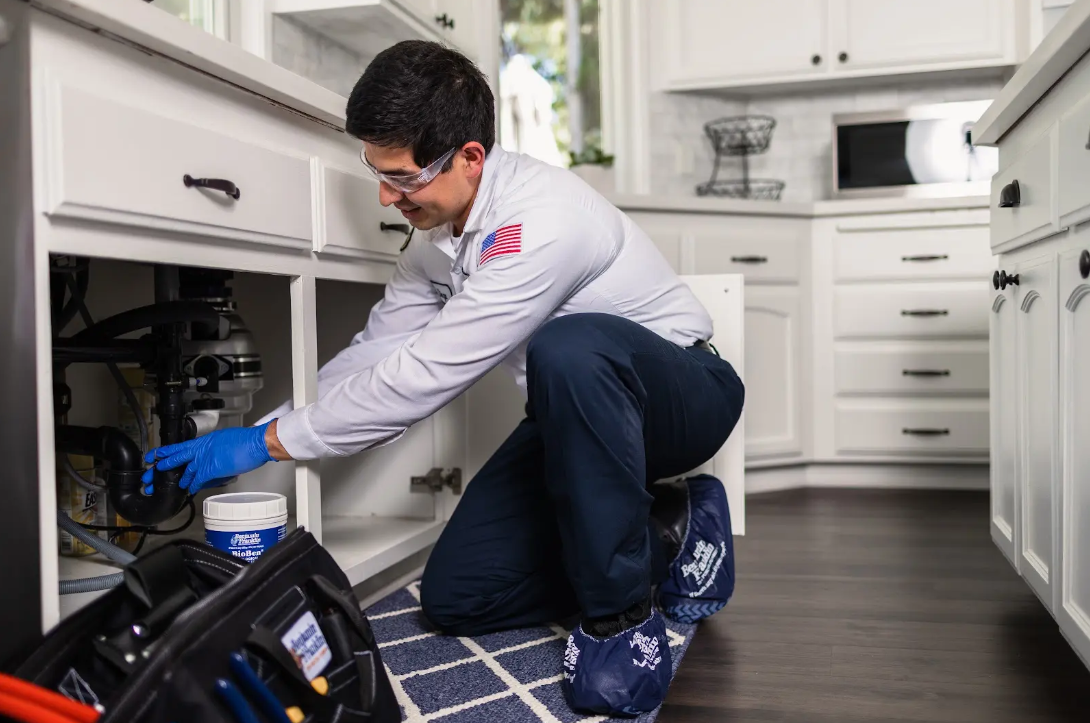
An under-sink filter treats water at one specific location, typically the kitchen sink.
The rest of the home's plumbing continues to receive untreated water.
This makes point-of-use filtration a more targeted approach when your primary concern is drinking and cooking water.
The Wichita Homeowner's Decision
Instead of asking which system is "better," consider what you're actually trying to accomplish.
|
If your main concern is... |
Consider... |
|
Better-tasting drinking water |
Under-sink filtration |
|
Filtering water for cooking |
Under-sink filtration |
|
Water quality throughout the house |
Whole-home filtration |
|
Reducing chlorine at showers and baths |
Whole-home filtration |
|
Sediment throughout the plumbing system |
Whole-home filtration |
|
Hard-water scale |
Water softener or appropriate conditioning system |
|
More extensive drinking-water filtration |
Under-sink reverse osmosis |
|
A combination of whole-home and drinking-water treatment |
Whole-home + under-sink system |
The key takeaway is that there isn't one filtration system that does everything.
Option 1: Whole-Home Water Filtration
Think of whole-home filtration as treating your water at the front door.
The system is installed on the home's main water supply so that filtration occurs before water reaches individual fixtures.
This may be a good fit if you want:
Filtered water throughout the house.
Instead of installing individual filters on multiple faucets, one system treats water entering the home.
Better water for bathing and showering.
If chlorine or certain sediment is one of your concerns, whole-home treatment means you're not limiting filtration to the kitchen faucet.
Protection for plumbing fixtures and appliances.
Depending on the system and filtration media, reducing sediment and certain contaminants can help reduce buildup and protect components that use water.
A more comprehensive water treatment approach.
For homeowners who want to address water quality throughout the house rather than at one faucet, point-of-entry treatment is the logical starting point.
Option 2: Under-Sink Water Filtration
Under-sink filtration takes the opposite approach.
Instead of treating every gallon entering your home, it concentrates treatment at one faucet.
This can make sense if your primary goal is:
"I want better water to drink."
An under-sink carbon filter may improve taste and odor, while a reverse-osmosis (RO) system can provide a more extensive level of filtration for drinking and cooking water.
RO systems use a semipermeable membrane to reduce a broad range of dissolved substances. However, the specific contaminants reduced depend on the system and its certifications.
An under-sink system may make sense if:
- Drinking water is your primary concern.
- You don't need filtered water from every fixture.
- You want a more targeted treatment solution.
- You want to pair drinking-water filtration with another whole-home treatment system.
Here's Where Wichita's Hard Water Changes the Conversation
There is one important wrinkle for Wichita homeowners:
Neither a standard whole-home carbon filter nor an under-sink filter should automatically be considered a water softener.
Wichita homeowners frequently deal with hard water, which is primarily associated with calcium and magnesium.
Those minerals can contribute to:
- White spots on fixtures
- Scale inside plumbing
- Mineral deposits around faucets
- Reduced efficiency in water-using appliances
- Buildup inside water heaters
If hardness and scale are your primary concerns, you may need a water softener or conditioning system rather than simply adding a carbon filter.
This distinction matters because installing the wrong system won't necessarily solve the problem you're experiencing.
What About PFAS, Lead and Other Contaminants?
This is where homeowners should avoid choosing a filtration system based solely on the word "filter."
Different technologies target different substances.
For example, activated carbon can be effective for certain contaminants, while reverse osmosis can reduce many dissolved contaminants. The exact performance depends on the specific equipment, filter media, flow rate, maintenance, and, most importantly, the system's certification and contaminant claims.
If you're concerned about a specific contaminant, don't assume that every whole-home or under-sink system removes it.
Look for a system certified by NSF International to reduce the specific contaminant you're concerned about — different NSF/ANSI standards cover different concerns, from taste and odor (NSF/ANSI 42) to health-related contaminants like lead (NSF/ANSI 53) to reverse osmosis performance (NSF/ANSI 58). That is one reason professional water treatment evaluations can be useful before purchasing equipment.
That is one reason professional water treatment evaluations can be useful before purchasing equipment.
So... Which One Should You Choose?
Choose whole-home filtration if...
Your goal is to improve water quality throughout your home, not just at the kitchen sink.
This is particularly appealing if you're concerned about water used for bathing, cooking, laundry, and appliances, not simply drinking water.
Choose an under-sink filter if...
Your primary goal is drinking and cooking water and you don't need to treat the rest of your home's water.
For homeowners who want more extensive drinking-water treatment, an under-sink reverse-osmosis system may be an option.
Consider both if...
You want comprehensive water treatment throughout the home plus highly treated drinking water at the kitchen sink.
For example, a homeowner might use whole-home filtration to address house-wide water quality concerns and an under-sink RO system for drinking and cooking.
These systems aren't necessarily competing solutions, they can serve different purposes.
Where Does a Water Softener Fit In?
Here's another important distinction:
Filter ≠ softener.
A water filter is generally designed to remove or reduce specific contaminants, particles, or substances depending on the filtration technology.
A water softener is designed specifically to address hardness minerals, primarily calcium and magnesium.
So if your Wichita home has:
- Scale around faucets
- White residue on shower doors
- Mineral buildup in appliances
- Frequent water heater sediment
- Difficulty getting soap to lather
A water softener may be more appropriate than a basic filtration system.
And in some homes, a softener and filtration system can work together.
What Should You Ask Before Buying a System?
Before searching for "plumbers near me" and scheduling an installation, identify the problem you're actually trying to solve.
Ask yourself:
- What don't I like about my water?
Is it taste? Odor? Hard-water scale? Sediment? A specific contaminant?
- Where do I want treated water?
Just the kitchen sink, or every faucet and shower?
- What does my water actually contain?
Start with your local water quality information and, when appropriate, professional water testing. The City of Wichita publishes an annual Water Quality Report (Consumer Confidence Report) detailing what's in the water leaving its treatment facilities.
- What technology addresses that issue?
Don't choose a system simply because it says "whole-home" or "advanced filtration."
- Can my home's plumbing accommodate the system?
Whole-home systems connect to the main water supply, so proper sizing, installation, flow rate, shutoffs, and maintenance access matter.
Why Professional Water Treatment Plumbing Matters
A water treatment system isn't simply an appliance you plug in.
Whole-home systems become part of your home's plumbing infrastructure. They need to be appropriately sized for water demand and installed into the main water line without creating unnecessary restrictions in flow.
Benjamin Franklin Plumbing of Wichita provides water treatment plumbing services including whole-home filtration, water softeners, point-of-use filtration, and reverse-osmosis systems. The company is also an authorized installer of Brita PRO® whole-home water filtration systems, which can be configured based on a home's specific water quality needs.
That means Wichita homeowners can have their water concerns evaluated before choosing a system rather than trying to guess which filter will solve the problem.
The Bottom Line: Treat the Water You Actually Want to Improve
There isn't a universal winner between whole-home and under-sink filtration.
If you want to improve water quality throughout your Wichita home, a point-of-entry system may be the better fit.
If your priority is drinking and cooking water at one faucet, an under-sink system may provide the targeted treatment you're looking for.
And if you're dealing primarily with Wichita's hard water, a water softener may be a more appropriate solution than either type of filter.
The right water treatment system starts with identifying the problem, not buying the biggest filter available.
If you're unsure which option makes sense for your Wichita home, Benjamin Franklin Plumbing can evaluate your water treatment needs and help you compare whole-home filtration, softening, and point-of-use options before installation.

 Your Privacy Choices