
Written By: Benjamin Franklin Plumbing of Wichita
If you live in Derby, Kansas, you may have already noticed the telltale signs of hard water: white spots on your glassware, mineral rings around faucets, soap that refuses to lather, or a chalky buildup inside your showerhead.
But hard water is more than a cleaning annoyance. Over time, dissolved calcium and magnesium can accumulate inside plumbing fixtures, pipes, water heaters and appliances. That can affect how efficiently your plumbing system operates and how long certain components last, not to mention being an eyesore.
For Derby, KS homeowners, understanding your water quality can help you decide whether you simply need to stay on top of routine maintenance or whether a water softener or other water treatment system makes sense for your home.
What Makes Derby Water “Hard”?
Water hardness refers primarily to the concentration of dissolved calcium and magnesium in the water.
The U.S. Geological Survey classifies water of more than 121 milligrams per liter (mg/L) of calcium carbonate as “hard.” Hardness is naturally common in groundwater because water picks up minerals as it moves through soil and rock. The City of Derby’s 2025 Water Quality Report states a hardness level of the water it purchases from the City of Wichita (listed as CACO3) as 130mg/L, putting it squarely in the hard category.
Those naturally occurring minerals are the reason hard water is a common consideration for homeowners in Derby and the surrounding Wichita area.
Hard water isn't generally considered a health concern. The bigger issue for homeowners is what those minerals can do to plumbing, fixtures, appliances and everyday cleaning.
For an authoritative explanation of how water hardness is measured and what it means, the U.S. Geological Survey’s guide to water hardness is a helpful resource.
5 Signs Hard Water Is Affecting Your Derby Plumbing
Not sure whether your home's water is actually causing problems? Look for these signs.
1. White Scale Around Faucets and Fixtures
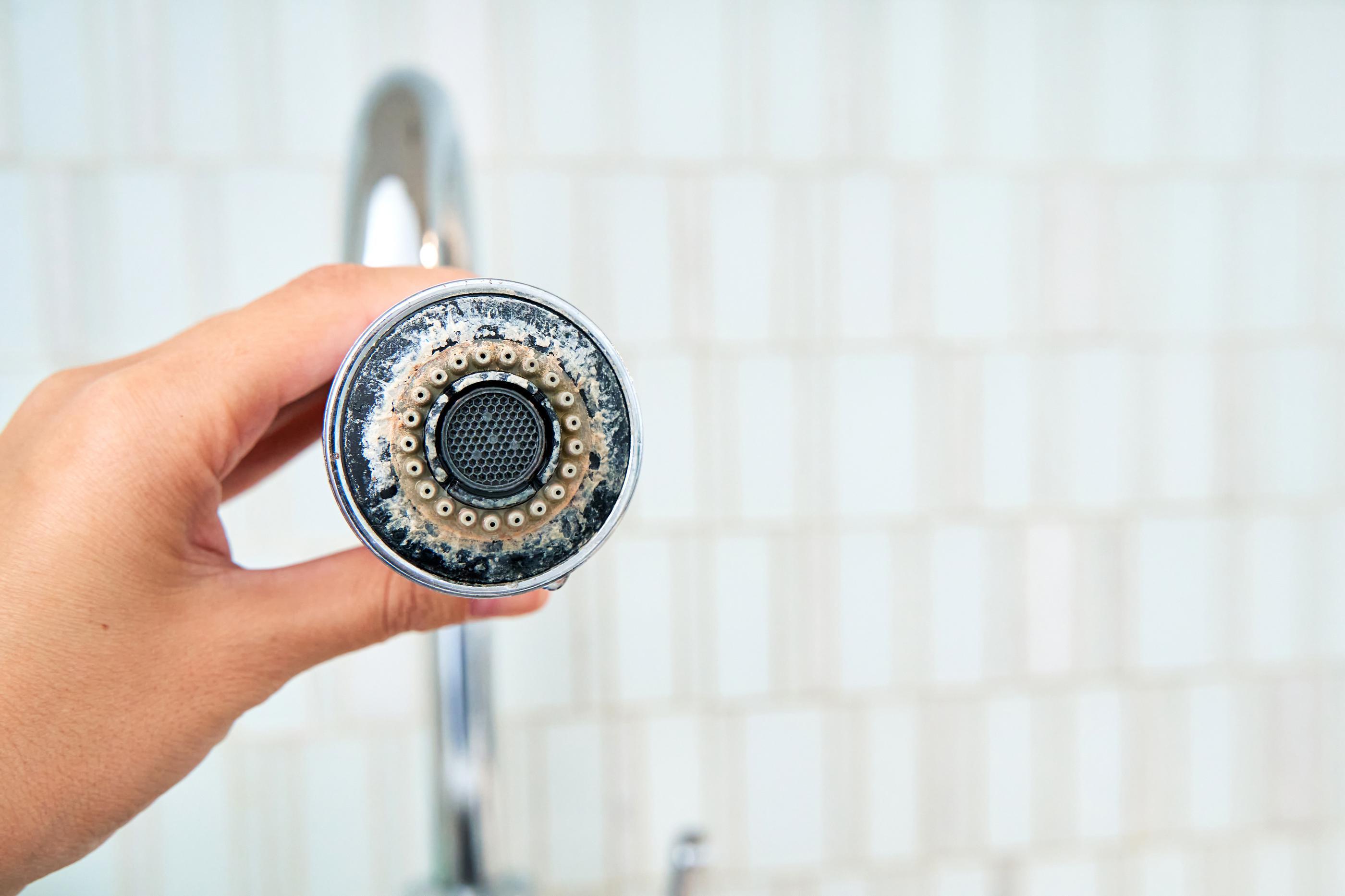
That crusty white material around a faucet aerator or showerhead is often mineral scale.
As hard water evaporates, dissolved minerals can remain behind and form deposits. Over time, those deposits can restrict water flow through small fixture openings.
2. Your Water Heater Is Collecting Sediment
Hard water can be especially problematic for water heaters because heating water encourages mineral deposits to form.
Inside a tank-style water heater, calcium carbonate can accumulate around the bottom of the tank or heating components. That layer of scale acts as an insulating barrier, making heat transfer less efficient.
The result can be:
- Longer heating times
- Reduced efficiency
- More stress on heating components
- Increased sediment accumulation
- Shorter water heater life
3. Your Showerhead or Faucet Has Low Flow
A partially blocked aerator or showerhead doesn't always mean you have a water-pressure problem.
Mineral deposits can accumulate inside the small passages where water exits the fixture. If multiple fixtures throughout the home are experiencing reduced flow, however, the issue may warrant a closer look at the plumbing system.
A plumber in Derby can help determine whether the restriction is isolated to a fixture or occurring farther upstream in the plumbing.
4. Soap Doesn't Seem to Work as Well
Hard water reacts with soap and can create the familiar film or “soap scum” that sticks to tubs, showers and sinks. If your soap doesn’t lather, you can thank the chemical reaction with the calcium and magnesium in your hard water.
You may also notice:
- More soap or shampoo is needed to create lather (or multiple washes required)
- Laundry feels stiff or scratchy
- Your clothing is dulling or looks faded/chalky
- Glassware develops cloudy spots
- Shower doors develop mineral film
These aren't necessarily signs of a plumbing failure, but they can be clues that your home has significant water hardness.
5. Appliances Need More Cleaning
Dishwashers, washing machines, coffee makers and other water-using appliances can also be affected by mineral deposits.
The harder the water, the more frequently mineral scales may need to be removed from components that come into contact with the water. Depending on the finish, a light vinegar soak on occasion may help.
How Hard Water Can Affect Your Derby Home’s Plumbing
Hard water doesn't typically cause a plumbing emergency overnight. Its impact is usually cumulative. Think of mineral scale as a gradual restriction rather than a sudden blockage.
With Derby’s water landing in the “hard” range, as noted above, that slow buildup is something most local homes will deal with eventually. Over months and years, deposits can accumulate on:
Water supply → Pipes → Valves → Faucets → Fixtures → Appliances
For Derby homeowners, it’s usually most noticeable where water is heated or evaporates: water heaters, dishwashers, showerheads, faucet aerators and coffee makers. How quickly it builds depends on the age and condition of your plumbing, water temperature, flow rates and how much water your household uses. A busy household with an older tank water heater will see it sooner than a newer home with lighter use.
This is one reason preventative plumbing maintenance matters in hard-water areas. Regularly cleaning aerators, descaling fixtures and maintaining your water heater can help manage existing buildup, but those steps don't remove the hardness from the incoming water itself.
That's where water treatment comes into the conversation.
Water Softener vs. Water Filter: What Does Your Derby Home Need?
Softeners and filters are often lumped together, but they solve different problems.
|
System |
Primary purpose |
Addresses hard-water minerals? |
Typical location |
|---|---|---|---|
|
Water softener |
Removes calcium and magnesium hardness |
Yes |
Whole home |
|
Water filter |
Reduces specific contaminants, sediment, taste or odor |
Usually no |
Whole home or point of use |
|
Reverse osmosis |
Removes most dissolved minerals and contaminants from drinking water |
Yes, but only at the tap it serves |
Usually point of use |
A traditional ion-exchange water softener works by exchanging calcium and magnesium ions for sodium or potassium ions. During regeneration, a salt solution rinses the resin, sending trapped hardness minerals down the drain.
In other words: a water filter isn't automatically a substitute for a water softener.
If your primary complaint is scale, mineral deposits and hard-water effects on plumbing, a water softener is designed specifically for that problem.
If your concern is chlorine taste, sediment or another specific contaminant, a filtration system may be more appropriate. Some homes may benefit from both. In a home with an RO system, a water softener can help protect the RO system itself from scale.
BENJAMIN FRANKLIN PLUMBING PRO TIP:
A note on sodium: according to the City of Derby’s 2025 Water Consumer Confidence Report, Derby’s water already contains about 140 mg/L of sodium. Traditional salt-based softeners add roughly 60 mg/L more. That’s minor for most people, but those on sodium-restricted diets, or who are sensitive to the taste, may want to pair a softener with reverse osmosis at the kitchen tap. RO filters out the vast majority of sodium, typically 90% or more, giving you low-sodium water where it matters most: in your glass and in your cooking.
When Should Derby Homeowners Consider a Water Softener?
You don't necessarily need a water softener simply because you live in an area with hard water.
The better question is: How is the hardness affecting your home?
A water softener may be worth considering if you're experiencing several of these issues:
- Persistent mineral scale on faucets and shower fixtures
- Frequent cleaning or replacement of clogged aerators
- White spotting on dishes and glassware
- Significant soap scum
- Recurring water-heater sediment or scale issues
- Difficulty getting soap or shampoo to lather
- Noticeable mineral buildup throughout the house
- Skin dryness or tightness
- Dull, stiff hair that doesn’t ever feel fully rinsed
A professional water test can help determine the actual hardness level instead of relying solely on visible symptoms.
How Plumbers in Derby Can Help With Hard Water
Hard water isn't necessarily a problem that requires a plumbing repair. But when mineral buildup starts affecting fixtures, appliances or the plumbing system itself, a professional evaluation can help identify what's happening.
A qualified plumber can evaluate:
Water hardness
Derby’s city water report provides a good starting point, but an in-home test confirms the hardness level at your tap and helps determine whether treatment is appropriate.
Existing plumbing
A plumber can look for evidence of scale buildup, restricted flow, or other plumbing issues that may be contributing to poor performance.
Water heater condition
Because hot water can accelerate scale formation, the water heater deserves particular attention in hard-water homes. A plumber can check for sediment buildup, flush the tank, and inspect the anode rod to keep it in top working condition.
Water softener sizing
A softener should be sized according to factors such as household water consumption and water hardness. An undersized system may regenerate too frequently, wasting salt and water, while an improperly configured system may let hard water through.
Installation requirements
A whole-home water softener becomes part of your home’s plumbing system. Proper installation involves more than setting a unit in the garage. It requires the right placement on the main water line, a bypass valve, a correctly installed drain line for regeneration and programming the system to your home’s water hardness.
Water Treatment for Derby Homes: Start With the Problem
The best water treatment system isn't necessarily the largest or most expensive one.
Start by identifying what you actually want to solve. If your problem is...
White scale and mineral deposits
Consider: Water softening
Chlorine taste or odor
Consider: Filtration
Sediment or specific contaminants
Consider: Targeted filtration
Drinking-water quality at one faucet
Consider: Point-of-use filtration or reverse osmosis
Several water-quality concerns throughout the home
Consider: A professionally designed combination of treatment systems
Salty tasting water
Consider: Reverse osmosis
Matching the system to the problem matters because filtration and softening aren't interchangeable technologies.
Benjamin Franklin Plumbing of Wichita provides water treatment services including water softener installation and service, whole-home filtration and point-of-use water treatment, with a 2-year guarantee on workmanship.
How To Know Your Existing Water Softener Needs Service
If your Derby home already has a water softener, don't assume it's working simply because it's installed.
Signs that a system may need service include:
- Salt usage seems unusually high
- The system isn't regenerating properly
- Hard-water symptoms have returned
- You notice changes in water quality
- The unit is leaking
- The system is making unusual noises
- The control valve isn't functioning correctly
- You aren't sure how old the equipment is
A plumbing professional can evaluate the system, check its connections and determine whether repair, maintenance or replacement makes the most sense.
A Simple Hard-Water Checklist for Derby Homeowners
- Check your faucets: Are there white or chalky deposits around the fixtures?
- Check your shower head: Has water flow decreased or become uneven?
- Check your glassware: Are there persistent spots or cloudy residue after washing?
- Check your water heater: Has it become increasingly noisy or required more maintenance?
- Check your appliances: Are you frequently descaling your dishwasher, coffee maker or other water-using equipment?
- Check your laundry: Are towels feeling stiff or scratchy, or are whites looking dingy?
- Check your refrigerator: Is the ice maker or water dispenser slowing down, or is ice cloudy with white flakes?
Check your shower doors & tub: Is soap scum building up quickly, even with regular cleaning?
- Check your softener’s salt: If you have a softener, is the salt level actually going down? If not, a hardened crust (a “salt bridge”) may have formed in the brine tank, and the system may not be regenerating.
- Then test your water: A professional water analysis can provide a much better starting point than guessing based on symptoms.
Need a Plumber in Derby for Hard Water or Water Treatment?
Hard water is a fact of life for many Derby homeowners, but you don't have to simply live with its effects.
Whether you need help diagnosing mineral buildup, maintaining your existing plumbing, installing a water softener, or determining whether another water treatment system is appropriate, professional plumbing guidance can help you choose a solution based on your home's actual water quality.
Benjamin Franklin Plumbing of Wichita serves Derby with licensed plumbing professionals and water softener services. Our team offers water softener installation and repair, along with broader plumbing and water treatment services. We’re happy to provide a free water test to assess what water treatment systems make the most sense for your home.
Last updated 11/1/2026

 Your Privacy Choices